


Dr. Rizwan Rumi
We must remember that tourism without environmental ethics is simply destruction in slow motion. Let us act before the silence of our dying mountains speaks louder than our words.
We proudly call Kashmir “Paradise on Earth”. When summer arrives or a long weekend gives us a brief window of respite, thousands of us pack our tents, load our vehicles and head toward the mountains. We seek refuge in the untouched landscapes of Gurez, the serene expanses of the Warwan Valley, the high-altitude trails of the Kashmir Great Lakes circuit and the lush, hidden meadows of Daksum. We seek an escape from the chaotic hum of urban centers, looking to heal our minds in the lap of pristine wilderness. We take breathtaking photographs, post vibrant, enviable updates on social media and loudly profess our profound love for nature.
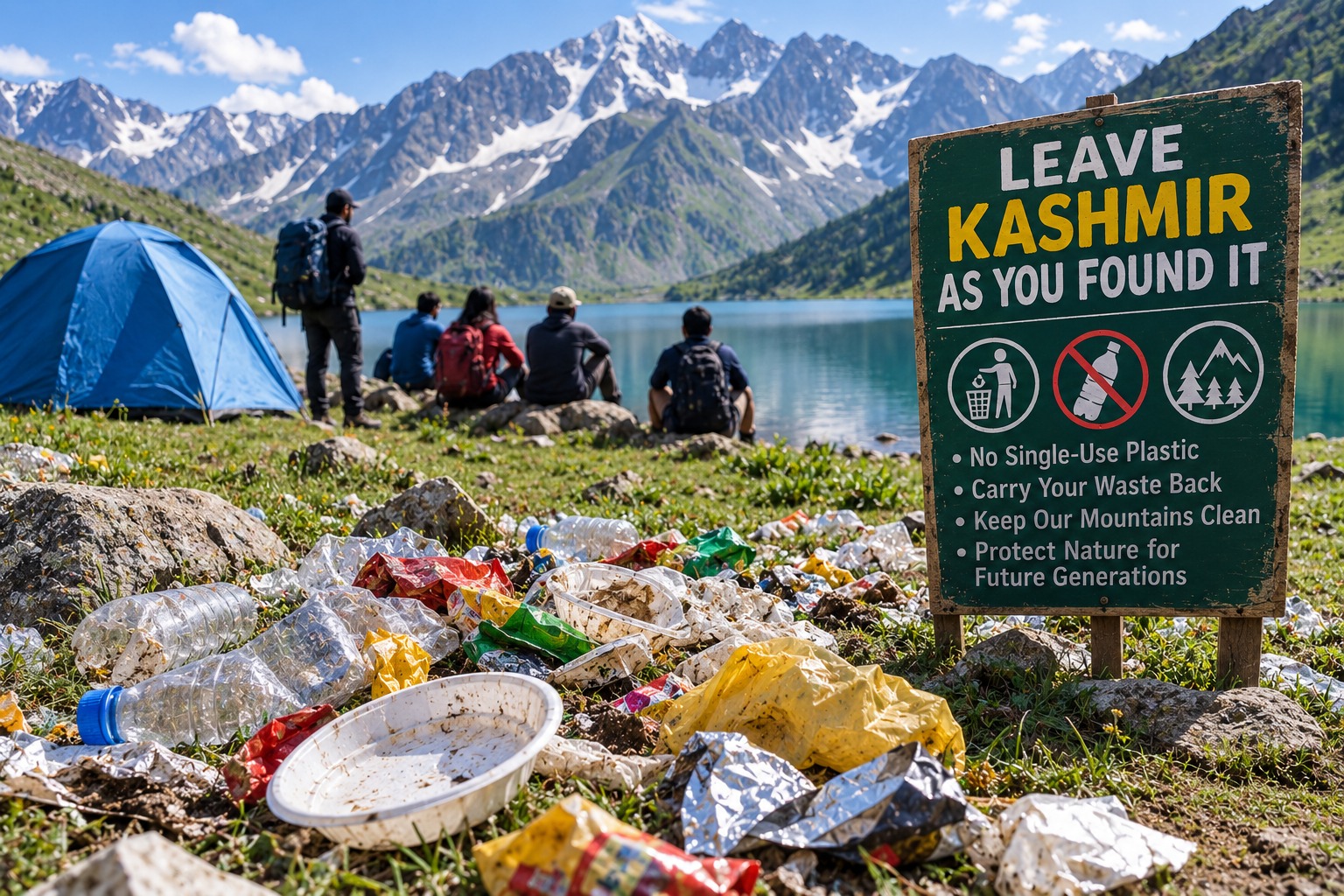
Yet, the moment we pack up our camps to return to the comfort of our city lives, a deeply unsettling paradox is laid bare. We leave behind a heart-breaking reality: a trail of plastic bottles, aluminum foil wrapper remnants, disposable styrofoam plates, half-burnt plastic packaging and scattered polythene bags. The very landscapes we claimed to love just hours prior are transformed into temporary dumping grounds. We are treating our absolute ecological sanctuaries like open-air dustbins, exhibiting a reckless disregard for the delicate environment that hosted us.
This behavior exposes a severe contradiction in our collective consciousness. We pride ourselves on our rich culture, hospitality and appreciation of beauty, yet we treat our public lands and wilderness areas with systematic disrespect. The ecological footprint of modern recreational tourism in Kashmir has evolved from a minor localized issue into an environmental emergency that threatens the fundamental integrity of our mountain systems.
The Hidden Crisis Above 11,000 Feet
The scale of this crisis is no longer invisible, nor is it confined to urban peripheral zones. According to recent field metrics from environmental tracking groups and regional department reports, our high-altitude alpine lakes are bearing the primary brunt of this unmanaged tourist rush. The Kashmir Great Lakes circuit alone saw unprecedented numbers of registered trekkers this season—far exceeding the carrying capacity of these fragile, high-altitude eco-zones. During recent community-led cleanliness drives along the Harmukh range, volunteers collected dozens of heavy gunny bags filled entirely with pure plastic trash, clustered heavily around the pristine, vulnerable waters of Gangabal Lake and Nandkol Lake.
Environmentalists and glaciologists warn that at altitudes exceeding 11,000 feet, the natural weathering, biological degradation and breakdown processes are incredibly slow. Sunlight is limited, and sub-zero winter temperatures stall any natural decomposition. A single plastic bottle, synthetic wet wipe, or cigarette butt discarded near these glaciers will remain entirely intact for centuries, leaching microplastics and toxic chemical additives directly into the permafrost. Even worse, the dense accumulation of dark, synthetic garbage alters ground albedo—the measure of how much light hits the surface and reflects back without being absorbed—and local ground temperatures, adding to the structural stress of our rapidly melting Himalayan glaciers.
Furthermore, the hydro-ecological link cannot be ignored. When we litter at an alpine campsite, we are not just marring a beautiful view; we are directly poisoning the precise freshwater headwaters that serve as the lifelines for our entire valley. The snowmelt feeds streams like the Kishanganga, the Lidder and the Sindh, which eventually provide drinking and agricultural irrigation water to millions downstream. Our garbage at 12,000 feet effectively becomes the toxicity in our drinking water at sea level.
The Illusion of “Someone Else’s Job”
The most troubling facet of this ecological crisis is not a lack of primary education or digital awareness; it is our deeply ingrained collective behavior and sense of entitlement. We are a literate, highly connected and politically aware society. We know plastic pollutes. We understand that it chokes local mountain wildlife, destroys topsoil health and degrades the pristine scenic aesthetic that sustains our multi-million dollar tourism economy. Yet, we casually toss plastic wrappers under centuries-old pine trees or throw water bottles out of moving vehicle windows, operating under the comfortable illusion that it is “someone else’s job” to restore the landscape.
Nature does not destroy its own habitat, nor do wild animals consciously poison their own water paths. Only humans do. We readily point fingers at municipal bodies, tourism development authorities, and local governance for poor regional waste management infrastructure. However, it is an exercise in intellectual dishonesty to blame the state for our own lack of basic civic morality. No government official carried that specific plastic bottle up to a remote, roadless Gurez meadow or a high ridge in Warwan and threw it onto the wild meadow flowers—we did that ourselves. The primary fault lies not in the lack of trash cans in the wilderness, but in our refusal to carry our own waste back to the point of origin.
The Language of Force: Heavy Penalties and Enforcement
Because we have completely failed to self-regulate or develop an intrinsic ethic of wilderness conservation, regional administrations are being forced to step in with rigid, heavy-handed measures. The District Administration has recently imposed a strict, total ban on single-use plastics across key eco-tourism sectors including the Gurez Valley. Checkposts are now actively operating at critical transit points like Tragbal and Pethkoot, where executive enforcement teams, backed by local law enforcement, are thoroughly inspecting incoming commercial and private vehicles for contraband plastics.
Tourists caught littering now face immediate, on-the-spot heavy financial penalties, and systemic protocols are being leveraged to trace vehicles tossing trash onto mountain roads. While these strict steps are entirely necessary to stave off immediate ecological collapse, it remains a stinging cultural embarrassment. It is a sad commentary on our societal maturity that we require police checkpoints, administrative force, and monetary penalties just to compel us to keep our own beautiful homeland clean. True civic pride should stem from internal respect, not the fear of an administrative fine.
Reclaiming Our Civic Responsibility: A Blueprint for Sustainable Travel
If we genuinely love Kashmir and wish to preserve it for those who follow us, we must immediately transition from careless consumers of nature to active, militant protectors of it. True exploration requires absolute, non-negotiable accountability. The next time you plan a trek or a camping expedition to Gurez, Warwan, Bangus, or any offbeat valley, you must commit deeply to a strict “Pack It In, Pack It Out” philosophy:
-
Zero Single-Use Plastic: Ditch packaged plastic water bottles completely. Invest in heavy-duty, reusable steel or copper flasks, and utilize portable gravity filters, UV purifiers, or chlorine dioxide tablets to safely drink from mountain streams.
-
The Dedicated Trash Pouch: Always dedicate a specific, durable, waterproof compartment of your backpack or vehicle entirely to trash storage. Every wrapper, wet wipe, piece of foil, and empty tin you bring into the alpine zone must return to the city with you for scientific, municipal disposal.
-
Active Group Accountability: If you observe a fellow camper, friend, or even a stranger dropping a piece of litter, call them out immediately but politely. Public peer accountability is vastly more effective than a passive, ignored government signpost.
-
Leave the Trail Better: Make it a personal, mandatory rule to pick up at least three pieces of plastic left behind by previous, less responsible groups on your route. Leave nothing but your footprints; take nothing but your memories and your own waste.
Nature does not need us; we desperately need nature. The mountains, glaciers, and alpine meadows of Kashmir will endure long after we are gone, but their capacity to sustain human life and provide spiritual solace depends entirely on how we treat them today. If we continue to treat our pristine meadows and high-altitude sanctuaries as open garbage bins, we will lose them irreversibly.
The next generation will not inherit the lush, green paradise we enjoyed; they will inherit mountains of faded plastic, contaminated topsoil, microplastic-laden water tables, and dried-up streams. Let us enjoy the wilderness of Kashmir, but let us protect it with fierce civic pride. It is time to step up and fulfill our basic responsibility as guardians of this land before the paradise we boast of to the world is permanently lost to our own carelessness.
Comments are closed.