


Rakshanda Gul
Cyber safety cannot remain an occasional campaign. It must become part of everyday digital culture. The digital world requires a new form of everyday vigilance—one in which users learn to recognise manipulation, question suspicious claims and understand the value of their personal information.
The internet has quietly become one of the most important spaces of modern life. For students, it is a classroom, a library, a social space, an entertainment platform and, increasingly, a gateway to financial and professional opportunities. A smartphone can connect a young person in a village in Kashmir to information from across the world within seconds. Digital payments can make transactions easier, online platforms can create new opportunities and social media can bring people together across geographical boundaries.
But the same digital world that creates opportunity also creates vulnerability.
A suspicious link can open the door to fraud. A seemingly harmless phone call can become an attempt to steal financial information. A photograph shared in confidence can be copied and circulated without consent. A promise of quick money can draw a young person into online gaming or betting and leave a family facing financial distress. A fake social media profile can damage a person’s reputation. A password or one-time password shared casually can turn into a financial loss within minutes.
The challenge, therefore, is not whether society should use technology. The digital transition is already here and, in many respects, it is indispensable. The more important question is whether people are learning to use technology with the same caution, judgment and responsibility that they apply to other aspects of life.
This is why cyber awareness cannot remain an occasional campaign. It must become part of everyday digital culture.
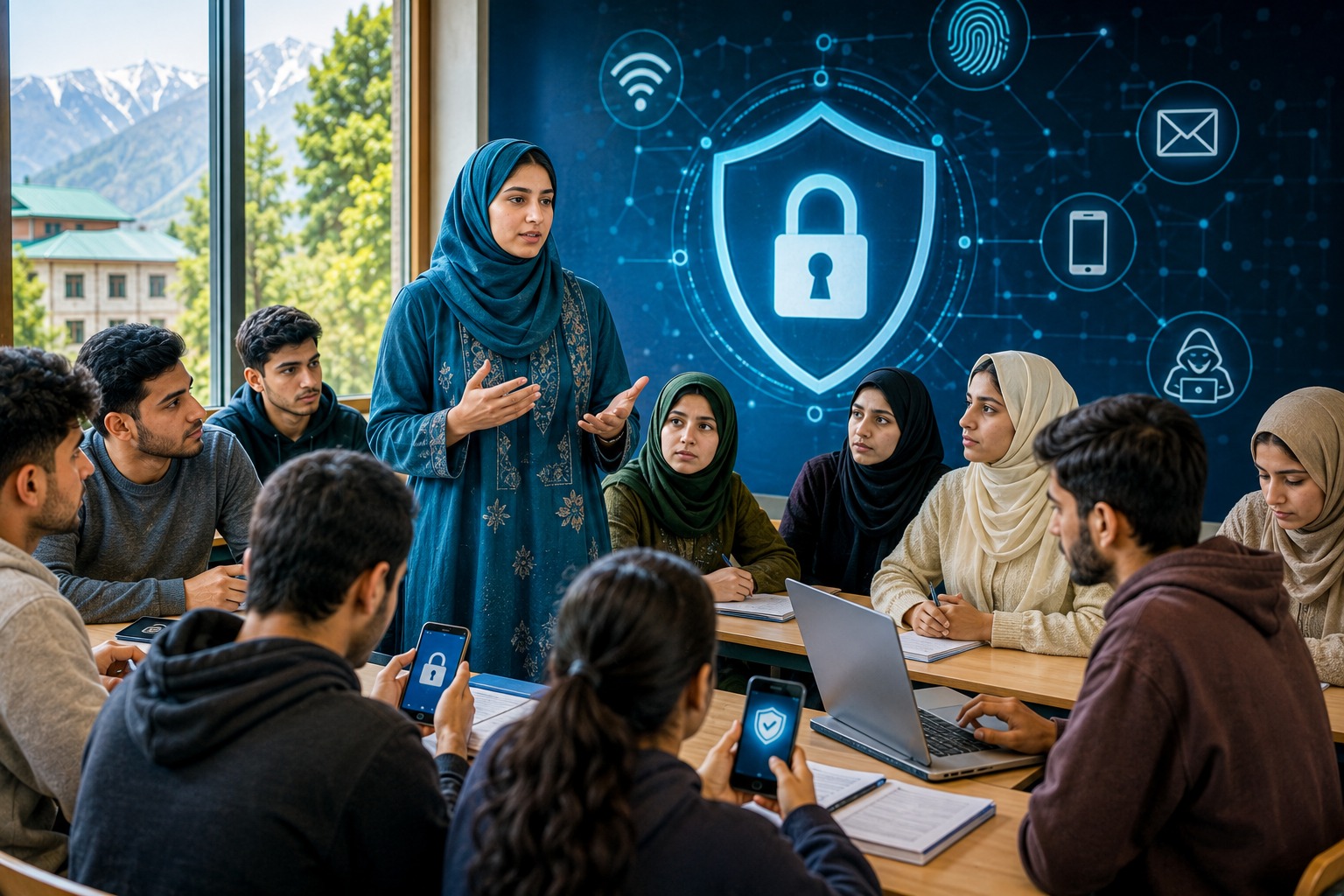
A recent awareness programme organised by the Kashmir Women’s Organisation (KWO) in collaboration with Government Degree College Hadipora, Rafiabad, around the theme “Responsible Use of Cyberspace”, offers a useful example of how this conversation can begin. The programme brought students and speakers together to discuss cyber safety, privacy, self-control and precautions that can help users navigate the digital world more responsibly.
Its significance lies not merely in the information shared during the session, but in the recognition that cyber safety is fundamentally an awareness issue.
The digital world and the human weakness
Cybercrime is often discussed in terms of technology: sophisticated software, hacking techniques, malicious links or digital systems. Yet many cybercriminals do not necessarily need extraordinary technical skills to deceive their targets. They exploit something much more ordinary—the human tendency to trust, react quickly, become curious or seek easy gains.
A message saying that an account will be blocked unless immediate action is taken creates fear. A caller claiming to represent a bank or government department creates authority. An offer promising unusually high returns creates greed or excitement. A message from an unknown account containing an attractive link creates curiosity.
The technology may be sophisticated, but the psychological trick is often simple.
That is why cyber safety cannot be left entirely to software, firewalls or security systems. Technology can provide protection, but human judgment remains one of the most important lines of defence.
The awareness programme’s emphasis on self-control is therefore particularly relevant. In the digital environment, the ability to pause before responding can be a powerful form of protection.
Before clicking a link, answering an unfamiliar request, sharing information or transferring money, users can ask four basic questions: Is it safe? Is it true? Is it okay to share? And, if there is any doubt, can I pause and verify?
These questions may appear simple. That is precisely their strength.
Cybercriminals often depend on speed. They want the victim to act before thinking. A fraudulent caller may create urgency. A deceptive message may suggest that an opportunity will disappear within minutes. A fake offer may demand an immediate payment.
The moment a person decides to slow down, the scammer loses one of the most important advantages—the victim’s impulsive reaction.
The spider’s web as a digital metaphor
The programme’s opening with the recitation of Surah Al-Ankabut, Chapter 29, “The Spider”, provided an unusual but meaningful way of approaching the subject.
The spider’s web is delicate, difficult to notice from a distance and yet capable of trapping what comes into contact with it. Dr Aabida Quanser, who hosted the programme, connected this imagery with the nature of cybercrime, where a trap may initially appear insignificant but can become increasingly difficult to escape once a person is caught in it.
The metaphor works particularly well in the context of cyberspace.
A fraudulent link may look like an ordinary message. A fake account may appear genuine. A caller may sound professional. An online advertisement may look attractive and convincing. Nothing may initially appear dangerous.
But the consequences can become serious once a person responds without verification.
The lesson is not to fear the internet. It is to understand it.
The digital world requires a new form of everyday vigilance—one in which users learn to recognise manipulation, question suspicious claims and understand the value of their personal information.
For young people, this lesson is particularly important because they are among the most active users of digital platforms. Their familiarity with technology should not be mistaken for complete digital awareness. Knowing how to use an application is not the same as knowing how to use it safely.
A student may be comfortable navigating social media, online games or digital payments while still being unaware of how easily personal information can be exploited.
Digital literacy, therefore, must go beyond technical familiarity.
When technology becomes a shortcut to easy money
One of the most troubling aspects of the digital age is the way technology can make risky financial behaviour appear normal, accessible and even entertaining.
Online gaming, betting and schemes promising quick financial returns can be particularly attractive to young people and others looking for easy income. The problem begins when entertainment or the promise of profit becomes an obsession.
The principal of Government Degree College Hadipora, Dr Prof. Tariq Wani, shared experiences of people who had suffered financial losses through different forms of cybercrime, including online gaming and fraud, as well as through the careless sharing of OTPs.
The broader lesson is important: financial vulnerability is not always caused by poverty. Sometimes it is created by the desire to become wealthy quickly.
A person who believes that a small investment can generate extraordinary returns may use savings, borrow money or repeatedly invest after initial losses in the hope of recovering what has already been lost. What begins as a seemingly small decision can gradually become a cycle of debt and financial distress.
The consequences extend beyond the individual.
Financial losses can create tension within families, affect relationships and undermine mental peace. A few minutes spent responding to an online temptation can create consequences that continue for months or years.
There is no technological shortcut to financial security.
Young people need to be encouraged to distinguish between legitimate digital opportunities and schemes built around unrealistic promises. Technology can create employment, entrepreneurship and learning opportunities, but sustainable economic progress still requires knowledge, patience and effort.
The promise of instant wealth should therefore be treated not as an opportunity by default, but as a reason to ask more questions.
The stranger on the other end of the phone
The traditional advice taught to children—“Do not talk to strangers”—has acquired a new meaning in the digital age.
The stranger may no longer be standing outside the gate. The stranger may be calling from a mobile number, sending a message through social media or presenting themselves as a bank official, government employee, courier representative or company executive.
The apparent legitimacy of the caller can create a false sense of security.
This is why users must understand that identity cannot be established merely because someone sounds convincing or possesses some basic information about them.
A caller-identification application may provide useful clues, but it cannot be treated as definitive proof of identity. The safest response to a suspicious call is often to disconnect and independently contact the organisation through an official number or verified communication channel.
There is nothing rude about refusing to provide information to an unknown caller. There is nothing impolite about saying, “I will verify this first.”
In fact, that hesitation can prevent fraud.
OTP: Four letters that can protect an account
Few digital safety messages are as simple and important as this one: never share your OTP.
The same applies to passwords, PINs, banking credentials and other confidential information.
People sometimes reveal such details because a caller creates urgency or claims that the information is necessary to complete a transaction. But confidential credentials are valuable precisely because they are meant to remain private.
The responsibility also extends to identity documents.
Aadhaar and other important documents should be shared only when genuinely required and through trusted channels. Sending copies of identity documents to unknown people through messaging platforms or social media can create risks that may not become apparent immediately.
The basic principle is uncomplicated: information that can be used to establish or access your identity should be treated as sensitive.
In an environment where people routinely share photographs, locations, phone numbers, documents and personal details online, privacy requires deliberate effort.
Your photograph is no longer entirely yours once it is online
Perhaps one of the most underestimated dimensions of digital risk is the permanence of information.
A photograph may be shared with a friend. A video may be sent privately. A personal message may be exchanged with someone considered trustworthy.
But once digital content leaves one’s device, control over it becomes difficult to guarantee.
It can be copied, downloaded, forwarded, edited or redistributed. Even if the original post is deleted, another person may already have saved it.
For students and young people, this is a particularly important lesson.
Digital relationships can develop quickly, and trust can sometimes be established without the kind of knowledge that would exist in an offline relationship. A person may appear familiar because they communicate regularly, but online familiarity is not necessarily the same as real-world trust.
This does not mean young people should withdraw from digital spaces. It means they should understand the consequences of what they share.
Photographs, videos and personal information should not be distributed casually. Privacy settings should be reviewed regularly. Unknown people should not automatically be given access to personal accounts.
Privacy is not something that technology companies alone can protect. Users have a role in protecting it too.
What happens after a cybercrime?
Awareness should not stop at prevention.
People also need to know what to do when prevention fails.
One of the most damaging responses to cybercrime is silence. Victims may feel embarrassed, fear social judgment or believe that reporting the incident will not make a difference. That hesitation can give perpetrators more time and may allow similar frauds to continue.
The message that cybercrime victims should report incidents rather than hide them is therefore crucial.
The National Cyber Crime Reporting Portal provides a mechanism for citizens to report cybercrime online, while financial cyber fraud can be reported through the national helpline 1930. Early reporting is particularly important in financial fraud because timely action can improve the chances of intervention.
Victims should preserve evidence: screenshots, transaction details, phone numbers, messages, emails and other relevant information.
Reporting is not an admission of foolishness. It is an act of responsibility.
A person who reports a cybercrime may help investigators identify a pattern, prevent another victim from being targeted and improve awareness of emerging forms of fraud.
The social stigma around being cheated online must therefore disappear.
People are manipulated by criminals precisely because criminals are skilled at manipulation. The correct response is not shame. It is awareness, reporting and prevention.
Cyber safety must enter the classroom
The programme at GDC Hadipora also highlights a larger institutional responsibility.
Cyber awareness cannot be confined to police advisories or occasional public campaigns. Schools and colleges are natural spaces for building responsible digital citizens.
Young people are already spending significant amounts of time online. It is therefore logical that digital responsibility should form part of their broader education.
Students need to know how to recognise phishing attempts, protect passwords, manage privacy settings, identify suspicious financial offers and respond to online harassment or fraud. They should understand that online behaviour has real-world consequences and that digital footprints can endure.
But educational institutions can do more than teach students.
They can become centres of community awareness.
A student who learns about cyber fraud in college may take the message home and share it with parents, grandparents and other family members. In this way, a classroom discussion can become a household conversation.
This is especially important in communities where some family members may have less digital experience than younger users.
The young may know how to navigate an application. Older family members may have financial experience and caution but less familiarity with digital deception. Bringing these generations into the same conversation can strengthen collective resilience.
Women and the cyber safety conversation
The involvement of the Kashmir Women’s Organisation in promoting cyber awareness is also significant.
Digital safety has a particular relevance to women because online spaces can be used for harassment, impersonation, misuse of photographs, manipulation and other forms of abuse. While cybercrime can affect anyone, awareness initiatives that create safe spaces for discussion can help women and girls understand both their rights and the practical steps available to protect themselves.
The broader conversation around women’s empowerment must therefore include digital empowerment.
A woman who can confidently use digital banking, online education, government services and communication platforms is better positioned to participate in the modern economy. But empowerment without safety can create new vulnerabilities.
The objective should be neither to discourage women from using technology nor to portray cyberspace as inherently dangerous. It should be to ensure that women have the knowledge and confidence to use it on their own terms.
Digital independence and digital safety must go together.
From awareness to digital culture
The greatest challenge is to move from one-time awareness to everyday behaviour.
A cyber awareness programme can tell students not to share OTPs. But the real test comes when a student receives a convincing call claiming to be from a bank.
A session can explain privacy. But the real test comes when an online acquaintance asks for a photograph.
A speaker can warn against quick-money schemes. But the real test comes when a message promises extraordinary returns.
Awareness becomes meaningful only when it changes behaviour at the moment of decision.
That is why simple, memorable messages are valuable.
Pause before clicking.
Verify before trusting.
Never share an OTP.
Protect your passwords.
Think carefully before sharing photographs or documents.
Do not allow the promise of quick money to override common sense.
Report fraud quickly.
These are not complicated instructions. Their effectiveness depends on whether people remember them when they need them most.
The responsibility belongs to everyone
Cyber safety is sometimes treated as the responsibility of governments, police agencies or technology companies. All of them have important roles, but none can protect users completely without their cooperation.
Technology companies must strengthen security and make reporting mechanisms accessible. Governments must improve enforcement, public awareness and institutional response. Educational institutions must teach digital responsibility. Families must discuss online risks openly with children. And individual users must exercise caution.
The responsibility is shared.
The KWO-GDC Hadipora programme is valuable precisely because it places students at the centre of this conversation. It recognises that the strongest cyber defence is not always a sophisticated technological system. Sometimes it is a student who refuses to click an unknown link, a parent who verifies a suspicious call, a young person who refuses to share an OTP or a victim who reports fraud immediately.
These small decisions collectively create a safer digital environment.
The internet has changed the way society communicates, learns, earns and interacts. There is no turning back from that transformation—and there should not be. The answer to digital risk is not digital retreat.
It is digital responsibility.
The image of the spider’s web offers a fitting final reflection. A web may appear delicate, but once a person becomes entangled, escape can become difficult. Cyber traps often work in the same way. They begin with something small: one click, one reply, one shared detail, one transfer of money.
The best time to break the chain is before it begins.
That requires awareness. It requires self-control. It requires the willingness to question what appears convincing and the patience to verify what demands immediate action.
Ultimately, responsible cyberspace is not created by technology alone. It is created by people who understand that every click can carry a consequence and that every piece of personal information has value.
The message is simple enough to remember and important enough to repeat: think before you click, protect what is private, never share your OTP, verify before you trust, use technology wisely and report cybercrime without delay.
In the digital age, awareness is not merely education. It is the first line of defence.
Comments are closed.