
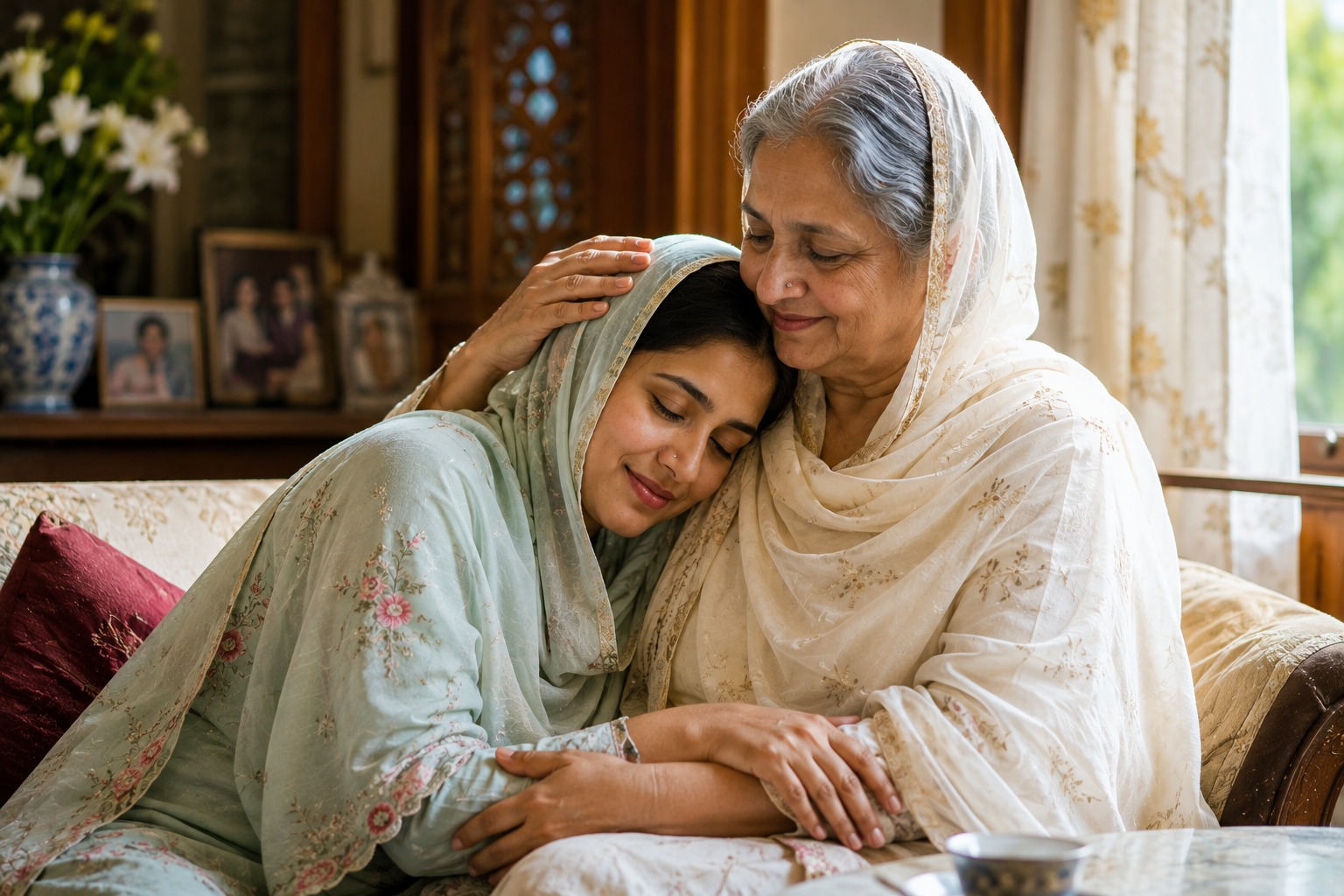
When Daughter Becomes Daughter-in-Law

(This short story reflects the feeling that daughters may become daughters-in-law, but their relationship with their parental home never truly ends. Through life’s ups and downs, a strong parental home can remain a source of support, confidence, and a sense of security.)


Usuf Mir


“Daughters do not belong to another family. They simply take responsibility for a new home. Their relationship with their parents does not end. A daughter may become a daughter-in-law, but she should never become a stranger in her parental home.”


It was the month of April. This year, April had five Sundays and two public holidays. The first week itself brought three consecutive holidays, and the employees were already making different plans for how to spend their time off.

Sahil and Gauhar worked in the same district. Years of working together had gradually turned their professional relationship into a close friendship. During a conversation at the office, they decided to spend the following Sunday together.

The next Sunday morning, Sahil arrived at Gauhar’s home. Gauhar had already told his wife, Ghazala, that his friend was coming, so tea and some light refreshments had been arranged in advance.

Their conversation began with ordinary matters, the home, and the garden. Ruhi could sometimes be seen playing in the courtyard and at other times sitting close to her mother.

During the conversation, Ghazala looked at Ruhi and said:

“This house belongs to Ruhi too.”

Sahil smiled and asked:

“Already? Ruhi is only ten years old.”

Ghazala replied confidently:

“Yes, already. I do not want her to leave this house as a bride one day and then be made to feel that she no longer has any connection with it.”

She then shared an incident.

“One day, a man came to our house. He wanted to buy ten marlas of land for his second son. During the conversation, he said that a house had already been built for one son, and now he needed land for the other.”

“I asked him, ‘Don’t you have any daughters?’”

He smiled and replied:

“Daughters belong to another family.”

I did not like what he said. I told him:

“Daughters do not belong to another family. They simply take responsibility for a new home. Their relationship with their parents does not end.”

After a few moments of silence, Ghazala’s voice became softer.

“Perhaps my thinking is different because I have experienced a lot myself.”

Her eyes became moist.

“Before I got married, I believed that my parental home would always remain mine. But many things change with time. Once, I went to my parental home with my children for a few days. I took my clothes out of my bag and placed them in the cupboard. The next morning, I found that my clothes had been put back into the bag.”

“I asked my sister-in-law about it, and she said that Mother had asked her to put them back.”

“At that moment, I was not angry. I was simply deeply hurt. I sat quietly in my room for some time. My eyes filled with tears, but I did not say anything to anyone.”

“The next day, when I was leaving to return to my husband’s home, my mother came with me as far as the veranda to see me off. As she always did, she placed her hand on my head and said, ‘Daughter, stay happy and take care of your home.’”

“I looked at my mother. I wanted to say, ‘Mother, this is my home too.’ But the words stopped at my lips. I quietly walked out.”

“Throughout the journey, one thought kept going through my mind: the home I had come to believing it was still my parental home had perhaps become only my mother’s home.”

“After that, whenever I went to my parental home with my children, one or two days would pass comfortably, but I no longer felt like staying for long. A strange feeling had quietly settled inside me that perhaps it was not right for me to stay there for too long.”

Ghazala remained silent for a few moments.

“Perhaps that was the day I decided that if my daughter ever left her home to become a daughter-in-law in another family, she would still remain my daughter. I would never let her feel that after marriage, her parental home had become a place where she no longer belonged.”

After another brief silence, she asked Sahil:

“What is the practice in your home? Have you kept a separate room for your daughter?”

Sahil nodded.

“Yes. Our daughter has her own room. Whenever she comes, the room is kept open for her. She also has the keys to her cupboards, and no one interferes with her belongings.”

Then he smiled and added:

“Yes, the room does not remain locked all the time. We use it when necessary, but its status always remains that of my daughter’s room.”

Gauhar, who had been quietly listening to the conversation, spoke for the first time:

“Perhaps we men are often slow to understand that what a daughter needs is not just a place in the house, but the assurance that she still belongs there.”

Sahil looked at Gauhar and smiled quietly.

Ghazala looked at Ruhi and said softly:

“I am not giving my daughter the idea of property. I am giving her the certainty of belonging. I want her never to feel like a guest in her own home.”

She looked at Ruhi for a few moments. Ruhi, unaware of the depth of the conversation, was gathering her books.

There were tears in Ghazala’s eyes, but there was a strange peace in her voice.

“Daughters may become daughters-in-law, but their relationship with their parental home should never end.”

Sahil looked at Ghazala. Gauhar remained silent too. Ruhi, playing in the courtyard, probably had no idea what the conversation meant. But that day, a home was being protected for her, a home where, even after becoming a daughter-in-law one day, she would always remain her mother’s daughter.


Author is former District Information Officer. He can be reached at yousufmir555@gmail.com

Comments are closed.