

The Silence After the Wanwun: Surviving the Financial Siege of Kashmiri Marriages

Nadia Afaq 


It is time to ask ourselves what we actually value; a brief afternoon of applause on borrowed money or a marriage that can endure when the marquee is taken down. Perhaps it is time we finally started preparing for a marriage, not just staging a wedding.

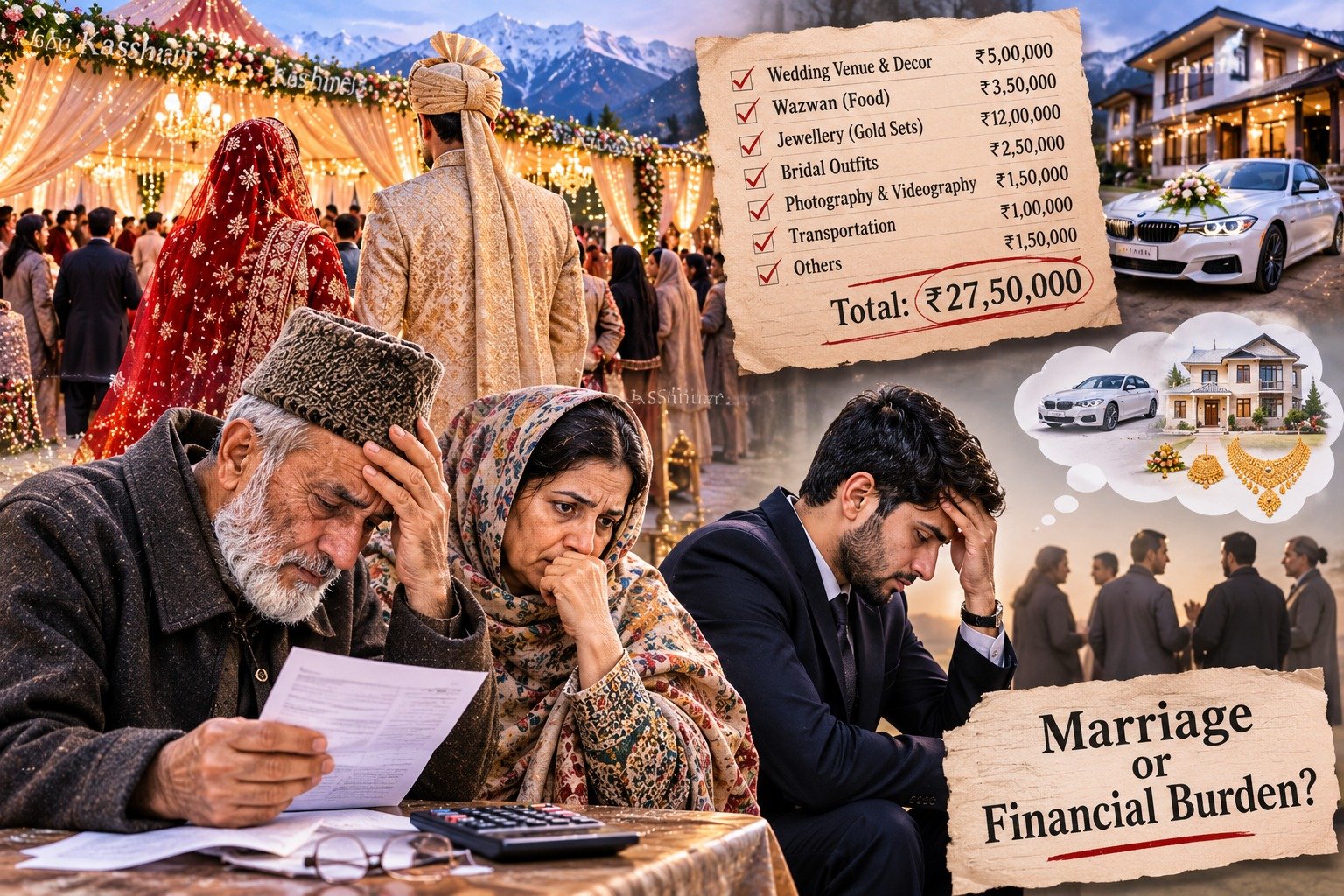
By two in the morning, the heavy aroma of cardamom, saffron, and woodsmoke begins to sour, trapped beneath the damp ceiling of the wedding marquee. While the guests trade banter over their final sips of kehwa, a father draws the balance sheet of the khandar (marriage) in the back room, tucked away from congratulatory eyes, staring at numbers: fifty thousand rupees spent on dry-fruit hampers, thirty-two meat dishes laid out for guests, gold sets worth lakhs purchased by mortgaging orchard land, and huge amounts poured into luxury tents, decorations, floral arrangements, lighting, sound systems, designer outfits, photography, videography, and other wedding arrangements.


There are expenses for transportation and countless details that seem small but add up to a staggering sum. Out front, the family’s generosity is praised as unmatched izzat (honor), while behind closed doors, the price of that honor is measured in debt, sacrificed savings, and land put at risk.


Weddings have always been occasions of warmth, hospitality, and togetherness in Kashmir. The aroma of Wazwan, the gathering of relatives, the excitement of the bride and groom, and the blessings of elders make a wedding much more than a ceremony.

But somewhere along the way, the meaning of this celebration has begun to change. Weddings are increasingly becoming displays of wealth, status, and social standing. The bigger the venue, the grander the feast, the more expensive the clothes, and the more elaborate the decorations, the more impressive the wedding is seen. What was once a celebration of marriage is increasingly turning into a competition over who can spend more.

The question is not whether we should celebrate weddings or not. The real concern is why a celebration that ought to bring happiness has become a source of anxiety, financial pressure, and social comparison for so many families. Behind the photographs of smiling couples and beautifully decorated stages are parents calculating expenses, boys postponing marriage until they can afford it, and girls worrying about whether their families will be judged for spending less.

And while some families struggle to meet these expectations, others deliberately spend beyond what is necessary simply to make a statement.

The Parents Who Pay The Price

A wedding seems to have become an opportunity to announce, without words, how wealthy a family is. The designer bridal outfits, expensive jewelry, stage decorations, luxury cars, multiple functions, and an extravagant wazwan become symbols of status. The intention is no longer simply to make the occasion memorable.

It is to make sure that people notice it, discuss it, and compare it with other weddings. They want people to talk about how grand their wedding was. One family spends a considerable amount, and another feels the need to spend even more. A celebration that should be personal becomes a public competition. What one family considers extravagant becomes another family’s minimum expectation.

Parents want their children to have a beautiful beginning to married life and their guests to leave with cherished memories. But slowly, this love and desire to make everyone happy become mixed with social expectations. Parents start worrying about what relatives will say, whether the food will be good enough, whether the arrangements will look impressive, and whether their wedding will match those they have attended.

 Instead of spending according to their means, they feel pressured to spend more just to avoid embarrassment. What begins as a sincere effort to make the occasion special gradually turns into a burden, with parents trying to satisfy everyone else while putting their own financial peace at risk.

A father with a modest income spends years saving for his daughter’s wedding. A mother  quietly sacrifices her needs,

believing that her son’s happiness must come first. Money that could have been used for home repairs, healthcare, education, or future security is spent on jewellery, clothing, decorations, and hospitality.

The pressure becomes worse when parents compare their circumstances with those of wealthier families. They know that they cannot afford a grand celebration, yet worry that a simpler wedding will invite comments from relatives or neighbors.

The Burden On Boys: When Marriage Becomes Unaffordable

For young Kashmiri men, the pressure often begins with the expectation that they must become financially established before marriage. Nowadays, having a job is not enough. A young man may be educated and employed, yet still be considered an unsuitable match if he does not possess a government job or own a car or a house.

Discussions about a prospective groom increasingly revolve around questions such as: How is the boy settled? Is he doing a government job? Does he have his own house and car? What is the total worth of property he owns, how is his job/business going, and what is the family thinking of giving to the bride in terms of gold and mehr?

A car has become a symbol of status. A government job is considered minimum eligibility. Owning a house is similarly treated as proof of stability. Gold jewelry remains an important part of Kashmiri wedding traditions, but even a modest set of ornaments costs lakhs of rupees. People compare how much gold one bride received: one family may give a few sets of jewelry, a dozen gold coins, bangles, and other ornaments, while another family’s choices are judged against that example.

Instead of asking what they can comfortably afford, parents feel pressured to match or even surpass what others have given. The expectations do not stop at gold; people also expect a luxury smartphone, costly clothes, and numerous gifts. Then there is mehr, the amount the groom undertakes to give the bride under the Islamic marriage contract, a right that belongs to her. What was once a few thousand rupees is now reaching lakhs. While mehr is the bride’s right and should be respected as such, the growing amounts reflect how financial expectations around marriage have changed. For those with uncertain employment or limited incomes, meeting these expectations makes marriage feel unattainable.

The Pressure On Girls: More Than Clothes And Jewellery

A girl is often expected to bring gold jewellery and numerous things such as expensive pherans, suits, shawls, shoes, handbags, cosmetics, perfumes, watches, and other personal accessories. Rather than being seen simply as thoughtful gifts to help her begin married life, these belongings become expectations against which the bride and her family are judged. There are gifts for the groom’s family.

Under the name of tradition, families feel obliged to prepare separate gifts for the groom’s family members and other close relatives. These include clothes, shawls, dry fruits, sweets, copper utensils, and gold jewellery for the mother-in-law, referred to as hash kant. The day after the wedding, the bride’s brother is supposed to bring an expensive samawar filled with dry fruits, along with numerous other gifts to ask about her well-being, commonly known as kehwa khabar.

Not every gift exchanged between families is dowry, and gifts given freely out of affection are different from demands. But when a family is expected to provide a long list of expensive items simply because it is marrying off a daughter, the distinction becomes difficult to ignore. Whether these expectations are called gifts, customary offerings, or wedding preparations, their financial effect on the bride’s family can be much the same.

Parents spend beyond their means to ensure their daughter feels valued. Some parents dip into their savings, borrow money, or postpone their needs to meet expectations that seem to grow with every wedding they attend.

Wazwan: Hospitality Or Competition?

For Kashmiris, wazwan is more than a meal served at a wedding. It is part of who we are. The sight of a traami placed before guests, the aroma of freshly prepared meat, and the familiar bustle around a wedding feast carry memories of family gatherings, traditions, and hospitality. We have grown up seeing Wazwan as an expression of love and respect for those who share our happiness.

Traditionally, Wazwan consisted of seven dishes: Rista, Rogan Josh, Tabak Maaz, Daniwal Korma, Aab Gosht, Marchwangan Korma, and Gushtaba. Today,  the menu has grown to 25 or 30 dishes, sometimes even more. Alongside the Wazwan, there are several varieties of salad, pulao, coke, halwa, disposable glasses, spoons, and packaging items with numerous other arrangements for every guest.

Each addition seems insignificant on its own, but together they make the feast pricier. The choice of meat, too, has become a matter of social standing. Serving sheep meat is considered a sign of prestige, while families serving beef worry that their arrangements will be considered less. Those who can afford sheep meat are regarded as wealthier or socially superior.

       There is another side to these grand arrangements that we do not always like to discuss: the food left behind. We have all seen how a wedding feast can unfold. Dish after dish arrives, guests eat what they can, and the meal eventually comes to an end. But not everything on the traami (big copper plate) is finished. Meat and rice remain, salads may go untouched, and bottles of water and soft drinks are left half-full. Food prepared with considerable effort ends up being thrown away. We worry about what guests might say if we serve fewer dishes or choose a less expensive menu but rarely think about what it means when so much is left uneaten.

Social Media And The Need To Impress

Social media has reorganized the psychology of the Kashmiri weddings. A celebration that once belonged solely to close family and immediate neighbors now demands an audience of thousands who will never set foot inside the courtyard.

Bridal entries, choreographed under theatrical smoke and captured by hovering drones, are engineered not for the intimacy of the moment but for the algorithmic lifespan of a reel. Every detail, from the florist’s imported backdrop to the bride’s hand-embroidered veil, is increasingly selected through the camera lens, judged not by how it feels in person, but by how convincingly it projects luxury on a screen.

       Scroll through the feed during the wedding season, and you will find an alarming absence of conscience: the very figures who claim to lead modern culture have abandoned all responsibility toward the community watching them. They call themselves “influencers,” yet remain willfully blind to the cultural erosion and emotional wreckage trailing behind their digital footprints. By trading basic communal empathy for brand sponsorships, barter deals, and fleeting algorithmic validation, they have downgraded sacred, private milestones into high-gloss commercial propaganda. They either fail to comprehend or simply do not care that every loaned designer lehenga, choreographed bridal entry flanked by artificial pyro-smoke, and sponsored five-tier dessert spread establishes a toxic, unattainable benchmark for thousands of impressionable minds.

For households who cannot barter their dignity in exchange for PR tags, trying to replicate these subsidized fantasies requires real, agonizing sacrifice. By confusing vulgar consumerism with authentic cultural stature, they have become the architects of modern societal anxiety, glorifying israaf (wasteful excess) for a few clicks while leaving middle-class parents to silently drown in crushing, generational debt.

       This compulsion to project stature extends beyond digital aesthetics into a naked pursuit of political clout. A wedding is no longer judged complete by the heartfelt blessings of elders but by the attendance of influential figures like ministers, MLAs, and administrative elites.

Ordinary guests are subtly repositioned into spectators as hosts scramble to stage photographs with these prominent guests, using their brief, calculated appearances to manufacture an aura of social elevation and security. Power, much like the floral decor, becomes just another prop hired for the evening.

       Yet the polished frame of an Instagram post never captures the quiet panic behind it, the mortgage quietly signed at the bank to fund that dessert spread, the decades of government provident funds liquidated in a single weekend, or the father staring blankly at a mounting stack of receipts long after the guests have gone.

 Social media captures the gloss and conceals the debt. In doing so, it normalizes an unattainable standard, convincing the next middle-class household that anything less than cinematic perfection is an embarrassment and chaining yet another family to the unending theater of public validation.

Who Remembers The Wedding After The Lights Go Out?

A wedding remains a topic of conversation for a few days, but eventually, the guests return to their routines, the decorations come down, and the photographs find their way into archives. What remains for the family, however, is years of financial strain and sacrifices made to fund a single day of celebration. Those who admired the grandeur never fully realized what it cost the family behind the scenes.

I wonder why we have made it so difficult. Why should a father worry about whether he can afford enough gold for his daughter? Why should a mother feel that her sacrifices are incomplete because she cannot provide everything that other families do?

Why is a young man mismatched for marriage because he isn’t a government official and can’t afford luxurious sets of gold, gifts, a car, or a house? And why should a girl remain unmarried or have her marriage prospects suffer simply because her family cannot afford the gold, gifts and other expectations placed upon them? These are not signs of a lack of love or responsibility. They are realities of life that deserve understanding, not judgment.

We have turned the sacred bond of Nikah into an expensive social obligation, and then we wonder why our homes are hollowed of peace. We fear neighborhood gossip far more than divine accountability, liquidating lifelong savings to impress guests who will complain about the salt in the gushtaba anyway.

We spend eighteen months choreographing a two-day spectacle but barely eighteen minutes preparing two souls for a shared lifetime. We follow Instagram trends more religiously than the Sunnah, prioritize the aesthetic of a rented marquee over character, and dread an ordinary wedding hall far more than a union completely drained of barakah (blessing).

And the bitter irony? The very audience we bankrupted ourselves to please will be the first to tally our shortcomings, debate the weight of our traami, and forget the entire affair by next Friday.

It is time to ask ourselves what we actually value; a brief afternoon of applause on borrowed money or a marriage that can endure when the marquee is taken down. Perhaps it is time we finally started preparing for a marriage, not just staging a wedding.


The author is the writer of The Loudest Silence and co-author of several books, including Fifty Muslim Scholars from the Golden Age of Islam (700–1200 AD), Fundamentals of Diplomacy and Governance, and Fifty Greatest Poets of the Muslim World. He can be mailed at nadiaafaq.ink@gmail.com.

Comments are closed.