

Muhammad Talha Amin Baruah
“The Jolha Muslims and Muslims of Adivasi origin represent two distinct components of Assam’s diverse Muslim society. Their histories reflect the rich cultural, occupational and ethnic diversity that has shaped the evolution of Islam in the state over centuries.”
Assam’s Muslim population comprises several communities. While communities such as the Goria, Moria, and Deshi Muslims have been widely studied, other groups like the Jolha Muslims and Muslims of Adivasi origin have received comparatively less academic attention. Understanding the history of these groups provides a broader picture of the cultural diversity of Muslim society in Assam.
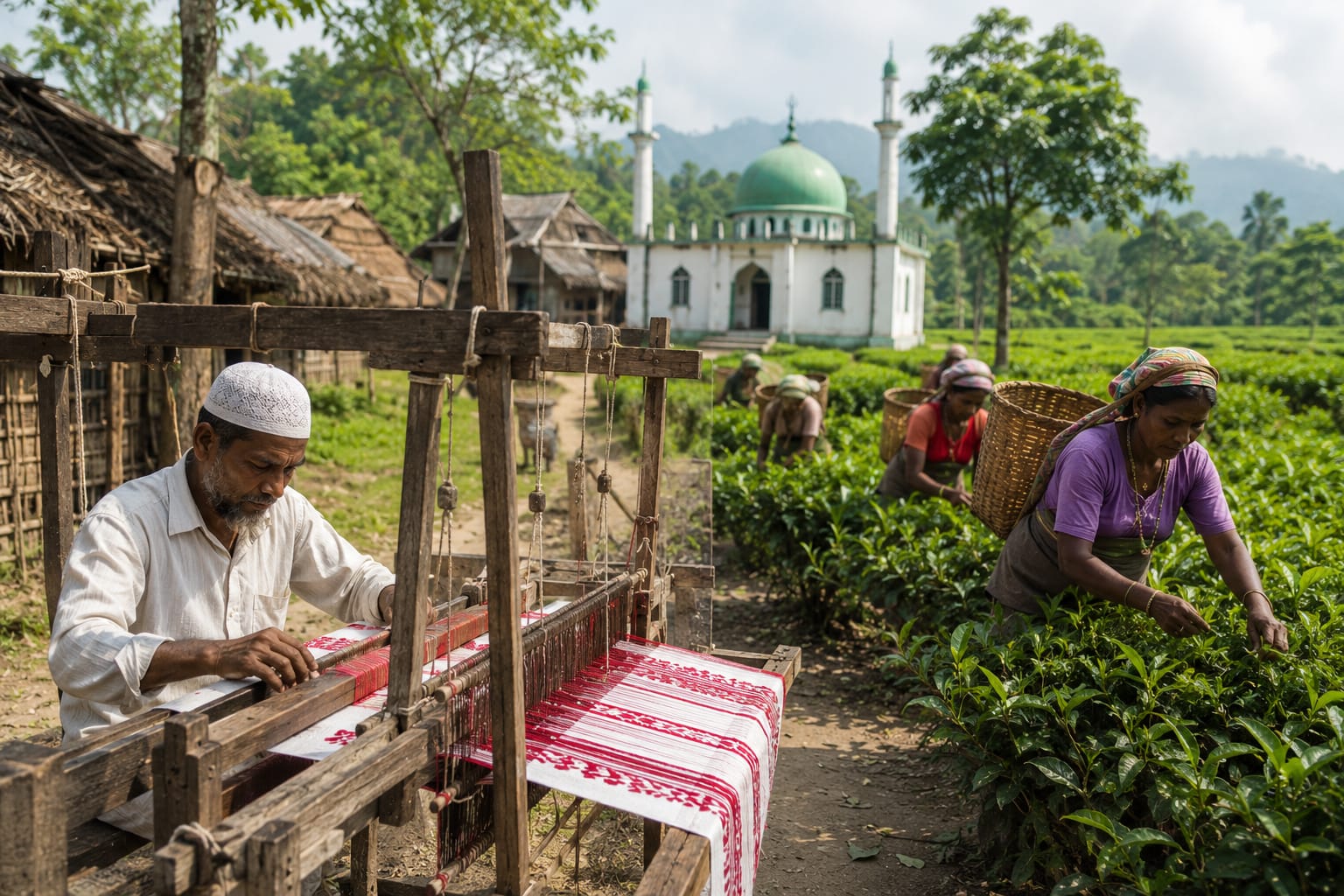
The Jolha Muslims of Assam are one of the indigenous Muslim communities of the state. The word ‘Jolha’ is derived from the Persian word Julaha, meaning “weaver”. Traditionally, the community earned its livelihood through handloom weaving. The history of the Jolha Muslims in Assam dates back several centuries. Historical records indicate that Muslim artisans, soldiers, scholars, and traders entered Assam at different times, particularly during the Sultanate and Mughal periods. Among these migrants were skilled weavers who over time mixed with the local population, adopted the Assamese language and customs, and gradually developed into a distinct indigenous Muslim community known as the Jolhas.
The first migration of Jolha Muslims occurred during the rule of the Ahom kings. Ahom rulers encouraged the settlement of skilled artisans, including Muslim weavers because of their expertise in textile production. As a result, Muslim weavers found opportunities in different parts of Assam. Their weaving skills contributed significantly to the traditional textile economy of the region. A second and larger wave of Jolha migration took place during British rule, particularly in the late nineteenth century. After the British annexed Assam in 1826 and expanded the tea industry. Among those recruited were Julha Muslims from Bihar, Odisha, Bengal, and parts of present-day Uttar Pradesh. While many worked in tea plantations, others were employed as weavers, rope-makers, tent-makers, machine workers, and skilled artisans connected with tea estates, railway construction, and other colonial enterprises.
Jolha families who migrated during the British period worked in tea estates or settled in tea garden areas. The Jolha Muslims are mainly found in districts such as Darrang, Sonitpur, and parts of Upper Assam. Although their population is comparatively smaller than some other Muslim communities in Assam, they have maintained a distinct social and cultural identity. Most Jolhas speak Assamese as their mother tongue. The 1891 Census of Assam identified the Jolhas as Muslim weavers and recorded 2,180 Jolhas in Assam. The Jolha Muslims follow Sunni Islam, with the majority belonging to the Hanafi school of jurisprudence.
“The histories of the Jolha Muslims and Muslims of Adivasi origin remind us that Assam’s identity has been shaped by centuries of migration, cultural interaction and shared traditions, making diversity one of the state’s greatest strengths.”
Let us now discuss about Adivasi Muslims in Assam. The Adivasi Muslims of Assam are people of Adivasi (Tea Tribe) origin who profess Islam. Unlike the Goria, Moria, Deshi, or Jolha Muslims, they are not regarded as a separate historical Muslim community of Assam. Instead, the term refers to individuals and families whose ethnic identity is Adivasi and whose religious identity is Muslim.
The history of the Adivasi population in Assam may date back to the British colonial period. Following the establishment of the tea industry in the nineteenth century, the British administration recruited thousands of labourers from the Chotanagpur Plateau and neighbouring regions, including present-day Jharkhand, Odisha, Chhattisgarh, Bihar, and West Bengal. These migrants belonged to several tribal communities such as the Oraon, Munda, Santhal, Kharia, Gond, and others. Most followed their traditional tribal religions, Hinduism, or Christianity. Within this diverse migrant population, a small number of families either migrated as Muslims or embraced Islam after settling in Assam. The Adivasis generally settled in and around tea garden areas and nearby villages, particularly in districts such as Tinsukia, Golaghat, Sonitpur, and Biswanath.
The Jolha Muslims and Muslims of Adivasi origin represent two distinct components of Assam’s diverse Muslim society. The Jolha Muslims have a long association with the traditional weaving profession and have played an important role in preserving Assam’s handloom culture. Muslims of Adivasi origin, whose history is linked to the migration of Tea Tribe communities during the British period, illustrate the coexistence of tribal heritage and Islamic faith within the state. Greater documentation and research on these communities will help in understanding their contributions and ensuring that their history and heritage receive the recognition they deserve.
Comments are closed.