

S Ahmad
For decades, India’s space programme has symbolised the country’s ability to achieve extraordinary scientific milestones despite limited resources. From launching satellites at a fraction of global costs to successfully reaching the Moon and Mars, India’s journey has been defined by innovation, precision and frugality. What began as a state-led scientific mission under visionary leaders like Vikram Sarabhai has gradually evolved into one of the world’s most respected space programmes.
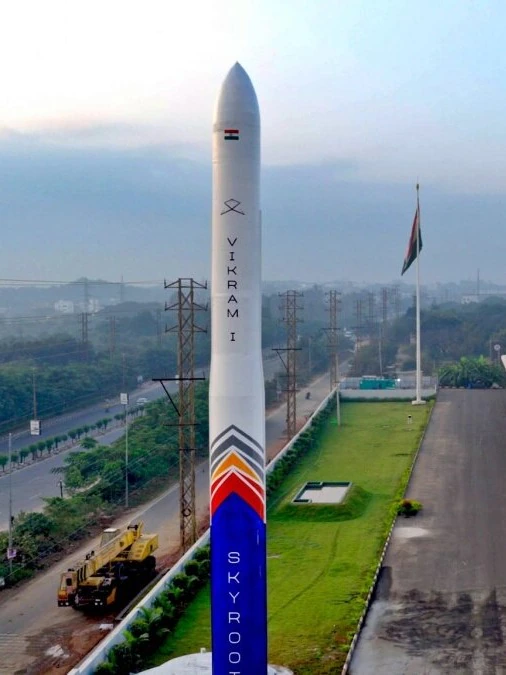
Yet the story unfolding today is fundamentally different from anything India has witnessed before. The significance of Vikram-1, India’s first privately developed orbital launch vehicle, lies not merely in its technological sophistication or commercial potential. Its real importance lies in what it represents: the emergence of a new model of India’s space ecosystem where government, industry, academia and entrepreneurs work together to transform the country from a successful spacefaring nation into a global space economy.
The launch of Vikram-1 under Mission Aagaman is therefore much more than another rocket mission. It is the clearest demonstration yet that India’s space sector has entered a new era—one driven by policy reforms, private innovation and commercial ambition.
For nearly six decades, the Indian Space Research Organisation (ISRO) carried the enormous responsibility of building India’s space capabilities almost single-handedly. Through pioneering missions, indigenous technological development and remarkable cost efficiency, ISRO established India as a trusted global player in satellite launches, planetary exploration, remote sensing and communication technology.
Its achievements are already part of scientific history. The Mars Orbiter Mission made India the first country to reach Mars on its maiden attempt. Chandrayaan missions established India’s growing capabilities in lunar exploration, while the successful landing near the Moon’s south pole elevated the country’s standing within the global scientific community. Launch vehicles such as the PSLV earned an international reputation for reliability, placing hundreds of foreign satellites into orbit.
These successes created an important foundation, but they also revealed an unavoidable limitation. A government agency, regardless of its competence, cannot by itself build an entire commercial space economy. As demand for satellite services, Earth observation, communications, navigation and launch capabilities expanded worldwide, it became increasingly clear that private enterprise had to become an integral part of India’s space journey.
Recognising this reality, the Government initiated one of the most significant policy shifts in the history of India’s scientific establishment. The Indian Space Policy 2023 fundamentally redefined the country’s approach by opening the entire space value chain to private participation. Activities once considered the exclusive domain of government institutions were made accessible to non-government entities under a structured regulatory framework.
The significance of this reform cannot be overstated.
Unlike traditional industries where private investment naturally follows market demand, space technology has historically required substantial public investment because of its complexity, long gestation periods and high financial risks. Governments around the world initially led space exploration before gradually encouraging commercial participation.
India has now entered this second phase.
Private companies are no longer viewed merely as suppliers of components or contractors executing government projects. They are becoming independent innovators capable of designing launch vehicles, manufacturing satellites, developing propulsion systems, providing Earth observation services and competing in international markets.
The rapid expansion of India’s space startup ecosystem illustrates the impact of these reforms. Within little more than a decade, the number of startups operating in this sector has grown dramatically. This remarkable transformation reflects far more than entrepreneurial enthusiasm. It signals growing investor confidence, improved regulatory clarity and expanding commercial opportunities.
Among the companies leading this transformation, Skyroot Aerospace occupies a particularly significant place. The successful demonstration of Vikram-S in 2022 established important technological capabilities while demonstrating that privately developed launch vehicles could operate successfully within India’s regulatory framework. Vikram-1 now seeks to build upon that achievement by becoming India’s first privately developed orbital launch vehicle capable of placing satellites into Low Earth Orbit.
Its technical features underline the growing sophistication of Indian private industry. Built using advanced carbon composite structures, powered by solid-fuel boosters and equipped with an innovative 3D-printed liquid engine, Vikram-1 reflects contemporary engineering approaches aimed at improving efficiency while reducing manufacturing complexity.
However, technological innovation alone does not explain the importance of this mission.
The commercial payloads carried aboard Vikram-1 perhaps reveal its greatest significance. Rather than serving only governmental scientific objectives, the mission supports customers representing multiple commercial applications. Technology demonstration satellites, orbital servicing experiments and innovative payloads designed for emerging space markets illustrate how India’s private launch capabilities are beginning to integrate with the expanding global space economy.
One payload designed to demonstrate orbital debris management deserves particular attention. As thousands of satellites enter Earth’s orbit each year, managing space debris has become one of the most pressing challenges confronting the international space community. Technologies capable of servicing, capturing or removing obsolete objects from orbit are likely to become increasingly valuable over coming decades. Indian companies participating in such emerging sectors demonstrate an encouraging willingness to address future challenges rather than merely replicate existing technologies.
Equally symbolic are the commemorative payloads honouring C. V. Raman, Vikram Sarabhai and Dr. A. P. J. Abdul Kalam. These miniature tributes connect India’s scientific past with its entrepreneurial future, reminding us that technological revolutions are built upon generations of scientific inquiry and public investment.
Behind these technological achievements lies an equally important institutional transformation.
The establishment of the Indian National Space Promotion and Authorisation Centre (IN-SPACe) represents one of the most consequential governance reforms within the sector. Acting as a single-window regulatory agency, IN-SPACe provides private companies with transparent procedures, access to ISRO facilities and a predictable policy environment.
Regulatory certainty is often overlooked in discussions about innovation, yet it is indispensable for attracting long-term investment. Entrepreneurs and investors require confidence that licensing procedures, regulatory approvals and operational guidelines will remain transparent and consistent. By separating regulatory functions from operational responsibilities, India has moved towards internationally recognised best practices for managing an increasingly commercialised space sector.
The creation of dedicated financial mechanisms further strengthens this ecosystem. Early-stage grants for startups, venture capital support and technology adoption funding collectively address one of the greatest obstacles confronting deep-technology enterprises: access to patient capital.
Unlike software startups that may generate revenue within relatively short periods, space technology companies frequently require years of research, testing and certification before commercial products become operational. Dedicated public funding therefore serves as a catalyst rather than a substitute for private investment, enabling promising innovations to survive the lengthy development cycles characteristic of aerospace technologies.
Liberalisation of foreign direct investment policies further complements these domestic reforms. Space technology has become one of the world’s most collaborative industries, with supply chains, manufacturing capabilities and research partnerships spanning multiple countries. More flexible investment norms enhance India’s attractiveness as a destination for global aerospace investment while facilitating technology transfer and international collaboration.
Nevertheless, the success of India’s private space ecosystem should not be measured solely by the number of startups established or rockets launched. The larger objective is to build an integrated industrial ecosystem capable of sustaining innovation across manufacturing, electronics, software, materials science, propulsion systems, artificial intelligence and downstream applications.
The commercial opportunities are immense.
Satellite-based communication, precision agriculture, climate monitoring, disaster management, navigation, mining, logistics, financial services and urban planning increasingly depend upon space-derived data. The value of the global space economy extends far beyond rockets themselves. Launch vehicles represent only the gateway to a much larger ecosystem of services that influence everyday economic activity.
India’s ambition to significantly expand its share of this rapidly growing global market is therefore both timely and realistic. The country’s strengths in engineering talent, software development, cost-effective manufacturing and scientific research provide important competitive advantages. When combined with supportive public policy and expanding private participation, these capabilities position India to become a significant player within the global commercial space industry.
The launch of Vikram-1 thus represents something larger than a successful engineering exercise. It reflects a broader national transition—from a country that excelled in government-led space exploration to one that now seeks to build a vibrant, innovation-driven and globally competitive space economy.
Yet the true test of these reforms lies beyond the launch pad. Sustainable success will depend on whether policy momentum can translate into long-term industrial capacity, global competitiveness and commercial leadership. That challenge now defines the next chapter of India’s space journey.
The excitement surrounding Vikram-1 should therefore be viewed through a broader economic lens. Space exploration today is no longer driven solely by scientific curiosity or national prestige. It has become one of the fastest-growing knowledge industries in the world, attracting governments, venture capital, multinational corporations and research institutions alike. What was once the exclusive domain of a handful of national space agencies has evolved into a vibrant commercial ecosystem where private companies develop satellites, provide launch services, manufacture components, process space-derived data and even explore future possibilities such as in-orbit servicing and space resource utilisation.
India’s aspiration to become a major player in this emerging economy is both ambitious and achievable. Estimates suggest that the global space economy could exceed one trillion dollars over the coming decades, fuelled by growing demand for satellite communications, broadband connectivity, Earth observation, navigation services, climate monitoring and defence applications. For a country with one of the world’s largest pools of engineers, a thriving digital economy and globally competitive manufacturing capabilities, the opportunity extends well beyond launching rockets. The larger prize lies in becoming an integrated supplier of technologies, products and services that support the global space value chain.
This is precisely why recent policy reforms deserve attention. The Indian Space Policy 2023 is not merely an administrative document; it represents a strategic shift in how the country views the space sector. Instead of treating space as an exclusive government function, the policy recognises it as an economic frontier where public institutions and private enterprises can complement each other. ISRO will continue to lead advanced scientific missions, planetary exploration and strategic research, while private industry increasingly drives commercial innovation, manufacturing and service delivery.
Such a division of responsibilities is neither unusual nor unprecedented. The United States provides perhaps the most successful example of this model. NASA continues to undertake deep-space exploration and scientific missions, while companies such as SpaceX, Blue Origin and Rocket Lab have transformed commercial launch services, satellite deployment and reusable rocket technology. Public investment created the scientific foundation, but private enterprise accelerated innovation, reduced costs and expanded commercial possibilities.
India is attempting to follow a similar trajectory while adapting it to its own institutional strengths and developmental priorities.
One of the strongest pillars supporting this transition is the growing role of IN-SPACe as an independent regulator and facilitator. The creation of a transparent, single-window mechanism for approvals addresses one of the most common concerns expressed by technology entrepreneurs: regulatory uncertainty. Innovation flourishes when policies are predictable, licensing procedures are efficient and access to public infrastructure is available on fair and transparent terms.
Equally encouraging has been the steady commercialisation of technologies developed over decades by ISRO. Institutions like NewSpace India Limited (NSIL) have begun transferring proven technologies to industry while enabling private companies to manufacture launch vehicles, satellites and related systems. Such technology transfer represents one of the most effective ways of converting publicly funded scientific research into commercially productive enterprises.
The transfer of Small Satellite Launch Vehicle (SSLV) technology to industry is a notable example. Rather than retaining exclusive control over mature technologies, India has chosen to empower private manufacturers capable of scaling production and competing globally. This approach allows ISRO to focus increasingly on cutting-edge scientific missions while industry expands commercial operations.
Financial support mechanisms have also evolved significantly. The creation of dedicated venture capital funds, seed grants and technology adoption programmes reflects an understanding that deep-technology startups require different forms of financing than conventional businesses. Space startups often invest years in research, testing and regulatory compliance before generating commercial revenue. Traditional banking systems are rarely equipped to support such long innovation cycles.
Public funding therefore plays an important catalytic role. Rather than replacing private investment, it reduces early-stage risks sufficiently to attract institutional investors who might otherwise hesitate to finance technologically ambitious but commercially uncertain ventures.
The liberalisation of foreign direct investment further strengthens India’s attractiveness as a destination for global aerospace investment. International partnerships bring not only capital but also advanced technologies, managerial expertise and access to global markets. Space exploration has always depended upon international collaboration, and future growth will increasingly rely upon cross-border innovation ecosystems.
Nevertheless, optimism should be accompanied by realism. Building a globally competitive commercial space industry presents formidable challenges.
The first challenge concerns scale. Although India’s startup ecosystem has expanded rapidly, many companies remain in early stages of technological development. Competing internationally requires sustained investment in research, manufacturing capacity, quality assurance, skilled human resources and global marketing. These capabilities cannot be developed overnight.
Second, commercial launch services operate within an intensely competitive international market. Established players possess larger production capacities, mature supply chains and significant financial resources. Indian companies will therefore need to compete primarily through innovation, reliability and cost efficiency—qualities that have historically characterised India’s broader technology sector.
Third, infrastructure must continue evolving alongside policy reforms. Testing facilities, launch infrastructure, manufacturing clusters, specialised suppliers and advanced research laboratories require continuous expansion. The success of individual companies ultimately depends upon the strength of the wider industrial ecosystem within which they operate.
Human capital represents another crucial dimension. India’s universities produce large numbers of engineers every year, yet the specialised skills required for aerospace engineering, propulsion systems, advanced materials, avionics and orbital mechanics remain relatively limited. Expanding collaboration between industry, academia and research institutions will therefore be essential if talent supply is to keep pace with industry demand.
There is also a strategic dimension that extends beyond economics.
Space has become increasingly central to national security, disaster management, climate monitoring and digital infrastructure. Satellites support telecommunications, banking networks, weather forecasting, navigation systems, agricultural planning and military operations. Building indigenous capabilities therefore strengthens not only commercial competitiveness but also strategic autonomy.
The importance of self-reliance has become particularly evident amid shifting geopolitical realities. Global supply chains have experienced repeated disruptions due to pandemics, conflicts and technological restrictions. Nations increasingly recognise that critical technologies—including those related to space—must possess resilient domestic capabilities alongside international partnerships.
The emphasis on indigenous manufacturing under the broader vision of Atmanirbhar Bharat should therefore be understood within this wider context. Producing launch vehicles, propulsion systems, satellites and supporting technologies domestically enhances national resilience while creating high-value employment opportunities.
At the same time, India’s space ambitions must continue reflecting the values that have traditionally distinguished its programme. Unlike narratives centred exclusively on geopolitical competition, India’s space journey has consistently emphasised developmental applications. Remote sensing has supported agriculture, resource management and disaster response. Communication satellites have expanded education, healthcare and broadcasting. Navigation systems have strengthened transportation and public safety.
The expanding role of private industry should reinforce rather than diminish this developmental orientation. Commercial success and public purpose need not be competing objectives. Companies developing satellite technologies for precision farming, climate monitoring, environmental protection and disaster resilience illustrate how innovation can simultaneously generate economic value and social benefit.
This balance will become increasingly important as India’s space economy matures.
Ultimately, Vikram-1 represents far more than the maiden flight of a privately developed orbital rocket. It embodies the confidence of a nation that has chosen to open one of its most strategic sectors to innovation, entrepreneurship and competition without abandoning the strong institutional foundations that made earlier achievements possible.
Its success will not be measured solely by whether every payload reaches its intended orbit, important though that is. Its greater significance lies in inspiring an entire generation of scientists, engineers, entrepreneurs and investors to believe that globally competitive space technologies can be designed, manufactured and commercialised from India.
The journey from Vikram Sarabhai’s modest sounding rockets launched from Thumba to privately developed orbital launch vehicles capable of serving international customers reflects one of independent India’s most remarkable scientific transformations. It demonstrates what sustained public investment, visionary leadership and institutional continuity can accomplish over decades.
As Vikram-1 prepares for liftoff, it carries with it more than satellites and scientific instruments. It carries the aspirations of a country determined to move beyond being a respected spacefaring nation towards becoming a leading space economy.
The launch pad, therefore, is not the destination. It is the starting point of a much larger journey—one where India’s future in space will increasingly be shaped not only by government laboratories but also by the imagination, enterprise and innovation of its private sector. If that momentum is sustained through consistent policy support, continued investment in research and an unwavering commitment to excellence, Vikram-1 may ultimately be remembered as the moment when India’s space story entered its most transformative chapter yet.
Comments are closed.