
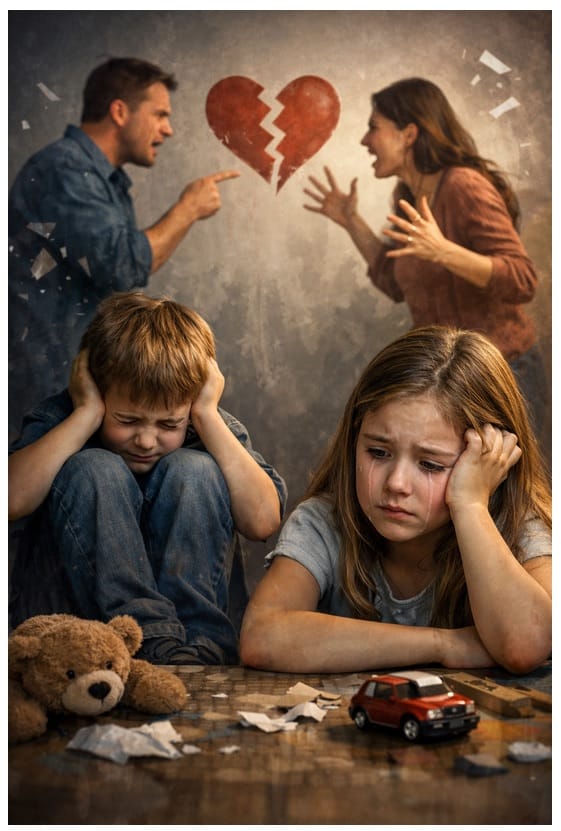


Beyond Childhood: The Lasting Effects of Parental Disputes

Mohammad Hanief


“A peaceful home is one of the greatest gifts parents can give their children. Every child deserves a home where conversations replace confrontations and love outweighs conflict. The strongest foundation for a child’s future is not wealth or success—it is emotional security.”

In an era marked by rapid social change, increasing economic pressures, and the growing influence of technology on family life, childhood itself is undergoing a transformation. While modern society has provided children with unprecedented access to education, healthcare, and opportunities, it has also exposed them to challenges that previous generations experienced less intensely. Among these, one of the most overlooked crises is the growing number of children being raised amid parental disputes.

The image of the traditional family has changed considerably over the past two decades. Dual-income households, demanding careers, rising living costs, social media influences, and the constant pressure to maintain a certain lifestyle have significantly altered family dynamics. According to mental health experts, these factors have contributed to an increase in stress within households, often leading to frequent disagreements between parents. While conflict itself is not uncommon in any relationship, it becomes deeply concerning when children are repeatedly exposed to hostility, emotional distance, and instability within their homes.

Today, children are not merely witnessing arguments in living rooms; they are experiencing conflict in new and more pervasive forms. They observe parents communicating through silence, exchanging harsh messages on smartphones, and carrying emotional tensions that linger long after disagreements have ended. In many households, technology has become both a connector and a divider. The same devices that keep families connected often become instruments of distraction, reducing meaningful conversations and increasing misunderstandings.

The consequences of parental disputes have become increasingly visible in schools and communities. Educators across the country have reported a noticeable rise in behavioral and emotional concerns among students. Anxiety, declining concentration, irritability, and social withdrawal are no longer isolated issues but recurring patterns observed among children navigating stressful home environments.

For younger children, parental conflict disrupts their fundamental sense of safety. Childhood is built upon predictability—the reassurance that home is a place of security and affection. When that environment is replaced by uncertainty, children begin to internalize fear and confusion. They may struggle to understand why their parents are upset and, in many cases, mistakenly assume responsibility for the tension surrounding them.

Adolescents face a different challenge. At a stage when they are already navigating questions of identity and belonging, parental disputes often intensify feelings of isolation and emotional instability. Many teenagers withdraw into digital spaces, spending excessive hours online as a means of escaping household tensions. Others exhibit signs of frustration through declining academic performance, strained friendships, or increased behavioral problems.

The current generation of children is also growing up in a world where mental health conversations have become more prominent than ever before. Yet, despite greater awareness, many families continue to underestimate the impact of conflict on young minds. Mental health professionals emphasize that children do not simply forget what they witness at home. Experiences accumulated during formative years frequently influence emotional development, relationship patterns, and coping mechanisms throughout adulthood.

Research in child psychology consistently demonstrates that prolonged exposure to parental disputes can alter a child’s perception of relationships. Children raised in high-conflict households often develop heightened sensitivity to tension. They become adept at reading facial expressions, anticipating arguments, and adjusting their behavior to avoid triggering disagreements. While such adaptability may appear to be maturity, it is often a response to chronic stress.

This emotional burden can have lasting consequences. Young adults who grew up amid parental disputes frequently report difficulties in establishing trust, maintaining healthy relationships, and expressing emotions. Some become reluctant to commit to long-term partnerships, fearing they may recreate the conflicts they witnessed during childhood. Others struggle with anxiety and self-doubt, carrying emotional scars that remain long after they have left their family homes.

Economic realities have further complicated the issue. Inflation, employment uncertainties, and increasing financial responsibilities have placed immense pressure on families worldwide. Financial disagreements remain among the leading causes of marital conflict, and children are often unintended witnesses to conversations surrounding debt, expenses, and future insecurities. In many cases, these discussions contribute to an atmosphere of persistent tension that becomes a defining feature of daily life.

The aftermath of the COVID-19 pandemic continues to influence family dynamics as well. Extended periods of confinement during lockdowns exposed many children to heightened levels of domestic conflict. Although societies have largely returned to normalcy, the psychological effects remain evident. Counsellors and educators continue to encounter children who developed anxiety-related symptoms during those years and continue to struggle with emotional regulation.

Social media has introduced another dimension to parental disputes. Unlike previous generations, today’s children can observe conflicts extending beyond the confines of the home. Public disagreements, indirect online remarks, and digital confrontations have blurred the boundaries between private and public life. The permanence of online interactions means that family tensions can follow children into spaces that were once considered escapes from domestic concerns.

Moreover, the increasing rate of separation and divorce has reshaped conversations surrounding parental conflict. While separation may, in some circumstances, provide a healthier alternative to prolonged hostility, experts stress that the manner in which parents manage such transitions significantly affects children’s well-being. Children benefit most when parents prioritize cooperation and emotional support, even in the absence of a shared household.

Educational institutions have become critical support systems in addressing this issue. Schools are increasingly investing in counseling services, emotional wellness programs, and initiatives designed to promote resilience among students. Teachers often serve as the first observers of emotional distress, recognizing subtle changes in behavior that may indicate challenges at home. However, schools alone cannot bear the responsibility of addressing a problem rooted in family environments.

Communities must also play an active role. Greater accessibility to family counselling, affordable mental health services, and awareness campaigns can help parents better understand the impact of unresolved disputes. Parenting workshops and support groups have proven effective in encouraging healthier communication practices and reducing conflict within households.

Importantly, conversations surrounding parental disputes should not focus solely on assigning blame. Parenting is an inherently demanding responsibility, and every family encounters moments of stress and disagreement. The challenge lies not in avoiding conflict altogether but in managing it in ways that preserve a child’s emotional security. Children benefit from witnessing respectful disagreement and constructive problem-solving just as much as they suffer from repeated hostility and emotional neglect.

The current generation has often been described as the most connected in history, yet many children continue to feel profoundly alone within their own homes. They possess access to information at their fingertips but struggle to find reassurance where it matters most. Their emotional needs cannot be met by technology, academic success, or material comforts alone. They require stability, understanding, and the confidence that the adults in their lives can provide a safe environment in which to grow.

As nations continue investing in education and youth development, equal attention must be given to the environments that shape children long before they enter classrooms. The future of society depends not only on the knowledge children acquire but also on the emotional foundations upon which their lives are built.

Children should never become casualties of conflicts they neither created nor understand. Their childhoods should be defined by curiosity, learning, and hope rather than tension and uncertainty. Addressing the impact of parental disputes is therefore not simply a matter of family welfare—it is an investment in the emotional health of future generations.

In the end, the measure of a society is reflected not only in its economic progress or technological achievements but also in the care it extends to its children. Every child deserves a home where disagreements do not overshadow affection, where conversations replace confrontations, and where peace is not an exception but a daily reality. For countless children growing up between battles, that reality remains a distant dream—one that society can no longer afford to ignore.


The author is a senior analyst and environmentalist. He can be reached m.hanief@gmail.com. Twitter/X: @haniefmha

Comments are closed.