

Malik Nazir
“Social media has given everyone a voice, but having a voice doesn’t mean having the right to speak at every moment. Sometimes humanity demands silence.”
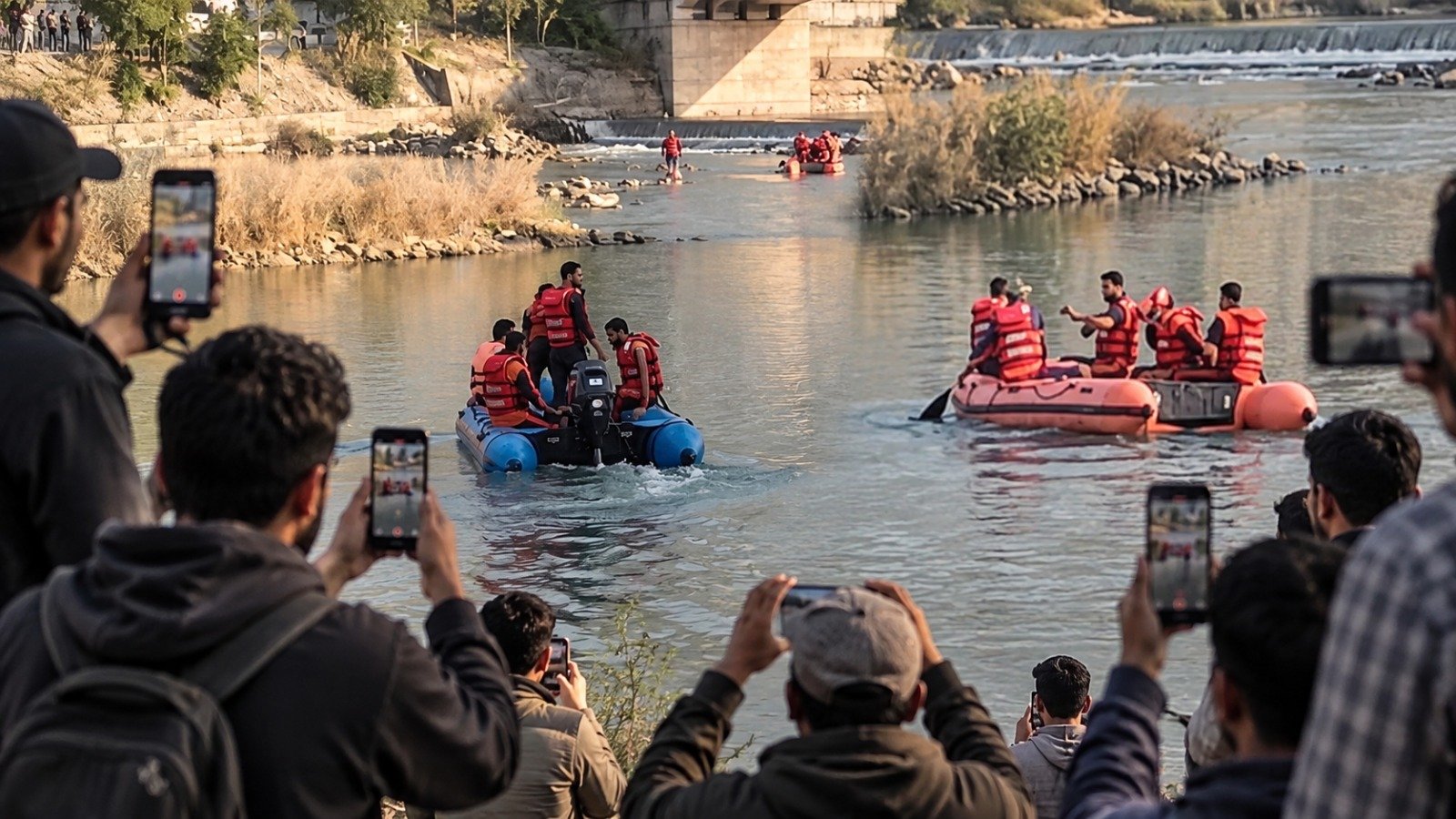
The tragedy unfolding in Kaloosa, Bandipora, has left an entire community deeply shaken. Eleven-year-old Moomin drowned in the Nallah Madhumati, and for the past five days, efforts have continued to retrieve his body. Authorities, rescue teams, local volunteers and people from different parts of the district have joined hands in the search. Many have spent hours in and around the water, using different means and equipment, driven by nothing more than the hope of bringing the child back to his family.
Some volunteers have even travelled from outside the district to participate in this humanitarian effort. Their presence reflects the finest side of humanity—the willingness to stand beside a grieving family in its darkest hour, even when there is no personal connection with them.
Yet, despite the best efforts of everyone involved, Moomin’s body is still awaited.
It is difficult to imagine what his parents must be going through.
For five days, they have not been waiting for their son to return from school, from the playground or from a friend’s home. They are waiting for something no parent should ever have to wait for—the recovery of their child’s body.
The ordinary anxieties of parenthood have suddenly been replaced by an unbearable uncertainty. A mother and father who once waited for the sound of their son’s footsteps, his voice at the door or his return after playing with friends are now waiting beside a river, hoping that the search teams will find him. There are perhaps no words adequate enough to describe the pain of such waiting.
And while this tragedy has brought out an inspiring display of solidarity, it has also exposed a disturbing side of our society.
Some individuals have reportedly started creating AI-generated videos depicting or amplifying the tragedy, often accompanied by dramatic background music, apparently to attract views, attention and engagement.
One has to pause and ask: Where have we lost our sense of sensitivity?
Technology is not inherently insensitive. Artificial intelligence is merely a tool. It is the intention behind its use that determines whether it becomes a force for good or a means of exploiting someone’s pain.
A grieving family’s tragedy cannot become entertainment.
A child’s death cannot become “content”.
A parent’s tears cannot be converted into views, likes and shares.
Before recording, editing or uploading anything connected with such a tragedy, we need to ask ourselves a simple question: If this were my child, would I want strangers to turn his suffering into a dramatic video with music and effects?
That one question should be enough.
There is a difference between informing people and sensationalising grief. There is a difference between spreading awareness and exploiting someone’s helplessness. There is a difference between documenting a rescue operation and turning a family’s tragedy into digital spectacle.
The people participating in the search deserve our respect. The authorities and rescue teams working under difficult circumstances deserve encouragement. The volunteers who have stepped forward deserve appreciation. Most importantly, Moomin’s family deserves privacy, dignity and our collective prayers—not unwanted publicity.
At a time like this, our responsibility is not to amplify grief but to share it.
If we cannot physically join the search, we can still help by offering prayers, supporting the family, assisting rescue teams in whatever legitimate way is required and avoiding the circulation of unverified or distressing material.
Social media has given everyone a voice, but having a voice does not mean having the right to speak at every moment. Sometimes humanity demands silence.
Perhaps the most meaningful tribute to Moomin at this moment would be to remember that behind every photograph, video or social-media post is a real family living through an unimaginable nightmare.
Let us therefore introspect before we press the record button.
Let us ask ourselves whether what we are about to post will help the family, assist the search or inform the public—or whether it will merely satisfy our own desire for attention.
Moomin is not a story for views.
He is someone’s beloved son, someone’s little brother, someone’s friend and a child whose absence has left a family waiting beside the Madhumati with a pain that no algorithm can understand.
May the search teams succeed in bringing Moomin home, and may Allah grant strength, patience and comfort to his grieving parents and family. Aameen.
“Moomin is not a story for views. He is someone’s beloved son, someone’s little brother, someone’s friend and a child whose absence has left a family waiting beside the Madhumati with a pain that no algorithm can understand.”
Author is an educator and can be reached at maliknazir.a@gmail.com
Editor’s Note: At the time this article was received, the child’s body had not yet been recovered. The body was subsequently retrieved from Nallah-e-Madhumati on Monday afternoon, after days of search and rescue efforts.
Comments are closed.