


Syed Yunis Bukhari
“Sleep is not simply a period of rest. It is a remarkable biochemical process during which the brain and body repair, regulate, remember and prepare for the day ahead.”
Every night, millions of people close their eyes, fall asleep and enter a world that appears to be one of complete inactivity. We often describe sleep as a time when the body and brain are “resting.” But beneath this apparent stillness, an extraordinary biochemical process is taking place. Cells continue to produce and use energy, hormones are released, neurotransmitters change their activity, memories are processed and tissues undergo repair. In reality, sleep is not a shutdown of the human body; it is one of its most carefully regulated biological activities.
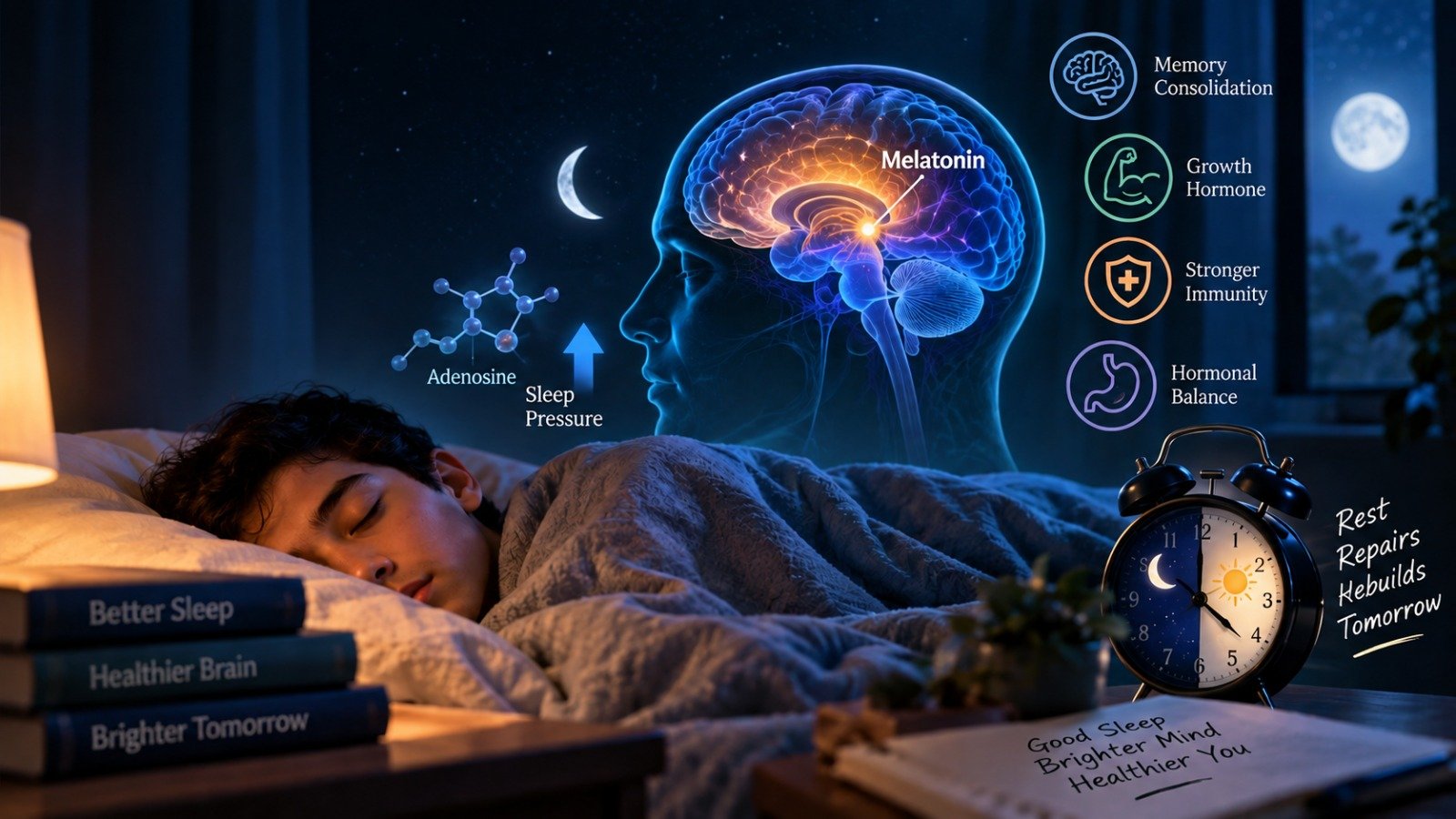
The chemistry of sleep begins with the body’s internal biological clock, known as the circadian rhythm. This approximately 24-hour cycle helps coordinate sleep, wakefulness, body temperature, hormone production and metabolism. One of the key molecules involved in this process is melatonin, a hormone produced primarily by the pineal gland. As darkness approaches, melatonin production generally increases, sending a biochemical signal to the body that it is time to prepare for sleep. In the morning, exposure to light suppresses melatonin production and helps promote wakefulness. This simple relationship between light, hormones and the brain demonstrates how closely our daily environment is connected with our biochemistry.
Another fascinating molecule involved in sleep is adenosine. Throughout the day, our cells continuously consume energy. ATP, or adenosine triphosphate, is the primary energy currency of the cell. As ATP is broken down and metabolized, adenosine accumulates in the brain. Increasing adenosine levels contribute to what scientists call sleep pressure, meaning the longer we remain awake, the stronger our biological drive to sleep becomes. This is also where caffeine provides an interesting biochemical lesson. Caffeine does not remove the body’s need for sleep; instead, it mainly blocks adenosine receptors in the brain. As a result, the feeling of tiredness is temporarily reduced, allowing us to remain alert even while sleep pressure continues to build.
Sleep also plays a major role in maintaining the health of the brain. During sleep, particularly during certain stages of deep sleep, processes involved in the removal of metabolic waste from brain tissue become more active. The glymphatic system, a waste-clearance pathway associated with the brain, helps facilitate the movement of fluid through brain tissue and the removal of certain waste products. Researchers are increasingly interested in understanding how sleep-related changes in these processes may influence long-term brain health.
Perhaps one of the most important functions of sleep is its relationship with memory and learning. The brain does not simply store everything we experience during the day like a computer saving files. Instead, newly acquired information is processed, reorganized and consolidated through complex changes in neural networks. During sleep, particularly during specific stages of non-rapid eye movement and rapid eye movement sleep, patterns of brain activity are associated with the consolidation of different types of memories. This is one reason why adequate sleep is especially important for students. Studying throughout the night may seem productive, but depriving the brain of sleep can interfere with the very processes needed to retain and recall information.
The biochemical influence of sleep extends beyond the brain. During deep sleep, the body releases growth hormone, which contributes to tissue repair, protein synthesis and other important physiological processes. Sleep also interacts with hormones involved in appetite and energy balance. Leptin, which generally signals satiety, and ghrelin, which promotes hunger, can be affected by sleep patterns. Disturbed or inadequate sleep may therefore influence appetite and eating behaviour and, over time, contribute to metabolic problems.
The immune system is also closely connected with sleep. During normal sleep, the body regulates numerous immune signalling molecules, including cytokines, which help coordinate inflammatory and immune responses. Adequate sleep supports the normal functioning of these processes, whereas persistent sleep deprivation can disturb immune regulation. This does not mean that one sleepless night will immediately cause illness, but repeated inadequate sleep can place additional stress on the body’s regulatory systems.
Modern lifestyles, however, are increasingly challenging these natural biochemical rhythms. Artificial lighting, late-night work, irregular schedules, excessive screen exposure and frequent consumption of caffeine can all interfere with the biological signals that normally prepare the body for sleep. The problem is not simply that people feel tired the next morning. Chronic disruption of sleep can affect cognition, metabolism, hormonal regulation and immune function.
The biochemistry of sleep therefore offers an important lesson: rest is not inactivity. While we sleep, our bodies are carrying out essential maintenance work that cannot simply be postponed indefinitely. Hormones are regulated, energy metabolism continues, memories are consolidated, tissues are repaired and the brain manages its metabolic environment.
In a world where being busy is often celebrated and sleeping less is sometimes treated as a sign of productivity, science tells us otherwise. Sleep is not time lost from our lives; it is an investment in the biological systems that allow us to function properly when we are awake.
The next time we close our eyes at night, we should remember that the body is not switching off. It is quietly performing one of the most sophisticated biochemical programs essential for human life.
“Sleep is not time lost from our lives; it is an investment in the biology that keeps us functioning.”
Author is Assistant Professor in the Department of Medical Laboratory Science, University Institute of Allied Health Sciences (UIAHS), Chandigarh University. He writes on health, education, environment and contemporary social issues. He can be reached at yunis.e16472@cumail.in
Comments are closed.