


Mohammad Muslim Bhat
“A Kashmir that is able to transport goods and people to other parts of India within hours rather than days represents a new kind of economy compared to that which existed even just five years ago.”
It had taken decades for people traveling from Jammu to Srinagar to endure what seemed more of a punishment than a trip due to the fact that it took up to nine hours to travel via the winding and landslide-prone Pir Panjal highway with winter restrictions. This is no longer the case, and the development that is about to take place is going to be more revolutionary rather than evolutionary in nature. The Union Road Transport Minister of India, Nitin Gadkari, announced at regional gatherings that it would only take three hours to travel on Jammu-Udhampur-Srinagar Corridor.
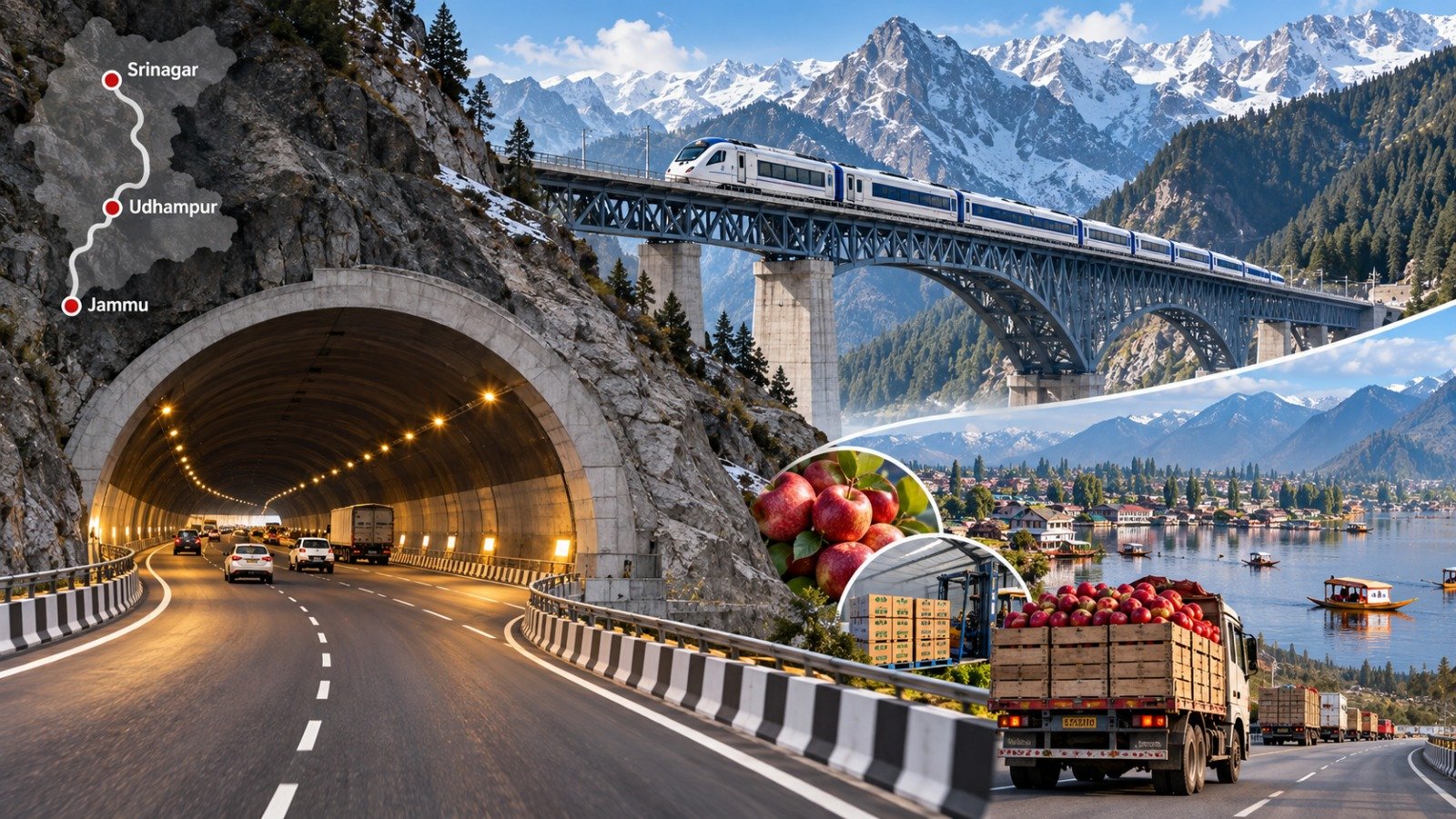
The key infrastructure project is the four-lane Jammu-Udhampur-Srinagar Highway, an estimated 250-kilometer highway valued at about Rs 16,000 crore, which has reportedly attained more than 95 percent completion as of mid-2026. When it becomes operational, it will reduce the distance between the two cities by about 70 kilometers and will reduce travel time from about nine hours to just four hours, according to data provided by the Ministry of Road Transport and Highways. Tunneling has played a key role in this development. In 2014, there were only five tunnels in the corridor. Today there are 25 tunnels, of which 20 have been built while five others are still under construction. These include some strategically important tunnels such as the Zojila Tunnel, the Sadhna Pass Tunnel, the Sinthan Pass Tunnel and a second alignment for the Chenani-Nashri tunnel, which is itself a 9.2-kilometer tunnel that helped shorten winter closures of part of the route.
In addition to the main highway, the planners have been constructing redundancy in the network of connectivity for the region, realizing the importance of not having a single point where the entire Valley could be isolated from the rest of the nation due to any blockage on NH-44. In this context, a 202-kilometre stretch between Chenani, Sudhmahadev, Doda, Kishtwar, and Anantnag and a 250-kilometre stretch from Kathua, Basholi, Bhaderwah, and Doda that comprises a seven-kilometre tunnel at Chattergala are being constructed to provide travelers from Punjab an all-weather route from Doda and Kishtwar without using the main highway from Jammu to Srinagar. A separate corridor from Jammu to Poonch is also being constructed. With the completion of these projects, Jammu and Kashmir Valley will have three all-weather road connectivity routes between them.
Roadways are just part of the equation. The Udhampur-Srinagar-Baramulla Rail Link, which is a 272-kilometer rail link that passes through some of the most complex geologic areas in the Himalayas, was inaugurated by Prime Minister Narendra Modi in June 2025, thus bringing the Kashmir valley region in India’s rail network for the very first time. This infrastructure project includes the building of the Chenab Bridge, which is a 1,315-meter long steel arch bridge capable of enduring wind speeds of up to 260 kilometers per hour in a zone 5 seismic area, an achievement that took almost 20 years to complete. The train service Vande Bharat Express became operational on this railway line starting from June 2025, connecting Srinagar to the shrine town of Katra of Shri Mata Vaishno Devi, while extending to Jammu Tawi in April 2026.
The economics of this project make perfect sense despite the physical challenges involved. Horticulture, which is Kashmir’s largest agricultural export sector, has been a prisoner to road blockades during the critical apple picking period, when producers have raced their trucks loaded with fragile produce against landslides, snowfall, and traffic blockages along the narrow stretches of NH-44. The availability of a secure, quicker and all-weather passageway alters the economic perspective for each truck transporting apples, cherries and saffron towards Delhi, Mumbai or port destinations. Tourism, the other significant sector of the economy, is likely to gain in a similar manner from this initiative, since the journey time has been one of the primary reasons preventing people from visiting Kashmir over other destinations.
There are other long-term goals also attached to this network expansion. The Srinagar Metro is a light rail transit project that was initiated back in 2023 as a MetroLite proposal. It will include the construction of two corridors spanning 25 kilometers and 28 stations and will go live in 2027, costing about Rs 5,559 crore and carrying 200,000 passengers daily. Alongside the metro, there is another expressway project called the 143-kilometer Jammu and Kashmir segment of the Delhi-Amritsar-Katra Greenfield Expressway. This project is set to conclude in August 2027 with a cost of about Rs 11,500 crore, reducing the Delhi-Katra distance by about 58 kilometres for pilgrims going to Vaishno Devi and tourists moving towards the valley.
“Horticulture has been a prisoner to road blockades during the critical apple-picking period, when producers have raced their trucks against landslides, snowfall and traffic blockages along the narrow stretches of NH-44.”
Comments are closed.