
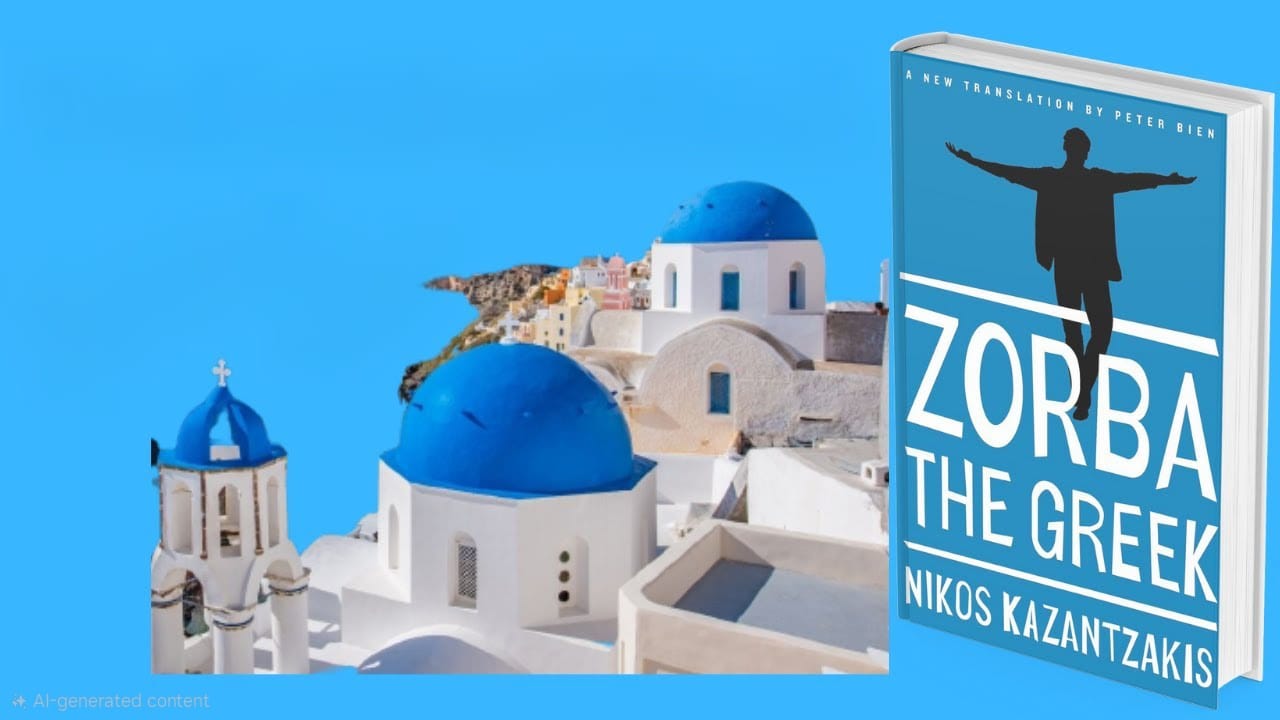

Zorba the Greek: Nikos Kazantzakis and the Art of Existential Engagement

Shabeer Ahmad Lone

“For Nikos Kazantzakis, life is not something to be observed from a distance but something to be lived with courage, passion, and responsibility. In Zorba the Greek, meaning emerges not from abstract thought alone but through action, friendship, risk, and wholehearted engagement with the world.”

Nikos Kazantzakis, one of the most profound and influential literary figures of twentieth-century Greece, devoted his life to probing the intricate, often paradoxical relationship between the self and existence. His works transcend the boundaries of conventional narrative, functioning as philosophical explorations in which literature and life converge. In his vision, existence is neither passive nor predetermined; it is a dynamic, participatory endeavor in which human consciousness, freedom, and choice continuously interact with the unpredictable and often turbulent realities of the world.

Drawing upon the cultural heritage of Crete, the spiritual traditions of Orthodox Christianity, and the philosophical currents of modern Europe-from Nietzschean affirmation of life to existentialist reflections on human responsibility-Kazantzakis crafted a literary-philosophical corpus that interrogates what it means to live fully, ethically, and courageously. Among his masterpieces, Zorba the Greek, originally titled Víos kai Politeía tou Aléxē Zorbá (Life and Times of Alexis Zorbas) and first published in 1946, stands as the most celebrated embodiment of this vision.

The novel dramatizes the tension between intellect and instinct, contemplation and action, theory and lived experience, through the interplay of its central figures: the reflective, bookish narrator and the exuberant, instinct-driven Alexis Zorba. Through their relationship, Kazantzakis asserts a fundamental principle: that authentic life emerges most fully not from abstract reflection or passive observation but from courageous engagement with the world, from embracing uncertainty, taking risks, and participating in the vivid tapestry of human experience. In this sense, his work is as much a philosophical treatise as it is a literary achievement, offering both intellectual rigor and profound human insight.

            Among his masterpieces, Zorba the Greek, originally titled Víos kai Politeía tou Aléxē Zorbá (Life and Times of Alexis Zorbas) and first published in 1946, stands as the most celebrated embodiment of his vision. The novel contrasts the reflective, bookish narrator with the instinctive, exuberant Alexis Zorba, portraying a profound dialectic between intellect and instinct, contemplation and action, theory and lived experience. Authentic life, Kazantzakis suggests, emerges not from reflection alone but through active engagement with the world—through participation, risk, passion, and the embrace of uncertainty.

            Set against the elemental and rugged landscape of Crete, the novel situates human desires, labor, joys, and sorrows within the rhythms of nature, rendering the environment itself a symbolic participant in the narrative. The narrator initially seeks meaning through study, detachment, and contemplation, believing life’s significance can be captured by abstract reasoning. Zorba, in contrast, embodies a life lived fully in the present, guided by intuition, passion, and bodily experience.

He dances, labors, laughs, and mourns with abandon, demonstrating that wisdom can arise from visceral engagement as much as from intellectual reflection. Through this interplay, Kazantzakis articulates a central human dilemma: reconciling thought with action, contemplation with participation, planning with spontaneity. Life is a dynamic arena in which understanding is inseparable from experience, and meaning is continuously forged through the interplay of reflection, choice, and embodied living.

            Freedom and individuality are central to Kazantzakis’s exploration of existence. Zorba’s freedom is rooted in detachment from convention, courage to follow one’s passions, and willingness to embrace life’s uncertainties without fear. The narrator, by contrast, initially associates freedom with intellectual detachment, control, and measured analysis. Through their relationship, the novel demonstrates that genuine freedom arises not from avoidance or abstraction but from the responsible exercise of choice, the acceptance of risk, and wholehearted engagement with life’s unpredictable currents. Freedom, in Kazantzakis’s vision, is inseparable from responsibility and moral courage: one cannot embrace life fully without confronting the consequences of one’s actions and the inevitability of suffering.

            Kazantzakis’s work also engages deeply with spiritual and metaphysical concerns. His existential vision is informed by Orthodox Christianity, mysticism, Nietzschean philosophy, and Eastern thought, creating a unique synthesis of faith, doubt, and human striving. Works such as The Saviors of God and Saint Francis demonstrate his quest to reconcile earthly existence with spiritual transcendence, showing that human life is simultaneously temporal and aspirational, physical and spiritual. This tension-between mortality and the longing for transcendence, body and spirit, desire and conscience-is central to his literary and philosophical project.

            Nikos Kazantzakis’s Zorba the Greek exemplifies a unique existential vision, blending intellectual reflection, embodied experience, and ethical engagement. While European contemporaries like Sartre and Camus explored freedom and absurdity through abstract reasoning, Kazantzakis emphasizes joyful, bodily participation, showing that meaning emerges through action, risk, and human connection. Compared with Dostoevsky, he shares concerns with morality and human struggle, yet he integrates sensory immediacy and relational vitality rather than purely psychological or theological depth.

 In Latin America, writers such as García Márquez root universal human questions in culture and myth, whereas Kazantzakis grounds existential inquiry in Cretan landscapes, labor, and folk traditions, merging local specificity with universal resonance. Similarly, spiritual writers like Tagore or Merton explore transcendence, but Kazantzakis fuses the physical, ethical, and spiritual dimensions, advocating life as both lived and authored. Across cultures, his work demonstrates that existential engagement is not merely intellectual but ethical, relational, and celebratory, making freedom, friendship, and moral courage the hallmarks of a life fully realized.

            In this light, Kazantzakis stands as a singular voice in twentieth-century literature: universally human yet deeply rooted, philosophically rigorous yet vividly lived, culturally specific yet globally resonant. Zorba the Greek exemplifies a participatory, transformative approach to existence, revealing that the pursuit of meaning—far from abstract or private—is an ongoing, relational, and socially conscious endeavor.

            The search for the meaning of life in Zorba the Greek is neither prescriptive nor didactic. Kazantzakis portrays life as a tapestry of intensity, uncertainty, joy, and sorrow. Meaning is constructed in living itself—in the choices one makes, the relationships one nurtures, and the courage to confront life’s adversities. The transformative friendship between the narrator and Zorba exemplifies this principle: through their bond, each character transcends his limitations. The narrator gains spontaneity, vitality, and appreciation for the immediacy of existence, while Zorba experiences reflective depth, ethical consideration, and emotional resonance that complement his instinctive engagement with life. Friendship, in Kazantzakis’s vision, is not mere companionship but a profound encounter in which human beings meet themselves more fully through the presence, challenge, and affirmation of another.

            Kazantzakis’s literary style further reinforces his philosophical vision. His lyrical prose, symbolic landscapes, and the juxtaposition of dialogue and introspection convey the tension between thought and action. Crete’s rugged mountains, the sea’s vastness, and the rhythms of labor all serve as metaphors for the human struggle, echoing his broader existential and psychological concerns. The narrative’s structure mirrors life itself: fluid, unpredictable, and at once tragic and celebratory.

            His philosophy extends to ethical and social dimensions as well. Life, in Kazantzakis’s view, is an arena for moral engagement, not merely personal fulfillment. While Zorba’s freedom is intensely personal, it intersects with questions of social responsibility, human solidarity, and ethical action. Through labor, creativity, and moral choices, individuals shape their own lives while contributing to the shared human journey. His vision resonates with existentialist and humanistic thought, emphasizing that while life offers no definitive answers, it provides opportunities for conscious engagement, ethical responsibility, and personal transformation.

            Nikos Kazantzakis resonates strongly with Muhammad Iqbal and key mystics like Rumi and Ibn ‘Arabi in their shared emphasis on self-realization, moral courage, and transformative engagement with life. Iqbal’s notion of khudi-the active cultivation of the self through struggle, choice, and ethical action-parallels Kazantzakis’s insistence that meaning emerges through participation, labor, and relational experience. Mystics such as Rumi celebrate joy, ecstasy, and the unity of the soul with existence, while Ibn ‘Arabi explores the paradox of individuality and interconnectedness; Kazantzakis channels these insights into a modern, embodied, socially engaged existentialism, where spiritual striving is inseparable from action in the world. Unlike classical mystics who prioritize withdrawal or contemplation, Kazantzakis affirms life fully, advocating that the pursuit of meaning is simultaneously ethical, spiritual, and relational, making human freedom, courage, and friendship central to the realization of self.

            Beyond Zorba, Kazantzakis’s oeuvre-autobiographical works such as Report to Greco, philosophical essays, and novels like The Last Temptation of Christ-collectively illuminate his understanding of human existence as a dynamic, participatory process. Life is neither a static object nor a predetermined trajectory; it is continuously authored through consciousness, choice, and action. It is in engagement with the world, with others, and with the unfolding mystery of existence that the self is realized. Kazantzakis challenges readers to confront life in its fullness, embrace its turbulence and beauty, and recognize that the pursuit of meaning is itself the essence of being human.

In integrating historical context, spiritual inquiry, literary technique, psychological depth, ethical engagement, and cross-cultural philosophical resonance, Kazantzakis presents an all-encompassing vision of life: one that is dynamic, participatory, and profoundly humanistic. His work urges us not merely to live, but to author life actively, courageously, and creatively, celebrating freedom, friendship, responsibility, and the unending quest for meaning.

            Essentially, Kazantzakis presents a vision of life that is both transformative and socially resonant: a philosophy of existence in which consciousness, choice, and action are inseparable from ethical responsibility, personal growth, and engagement with others. His literary and philosophical corpus-spanning novels, essays, and autobiographical reflections-illuminates the human struggle to reconcile freedom with limitation, desire with morality, individuality with social and spiritual connectedness. Life, in Kazantzakis’s view, is not merely endured but authored; it is an ongoing negotiation between aspiration and constraint, joy and suffering, body and spirit.

Zorba the Greek exemplifies this ethos, portraying a friendship in which human beings encounter themselves more fully through encounter with the other, through dialogue, risk, and shared experience. Beyond individual narrative, his work holds enduring social relevance, urging readers to confront injustice, embrace human solidarity, and cultivate moral courage in a complex, uncertain world. Kazantzakis challenges us to live with intensity, to act with conscience, and to recognize that the search for meaning-far from being a private or abstract endeavor-is a communal, ethical, and profoundly human enterprise. In this vision, life is not merely lived; it is deliberately, passionately, and courageously authored, and the self is realized not in isolation but in ongoing, transformative engagement with the world, others, and the inexhaustible mystery of existence.


Author is a teacher, Writer, Researcher and  Member ICPR,MAAS. He can be mailed at shabirahmed.lone003@gmail.com

Comments are closed.