

Yamin Mohammad Munshi
“The real danger of a ground invasion of Iran is not that it would be militarily unwinnable. It is that it could produce a victory so costly, unstable, and politically fragile that the very meaning of success would become impossible to define.”
Wars are often imagined in the language of speed; shock, awe, precision, dominance. They begin as diagrams on briefing tables, arrows sweeping across maps, timelines compressed into neat expectations. Yet the history of modern conflict suggests something far less orderly. Wars, especially those launched with confidence, tend to slip their conceptual boundaries. They grow, mutate, and resist conclusion.
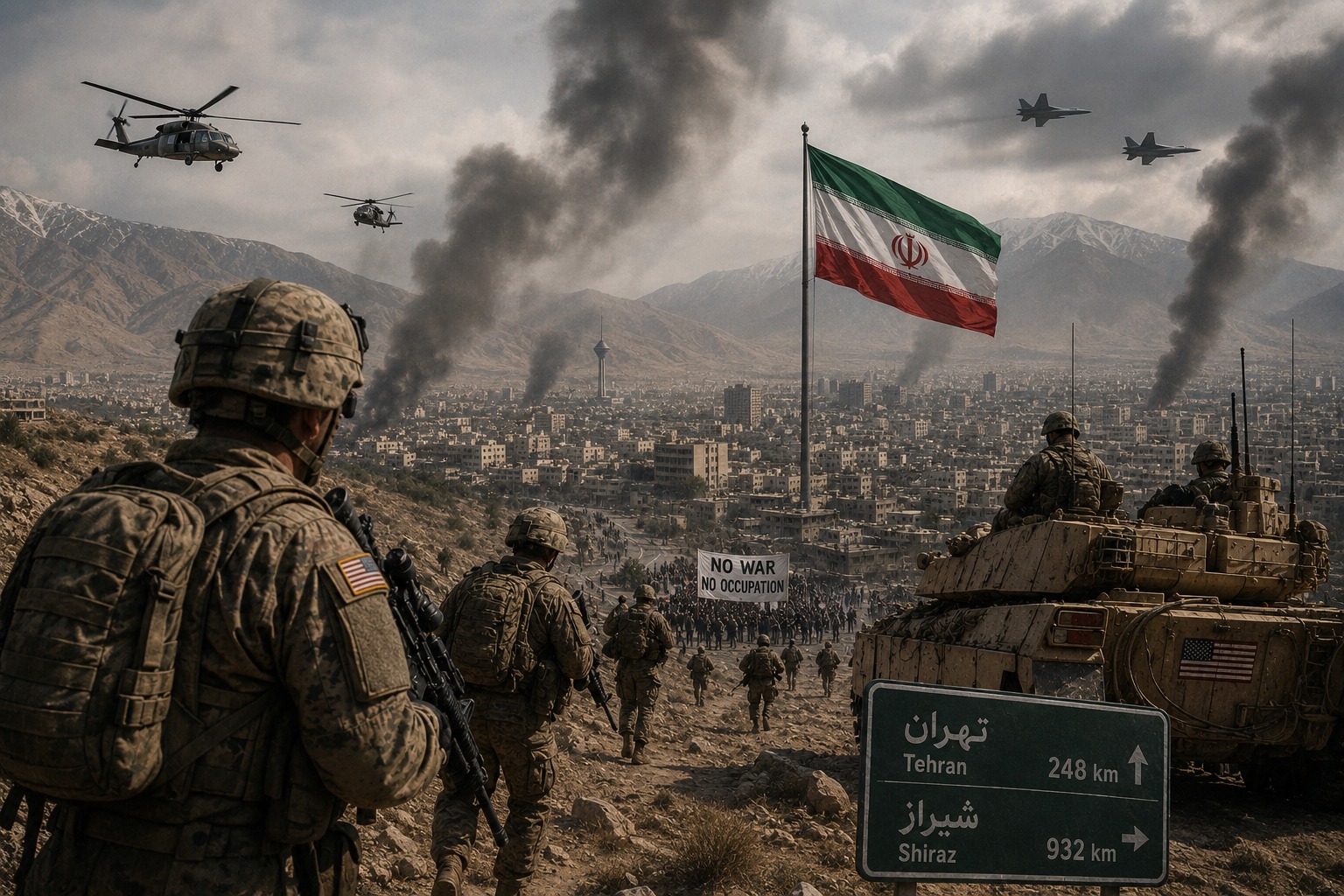
A hypothetical American ground invasion of Iran would almost certainly follow this older, more familiar pattern. It would not be the clean projection of power imagined in strategic circles, but a slow entanglement shaped by geography, politics, and unintended consequences. The issue is not whether the United States could defeat Iran in a conventional sense; it is whether such a victory would mean anything politically durable.
The argument here is straightforward: a ground invasion of Iran would not merely be risky; it would be a profound political error, one rooted in a recurring misreading of power itself.
I. Terrain, Scale, and the Quiet Advantage of Defense
Iran resists simplification. It is not only large, though its size alone complicates any invasion, it is internally varied in ways that frustrate external control. Mountain ranges cut across its landscape, urban centers sprawl unpredictably, and vast distances separate key regions of strategic importance.¹
Military planners understand, at least in theory, that terrain shapes outcomes. The Zagros Mountains in the west and the Alborz range in the north are not just physical features; they are defensive assets. Armies moving through them slow down, fragment, and lose coherence. Supply lines stretch thin. Control becomes temporary and uncertain.²
The deeper problem, however, is not the initial invasion but what follows. Occupation requires presence, and presence requires numbers. The counterinsurgency guidelines outlined in the U.S. Army’s own field manuals suggest that stabilizing a population demands a dense and sustained deployment of forces.³ Applied to Iran, such calculations quickly exceed anything the United States could plausibly maintain.
In this sense, geography does not simply complicate war, it transforms it. What begins as invasion becomes endurance. And endurance, over time, erodes even the most capable military force.
II. Memory Without Learning: The Echo of Iraq
The shadow of the Iraq War lingers over any discussion of Iran. It is not just a historical reference point; it is an unresolved lesson.
The invasion of Iraq was, at its outset, framed with a similar confidence. The regime would fall quickly, institutions would be rebuilt, and a new political order would emerge. What followed instead was fragmentation. State structures collapsed faster than they could be replaced, and the vacuum filled with forces that no external actor could fully control.⁴
One of the more striking consequences of that war was the quiet expansion of Iran’s influence. By removing a regional rival, the United States inadvertently reshaped the balance of power in Tehran’s favor.⁵ This may or may not have been an intended outcome, but was a somewhat a predictable one, if only the prediction had been taken seriously.
Analysts such as Kenneth M. Pollack have pointed out that the central failure in Iraq was not tactical but conceptual: the belief that political order could be engineered through military force.⁶
To imagine a different outcome in Iran is to assume that the same logic, applied to a larger and more complex society, would somehow yield a better result. That assumption does not hold. If anything, the scale of Iran suggests that the consequences would be more severe, not less.
III. War Without Borders: Networks, Retaliation, and Economic Shock
Iran does not prepare for war in the conventional sense alone. Its strategy has long relied on dispersion, on influence that extends beyond its borders through aligned groups, regional partnerships, and indirect capabilities.⁷
This matters because a ground invasion would not remain confined to Iran itself. It would activate a wider network of responses, stretching across the Middle East. Attacks on supply lines, disruptions in neighboring states, and pressure on allied governments would become part of the same conflict.
The International Institute for Strategic Studies has described Iran’s approach as one of layered deterrence, designed not to win outright but to raise the cost of confrontation to unacceptable levels.⁸ In practice, this means that even a militarily superior adversary cannot easily translate battlefield success into strategic control.
There is also the question of the global economy, which tends to react faster than political systems can respond. Iran’s proximity to the Strait of Hormuz places it in a position to disrupt a significant share of the world’s oil supply.⁹ The U.S. Energy Information Administration has repeatedly warned that instability in this corridor would have immediate and far-reaching consequences for energy markets.¹⁰
In such a scenario, the effects would not remain regional. Energy prices would rise, markets would fluctuate, and economic pressure would spread globally. War, in other words, would not be experienced only on the battlefield, it would be felt in economies far removed from it.
IV. Power, Legitimacy, and the Long Decline
Military action does not occur in a vacuum of legitimacy. It is interpreted, judged, and responded to by other states, institutions, and populations. The Iraq War demonstrated how quickly international support can erode when the legal and moral foundations of intervention are contested.¹¹
A similar invasion of Iran would likely face even greater skepticism. Without broad international backing, the United States would find itself increasingly isolated, its actions framed not as collective security but as unilateral assertion. Scholars such as Richard Falk have argued that such patterns weaken the broader structure of international norms, making future cooperation more difficult.¹²
There is also a domestic dimension that cannot be ignored. Prolonged wars test the limits of public tolerance. As costs rise and objectives blur, political support tends to decline.¹³ This is not a matter of ideology but of endurance; democratic societies struggle to sustain conflicts that lack clear endpoints.
Overlaying all of this is the longer arc of strategic overreach. The historian Paul Kennedy famously described how great powers decline not only because of external pressures but because of internal overextension.¹⁴ Commitments accumulate, resources thin out, and flexibility diminishes.
An invasion of Iran would add another heavy burden to an already extensive network of global obligations. It would not simply be one war among many; it would reshape priorities, divert resources, and constrain future choices.
Even if initial military objectives were achieved, the broader outcome would likely mirror what Andrew J. Bacevich has described in earlier conflicts: a pattern in which tactical success fails to produce strategic clarity.¹⁵ Battles may be won, but the larger political question, what the war was meant to accomplish, remains unanswered.
A ground invasion of Iran would not fail because of a lack of military capability. It would fail because it asks the wrong question of military power. It assumes that force can produce political order, that removal can substitute for reconstruction, and that complexity can be managed from the outside.
History suggests otherwise. Geography complicates control. Memory warns against repetition. Networks extend conflict beyond borders. Legitimacy, once lost, is difficult to recover. And power, when overextended, begins to erode from within.
The real danger, then, is not that such a war would be unwinnable in the narrow sense. It is that it would be winnable in ways that do not matter; producing outcomes that undermine the very objectives it was meant to achieve.
In that quiet gap between victory and consequence lies the true measure of the blunder.
Footnotes;
-
Central Intelligence Agency, The World Factbook: Iran (Washington, DC: CIA, 2024).
-
Stephen Biddle, Military Power: Explaining Victory and Defeat in Modern Battle (Princeton: Princeton University Press, 2004), 211–215.
-
U.S. Army and Marine Corps, FM 3-24 Counterinsurgency Field Manual (Chicago: University of Chicago Press, 2007), 1–27.
-
Charles Tripp, A History of Iraq (Cambridge: Cambridge University Press, 2007), 275–300.
-
Vali Nasr, The Shia Revival (New York: Norton, 2006), 185–210.
-
Kenneth M. Pollack, A Path Out of the Desert (New York: Random House, 2008), 134–150.
-
Anthony H. Cordesman, Iran’s Military Forces and Warfighting Capabilities (Washington, DC: CSIS, 2015).
-
International Institute for Strategic Studies, The Military Balance 2023 (London: IISS, 2023).
-
Strait of Hormuz, see also: U.S. Energy Information Administration, “World Oil Transit Chokepoints,” 2023.
-
U.S. Energy Information Administration, “World Oil Transit Chokepoints,” 2023.
-
Philippe Sands, Lawless World (London: Penguin, 2005).
-
Richard Falk, The Costs of War (New York: Routledge, 2013).
-
John Mueller, War, Presidents, and Public Opinion (Lanham: University Press of America, 2005).
-
Paul Kennedy, The Rise and Fall of the Great Powers (New York: Random House, 1987).
-
Andrew J. Bacevich, America’s War for the Greater Middle East (New York: Random House, 2016).
Comments are closed.