


Mudasir Wani
“An award should represent respect earned through contribution, sacrifice, originality, integrity, and excellence. It should never resemble a tourism package bundled with stage photography, sponsored publicity, and paid visibility.”
In recent years, Kashmir has witnessed the rapid growth of a troubling trend: the commercialization of awards, recognitions and honorary titles under the banner of social service, education, literature, media excellence, youth empowerment, entrepreneurship and public contribution. What once symbolized genuine merit and public respect is increasingly being reduced to a packaged business model where recognition can often be obtained through registration fees, sponsored participation or paid event packages rather than authentic achievement.
Across the Valley, particularly in Srinagar, a growing number of private organizations, NGOs, companies, and event management groups from different parts of the country have begun organizing grand “award ceremonies” in hotels, convention halls and tourist venues. These events are often presented as prestigious national honours, but in reality many have little or no institutional credibility beyond the organizations that created them themselves.
The pattern has become increasingly visible. Invitations are circulated widely on social media, WhatsApp groups, local newspapers and digital media platforms. Attractive posters carry phrases such as “National Excellence Award,” “International Icon Award,” “Best Social Worker Award,” “Pride of India Award,” “Education Leadership Award ” or “Kashmir Talent Honour.” Organizers often mention participation from politicians, retired officials, celebrities or public figures to create an impression of legitimacy and importance.
However, behind the glamorous stage decorations and media coverage lies a deeper and more uncomfortable reality, many of these recognitions are essentially commercial events operating through paid registrations and packaged participation.
One of the most striking features of these events is the way they are packaged almost like tourism products rather than genuine recognition platforms.
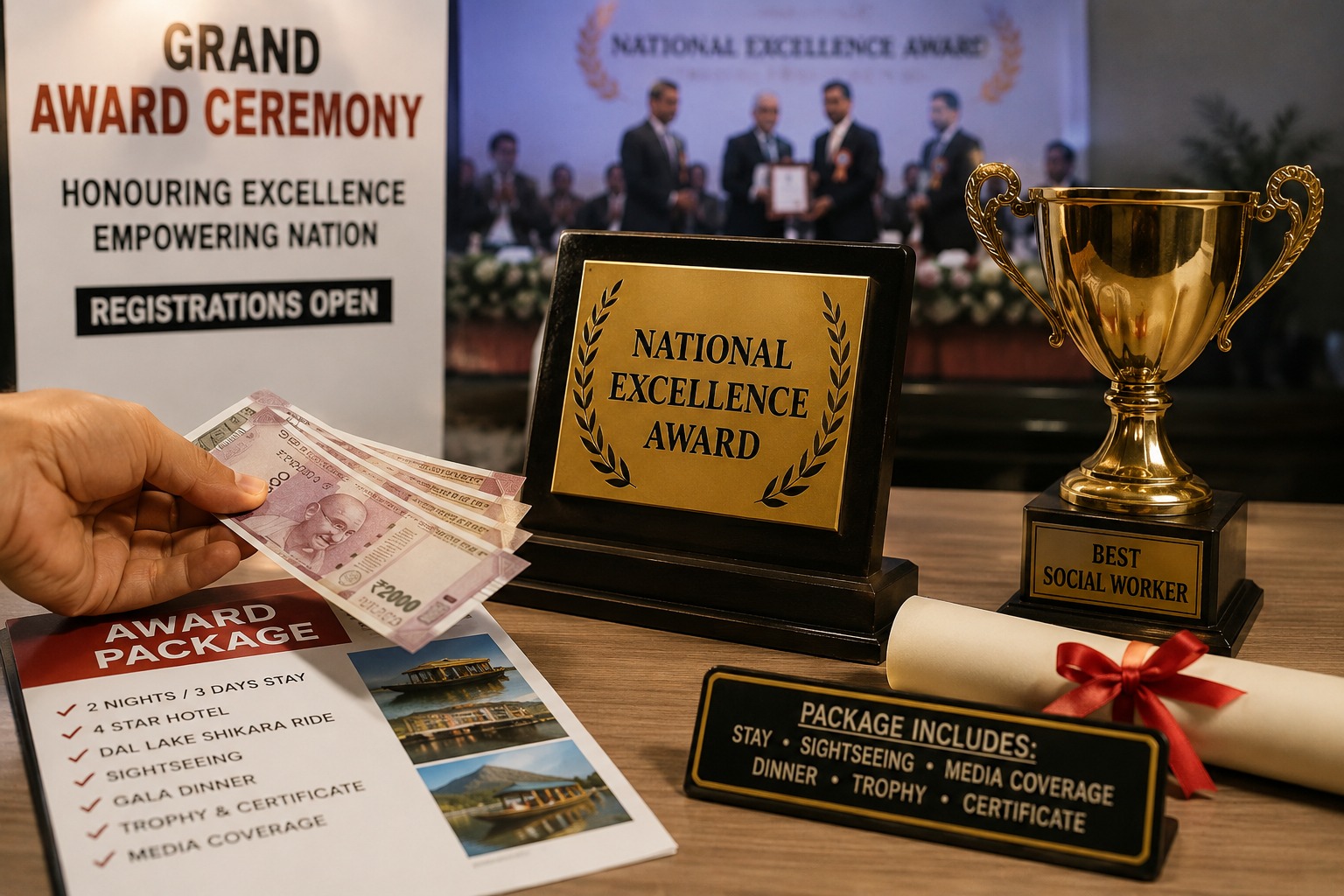
Participants are frequently offered different “packages” that may include:
Two-day or three-day stay in a four-star hotel, Dal Lake shikara rides, Srinagar sightseeing, Gala dinner and cultural programs, VIP seating arrangements, Paid media coverage, professional photography and video reels, Trophy and framed certificate,
“National-level” recognition titles, Postal delivery of awards for those unable to attend physically. In many cases, higher payment packages promise better visibility, front-row seating, larger trophies, more stage time or additional publicity. Some organizers even assure guaranteed media coverage and social media promotions as part of the package.
This transforms the entire concept of honour into a commercial transaction where recognition appears linked more to affordability than merit.
Confusion Between Government Honours and Private Awards. The most dangerous aspect of this trend is the confusion deliberately or unintentionally created between government-recognized honours and privately created awards. Many ordinary people fail to understand an important distinction,
A government-recognized award is established through official institutions, statutory bodies, universities, academies or government departments with defined eligibility, transparent selection procedures, scrutiny committees,
and institutional accountability.
By contrast, a private award created by an NGO, company or event group is fundamentally a private recognition. There is nothing inherently illegal about private awards but problems arise when they are projected as if they carry official national importance, institutional authority or government endorsement.
Several organizations prominently display phrases like “Registered under the Ministry of Corporate Affairs” “Government registered NGO” , “ISO Certified” , “Recognized organization” “National body”.These terms often create a false perception among the public that the awards themselves are government-approved honours. In reality registration of a company, NGO, trust or society merely means the entity legally exists. It does not automatically make its awards nationally recognized or institutionally prestigious.
A company registered under the Ministry of Corporate Affairs is still a private entity. An NGO registered under the Societies Registration Act remains a non-government organization not a government authority. Yet many participants and even media outlets fail to differentiate between legal registration and official credibility.
Media’s Failure to Maintain Distinction and role of sections of the media in amplifying this confusion deserves serious scrutiny. Many local media outlets publish event reports without critically examining the nature of the organizations involved or the legitimacy of the awards being distributed. Headlines frequently describe recipients as having received “national awards” or “international honours” without clarifying whether these recognitions were government-backed or privately organized.
In some cases, newspapers and digital platforms reproduce press releases almost word-for-word, functioning more like promotional partners than independent media institutions.
As a result, the general public begins to assume that award recipients have achieved officially recognized distinctions comparable to genuine state or national honours. This creates an artificial prestige ecosystem where visibility overshadows authenticity.
The situation becomes more problematic when photographs with politicians, bureaucrats or public personalities are strategically used to legitimize events. A politician attending a function as a guest does not convert a private award into a government-recognized honour. Yet images from such events are often circulated in ways that blur this distinction intentionally. The Psychology Behind Paid Recognition, The popularity of such award events also reflects a deeper social and psychological issue.
In the age of social media, public validation has become a powerful currency. Many individuals seek recognition, titles, trophies and certificates to enhance social status, professional image or online visibility. Organizers understand this desire and convert it into a business opportunity, for some participants, the attraction lies in being called an “award-winning social worker,” “international author,” “national educator,” or “youth icon.” The trophy itself becomes secondary, the real value lies in the perception created around it.
This has led to an inflation of titles and recognitions where almost every category imaginable now has an award attached to it. The result is dilution of genuine excellence.
When hundreds of awards are distributed in a single evening across loosely defined categories, the meaning of honour itself begins to weaken.
Genuine Contributors Become Invisible, Perhaps the greatest tragedy of this culture is its impact on genuinely deserving individuals.
Kashmir has countless teachers, writers, researchers, social workers, journalists, healthcare workers, artists and grassroots volunteers who dedicate decades of sincere service without publicity or financial influence. Many of them remain unnoticed because they neither seek commercial recognition nor participate in paid visibility networks.
Meanwhile, individuals with stronger financial resources, social connections or promotional skills often dominate public attention through privately organized recognitions. This creates an unfair imbalance where genuine contribution competes against manufactured visibility.
In the long run, such practices discourage merit and promote symbolic achievement over real service.
Not Every Private Award Is Fake But Transparency Matters. It is important to maintain balance in this discussion. Not every private award or NGO recognition is fraudulent or meaningless.
Many credible civil society organizations, literary forums, academic institutions and independent foundations genuinely honour deserving individuals through transparent processes. Private recognition itself is not wrong. In democratic societies, non-government institutions have every right to appreciate talent and contribution. The issue arises when awards are effectively sold through participation fees, selection criteria remain unclear
Recognition is linked to package payments, Organizers exaggerate institutional legitimacy
Media presents private honours as official recognition, Public perception is manipulated intentionally, Transparency is the key difference between credible appreciation and commercialized recognition.
If an organization openly states that it is a private platform recognizing participants through its own internal process, there is clarity. But when private ceremonies are projected as nationally authoritative honours, ethical concerns emerge. Kashmir urgently needs greater public awareness regarding institutional credibility and the difference between
Government awards, University honours, Statutory academy recognitions, Independent private recognitions, Commercial event-based awards, Citizens should ask important questions
Who established the award?
What is the selection process?
Is there an independent jury?
Are nominations transparent?
Is payment linked to recognition?
Does the award have institutional standing beyond the organizer itself? Without critical questioning, society risks normalizing a culture where recognition becomes purchasable and public trust becomes vulnerable to manipulation.
An award should represent respect earned through contribution, sacrifice, originality, integrity or excellence. It should not resemble a tourism package combined with stage photography and promotional publicity. The increasing commercialization of recognition in Kashmir reflects a wider societal crisis where appearance often overshadows substance and publicity competes with authenticity.
If this trend continues unchecked, genuine honours may gradually lose public value because people will struggle to distinguish between earned recognition and purchased visibility. The responsibility lies not only with organizers, but also with participants, media institutions, public figures and society itself. Recognition without credibility ultimately weakens the very culture of excellence it claims to promote.
A society that cannot distinguish between honour and marketing risks reducing merit into mere decoration.
Comments are closed.