
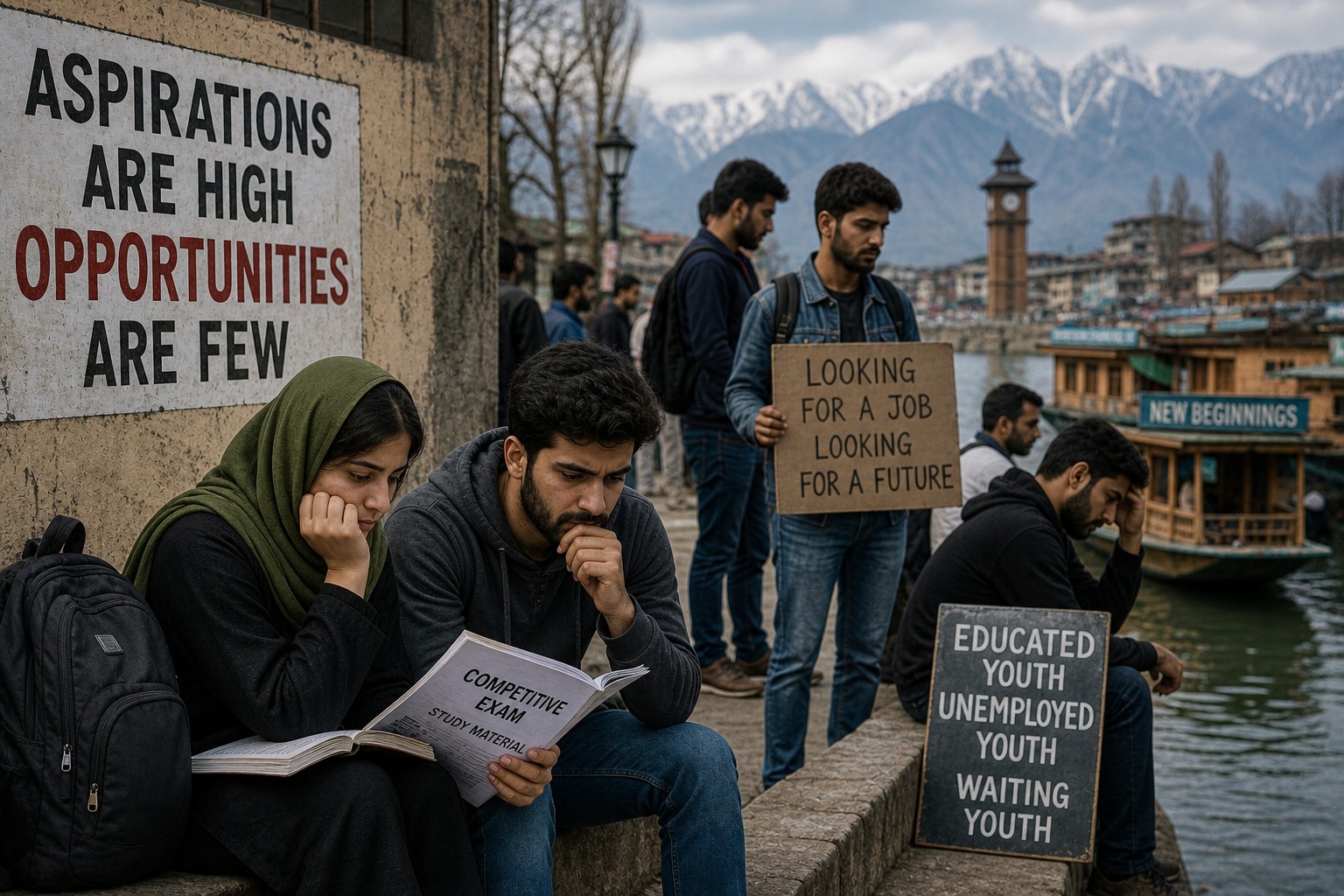

The Waiting Generation: Youth Aspirations and Frustration in Kashmir!

Mudasser Wani 


“Kashmir’s youth are not short of ambition—they are short of opportunity. This is not a failure of individuals, but of a system that has not kept pace with changing aspirations. A generation that has done everything right—studied, adapted, prepared—finds itself still waiting. That waiting is no longer patient; it is quietly turning into frustration.”

Kashmir has long been described through the language of conflict, geopolitics  and beauty. Yet beneath these dominant narratives lies another quieter reality, one that defines the present and shapes the future of the region. It is the story of its youth. Educated, ambitious, digitally aware and increasingly restless. This is a generation caught between aspiration and uncertainty, between dreams of progress and the constraints of lived reality. It is in many ways a waiting generation.

The youth of Kashmir today represent a demographic force with immense potential. With expanding access to education, rising literacy rates and exposure to global ideas through the internet. young Kashmiris are more informed and aspirational than ever before. However the opportunities available to them have not kept pace with these changing aspirations. The result is a widening gap between what young people expect from life and what they are actually able to achieve.

At the center of this crisis lies unemployment. Official data paints a stark picture. Jammu and Kashmir’s unemployment rate stands at around 6.7 percent, significantly higher than the national average of approximately 3.5 percent . The situation becomes even more alarming when focusing specifically on youth. In urban areas nearly 32 percent of young people aged 15–29 were unemployed in 2024, almost double the national average . Overall youth unemployment has been reported at around 17.4 percent reflecting a structural inability of the economy to absorb its growing workforce.

These numbers are not just statistics they represent lives in suspension. More than 3.5 lakh young people are officially registered as unemployed with the Kashmir division accounting for the majority. Behind each number is a story of delayed independence, postponed ambitions and increasing psychological strain. For many years of education culminates not in employment but in prolonged waiting, waiting for recruitment lists, waiting for exams, waiting for opportunities that often fail to materialize.

Education which should ideally serve as a pathway to empowerment has in many cases become part of the problem. Kashmir has witnessed a significant expansion in higher education institutions over the past two decades. However this expansion has not been matched by corresponding growth in the job market. The result is a phenomenon often described as “overqualification,” where highly educated individuals compete for jobs that do not require their level of training. Graduates, postgraduates and even PhD holders are frequently seen applying for clerical or low-skilled positions not out of choice but necessity.

This mismatch between education and employment has deep implications. It erodes the perceived value of education, fosters disillusionment and creates a sense of systemic failure. When effort and achievement do not translate into opportunity frustration becomes inevitable. Over time this frustration can manifest in various ways ranging from quiet withdrawal to active dissent.

Another critical dimension of youth frustration in Kashmir is the overwhelming dependence on government jobs. Historically  the public sector has been the primary source of stable employment in the region. However  the number of available positions is limited and recruitment processes are often slow and unpredictable. Delays in examinations, cancellations and allegations of irregularities further exacerbate the sense of uncertainty. As a result  a large segment of the youth population finds itself locked in a cycle of preparation and waiting  sometimes for years.

The private sector which could potentially absorb this workforce remains underdeveloped. Structural constraints, including limited industrialization, political instability and geographical challenges have hindered the growth of a robust private economy. While sectors like tourism and handicrafts offer employment opportunities they are often seasonal and vulnerable to external disruptions. This lack of economic diversification leaves young people with few viable alternatives.

Compounding these economic challenges are social and political factors that shape the lived experiences of Kashmiri youth. Security concerns, administrative procedures and regulatory frameworks often intersect with employment opportunities in complex ways. For instance  debates around verification processes for jobs have highlighted concerns about fairness and accessibility  with critics arguing that such mechanisms can create additional barriers for young job seekers.  These dynamics contribute to a broader sense of alienation and exclusion.

Despite these challenges, it would be inaccurate to portray Kashmiri youth solely as victims of circumstance. There is also a strong undercurrent of resilience, innovation  and adaptation. Increasingly young people are exploring alternative pathways, including entrepreneurship, freelancing and digital work. Government initiatives such as self-employment schemes have attempted to encourage this shift and while their impact is still evolving, they represent a recognition of the need for new economic models.

The rise of the digital economy has opened new possibilities. Freelancing platforms, online businesses and remote work opportunities have enabled some young Kashmiris to bypass traditional employment structures. From software development to content creation, there is a growing cohort of youth leveraging technology to create livelihoods. However these opportunities are not uniformly accessible. Issues such as internet disruptions, lack of infrastructure and limited digital literacy in certain areas continue to pose challenges.

Gender adds another layer of complexity to the youth question in Kashmir. Female participation in the workforce remains relatively low and unemployment rates among young women are significantly higher than those of their male counterparts. Social norms, safety concerns and limited access to opportunities restrict the economic engagement of women, thereby excluding a substantial portion of the youth population from contributing fully to the region’s development.

Psychologically, the impact of prolonged uncertainty cannot be overstated. The experience of waiting without clear timelines or outcomes creates a sense of stagnation. For many young people, life milestones such as financial independence, marriage and social mobility are delayed. This delay is not merely economic, it is existential. It raises fundamental questions about identity, purpose and belonging.

At the same time the aspirations of Kashmiri youth are not diminishing. If anything they are becoming more ambitious. Exposure to global standards through education and media has broadened horizons. Young people aspire not just to secure jobs but to achieve dignity, recognition and a sense of agency. They seek opportunities that align with their skills and ambitions rather than merely providing subsistence.

This tension between aspiration and reality defines the current moment. It is a tension that has both risks and possibilities. On one hand unlimited expectations can lead to frustration, disengagement and social unrest. On the other hand if harnessed effectively  the energy and potential of youth can drive innovation, economic growth and social transformation.

Addressing the challenges faced by Kashmiri youth requires a multidimensional approach. Economic diversification is essential. Investment in sectors such as technology, renewable energy and sustainable tourism can create new employment opportunities. Skill development programs must be aligned with market needs, ensuring that education translates into employability. Strengthening the private sector and encouraging entrepreneurship can reduce dependence on government jobs.

Equally important is the need for transparent and efficient governance. Recruitment processes must be streamlined and credible  restoring trust among young job seekers. Policies should be designed to remove barriers rather than create them, ensuring that opportunities are accessible to all segments of society.

Social interventions are also crucial. Mental health support, career counseling  and community engagement initiatives can help address the psychological dimensions of youth frustration. Empowering women and ensuring their participation in the workforce can unlock untapped potential and contribute to inclusive growth.

Ultimately the story of Kashmir’s youth is not just one of frustration it is also one of possibilities. It is a story of a generation that refuses to give up on its aspirations, even in the face of uncertainty. The challenge lies in transforming this waiting into movement, the potential into progress.

The future of Kashmir will be shaped not only by political decisions or economic policies but by the trajectories of its young people. If their aspirations are met with opportunity, the region can move toward stability and prosperity. If not, the gap between hope and reality will continue to widen.

In this sense, the waiting generation is not merely waiting, it is watching, questioning and preparing. The direction it takes will determine the course of Kashmir’s future.

A society is ultimately measured by how it responds to the expectations of its youth. If their energies are recognized and their ambitions given space to unfold, the same generation now described as “waiting” can become one that builds, leads and transforms. If ignored, the cost will not only be economic but deeply social, eroding trust in institutions and in the very idea of progress.

The choice therefore, is not abstract. It is immediate and consequential. Kashmir stands at a point where its youth can either remain suspended in uncertainty or step into roles that shape a more stable and self-assured future. The difference will lie in whether structures evolve to meet aspiration with opportunity.

Until then, the waiting continues but it is no longer silent. It carries questions, expectations and an unspoken demand for change. And in that demand lies the possibility that this waiting generation may yet redefine what it means to wait not as a condition of delay but as the threshold of transformation.

The Author is a colominist and writes on socio- political issues and can be reached at wanimudasirnazir@gmail.com

Comments are closed.