
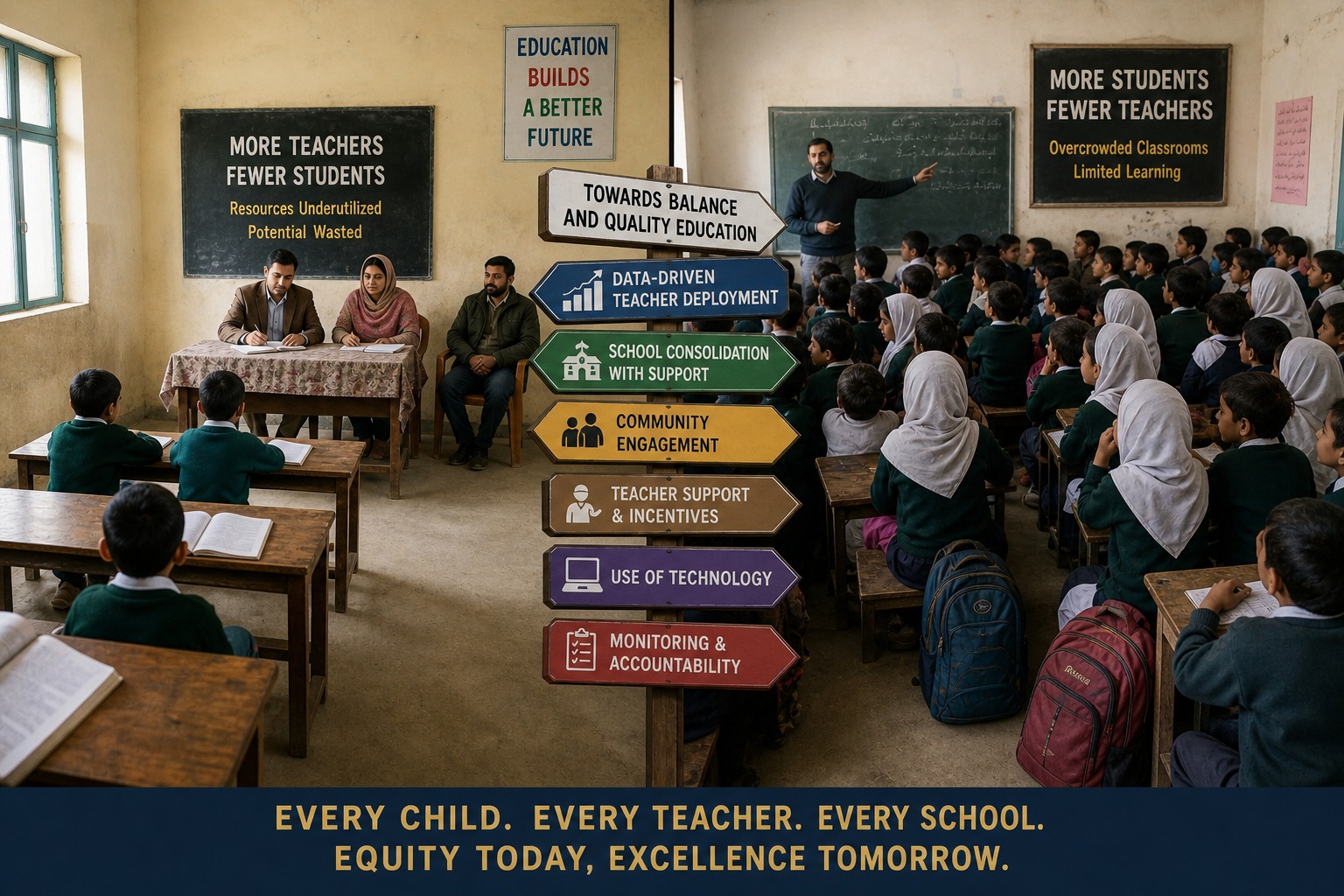


Addressing the Imbalance of Teachers and Students

Malik Mushtaq


“This issue is not about infrastructure alone—it is about fairness in opportunity. Every child deserves a classroom that functions, a teacher who can engage, and an environment that supports learning. Anything less is a compromise we cannot justify.”

In the quiet corners of our education system, far from the noise of policy debates and urban success stories, a silent crisis continues to unfold. It is not always about the absence of school buildings or even a shortage of teachers. Instead, it is a paradox that reflects deeper systemic gaps—some schools have more teachers than students, while others struggle with overcrowded classrooms and too few educators. This imbalance, especially visible in rural and marginalized areas, is not just an administrative concern; it is a moral challenge. If education is the backbone of a just and progressive society, then such disparity represents a fracture that cannot be ignored.

This issue is not merely statistical—it is profoundly human. It affects children whose futures depend on the quality of education they receive, teachers whose potential often remains underutilized or overstretched, and communities that continue to grapple with unequal opportunities. Addressing this imbalance demands sincerity in intent, courage in decision-making, and compassion in execution.

At first glance, having more teachers than students may appear to be an advantage, suggesting the possibility of individualized attention and improved learning outcomes. However, the reality is far more complex. In many remote villages and economically weaker regions, declining enrollment—driven by migration, poverty, or lack of awareness—has left schools functioning with only a handful of students. Teacher postings, often based on sanctioned positions rather than real-time needs, fail to adapt to these changing demographics. As a result, resources remain underutilized.

At the same time, there are schools—particularly in semi-urban or accessible rural areas—where student numbers far exceed available teaching staff. In such environments, overcrowded classrooms become the norm, limiting individual attention, reducing teaching effectiveness, and increasing stress for both students and teachers. This uneven distribution reveals systemic shortcomings in planning, monitoring, and responsiveness.

Behind these numbers are real lives and lived experiences. A child walking long distances to attend a school with very few peers may miss out on the collaborative and competitive aspects of learning. A teacher stationed in an isolated area may struggle to maintain motivation despite sincere efforts. Parents, disillusioned by the system’s inefficiencies, may withdraw their children from formal education altogether. In disadvantaged regions, these issues are often compounded by poverty, limited infrastructure, low parental literacy, and cultural barriers that further weaken educational participation.

This imbalance demands urgent attention because education is not a privilege—it is a fundamental right. When systems fail to deliver quality education to the most vulnerable sections of society, it becomes a question of social justice. Beyond individual consequences, the broader impact is equally concerning. In a world increasingly driven by knowledge and innovation, neglecting foundational education undermines a nation’s long-term development. Today’s students are tomorrow’s leaders, professionals, and citizens; their learning environment must be nurtured with foresight and care.

The roots of this imbalance are multifaceted. Rigid teacher posting policies often ignore ground realities, while migration patterns continue to shift student populations unpredictably. The absence of reliable, real-time data further complicates planning and resource allocation. Inadequate infrastructure discourages enrollment, particularly in marginalized communities, while socio-cultural factors may limit the perceived value of education. Even where policies exist, gaps in implementation and monitoring prevent meaningful outcomes.

Addressing such a deeply embedded issue requires more than routine adjustments; it calls for bold and compassionate reform. A data-driven approach to teacher deployment is essential, ensuring that staffing aligns with actual student strength rather than outdated norms. This process must be transparent and sensitive, recognizing teachers as professionals whose dignity and stability matter.

In areas with extremely low enrollment, school consolidation may offer a practical solution, but it must be approached with caution. Students should not be burdened with excessive travel distances; supportive measures such as transportation facilities or residential schooling options must accompany such decisions. At the same time, strengthening community engagement can play a transformative role. When parents, local leaders, and community members actively participate in the education process, enrollment and retention tend to improve.

Teachers serving in remote and challenging areas deserve recognition and support. Incentives—both financial and professional—can help boost morale and attract talent to underserved regions. Technology, too, offers opportunities to bridge gaps. Digital tools, smart classrooms, and hybrid learning models can enhance educational delivery, particularly where human resources are limited.

However, no reform can succeed without effective monitoring and accountability. Regular assessments, feedback mechanisms, and clear performance indicators are necessary to ensure that policies translate into real impact on the ground. At its core, the goal is not merely to balance numbers but to ensure quality education for every child.

Ultimately, this issue is about fairness and responsibility. Every child, regardless of their background or location, deserves access to a meaningful and enriching learning environment. Every teacher deserves the opportunity to contribute effectively. Every school should function as a vibrant space of learning, growth, and possibility.

We must ask ourselves difficult but necessary questions: Are we doing justice to our children? Are our resources being used wisely? Are our decisions guided by empathy as much as efficiency?

Meaningful change requires collective effort. Governments, educators, policymakers, parents, and civil society must move beyond assigning blame and instead work collaboratively toward solutions. The vision should be clear—a system where no school is underutilized or overcrowded, no teacher feels redundant or overburdened, and no child is denied quality education due to systemic imbalance.

The issue of teacher-student disparity is not just an administrative concern; it is a test of our values as a society. It challenges our commitment to equity, our ability to adapt, and our willingness to act with humanity. Acknowledging the problem is only the first step. What matters is how we respond—with sincerity, courage, and compassion.

Let us not allow classrooms to fall silent where there should be curiosity, dialogue, and laughter. Let us ensure that every teacher stands where they are needed most, and every child learns in an environment that nurtures their potential. The future of our society depends on the choices we make today. Those choices must be guided by wisdom, justice, and a deep sense of humanity.

Comments are closed.