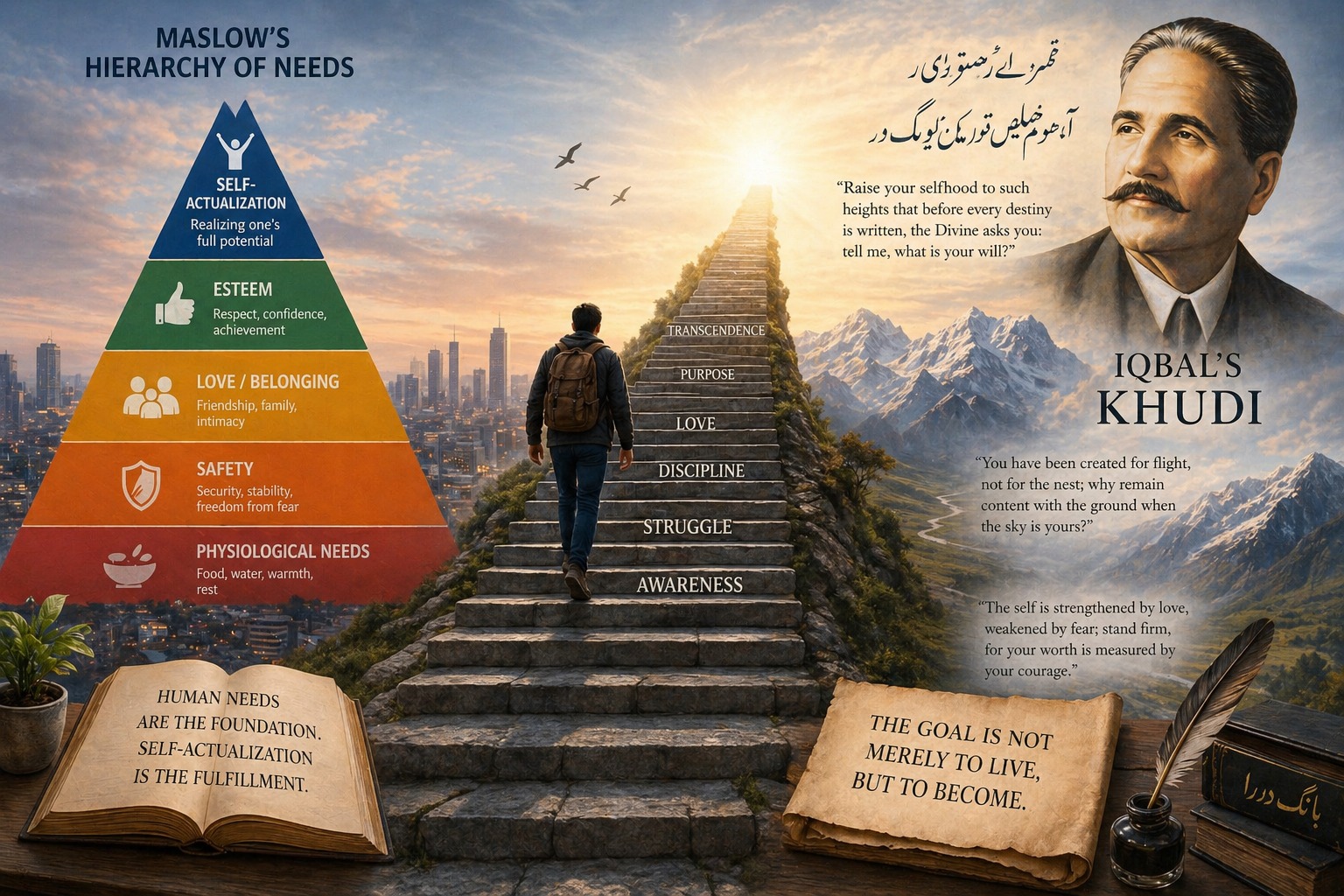

Maslow’s Hierarchy of Needs and Iqbal’s Khudi in Dialogue with the Modern Mind

Firdous Ahmad Malik


“Self-actualization is not the end of the journey—it is the beginning of responsibility. What you become matters more than what you attain.” 

The modern individual stands at a curious crossroads—surrounded by material abundance yet often grappling with inner emptiness and the search for meaning. In this landscape of psychological inquiry and spiritual yearning, two influential frameworks offer guidance: the Hierarchy of Needs proposed by and the concept of Khudi articulated by . Though separated by geography, discipline, and method, both thinkers engage deeply with the question of what it means to become fully human. Bringing their ideas into dialogue allows us to better understand the layered journey of the self in the modern world—one that moves from survival toward transcendence.

Maslow’s Hierarchy of Needs presents human motivation as a progression. At its base lie physiological needs—food, water, rest—followed by safety, belonging, esteem, and ultimately self-actualization. This model, though often visualized as a pyramid, is better understood as a fluid system in which individuals navigate multiple needs simultaneously. Maslow believed that once basic deficiencies are addressed, humans are naturally drawn toward growth, creativity, and fulfillment. The highest stage, self-actualization, is not merely success in worldly terms but the realization of one’s inner capacities. It is the point where a person becomes authentically themselves, guided not by fear or lack but by purpose and vision.

Iqbal’s philosophy of Khudi, however, begins where Maslow’s model seems to culminate. For Iqbal, the self is not a passive entity waiting to be fulfilled but an active force that must be strengthened through struggle, love, and discipline. The journey of Khudi is not about satisfying needs but about awakening potential. Iqbal’s poetry repeatedly calls upon the individual to rise above complacency and discover the divine spark within. As he suggests in one of his translated verses: “Raise your selfhood to such heights that before every destiny is written, The Divine asks you: tell me, what is your will?”

This powerful idea reflects Iqbal’s belief that human beings are not merely shaped by circumstances but are capable of shaping their own destiny through a strong and awakened self. In contrast to Maslow’s gradual ascent, Iqbal envisions a more dynamic and even rebellious climb—one that resists passivity and demands courage.

The modern mind often oscillates between these two paradigms. On one hand, it seeks stability, comfort, and recognition—the very needs Maslow outlines. On the other, it longs for meaning, purpose, and transcendence—the realm of Iqbal’s Khudi. This tension is especially visible in a world driven by consumerism, where the satisfaction of lower needs often becomes an endless cycle. Iqbal warns against this stagnation in another translated line: “You have been created for flight, not for the nest; Why remain content with the ground when the sky is yours?”

Here, the metaphor of flight captures the essence of Khudi—a refusal to remain confined by material limitations. While Maslow acknowledges the importance of fulfilling basic needs, Iqbal insists that true human dignity lies in surpassing them.

Yet, the two perspectives are not mutually exclusive. Maslow’s framework can be seen as laying the groundwork upon which Iqbal’s vision builds. Without food, safety, and belonging, the pursuit of higher ideals becomes difficult. However, once these needs are met, the question arises: what next? It is here that Iqbal’s philosophy becomes essential. He does not allow the individual to rest at the level of comfort or even self-esteem. Instead, he pushes toward a state of continuous becoming—a self that is always evolving, always striving.

Creativity forms a bridge between these two thinkers. Maslow identified creativity as a key characteristic of self-actualized individuals, describing it as spontaneous, authentic, and deeply human. Iqbal, too, celebrates creativity, but he frames it as an act of spiritual significance. For him, to create is to participate in the ongoing act of creation itself. In another translated verse, he writes: “Shape your world with the strength of your own vision; For you are not a mere spectator in the universe.”

This call to creative agency resonates strongly in the modern era, where innovation is often equated with progress. However, Iqbal’s emphasis on moral responsibility ensures that creativity is not reduced to mere productivity or profit. It must serve a higher purpose, aligned with truth and justice.

The concept of identity further highlights the contrast between Maslow and Iqbal. In Maslow’s theory, identity develops as individuals satisfy their needs and build self-esteem. It is influenced by social interactions and personal achievements. Iqbal, however, views identity as something to be forged through inner struggle. The self is not discovered but created. This process requires confrontation with one’s limitations and a commitment to growth. As he expresses in a translated line: “The self is strengthened by love, weakened by fear;
Stand firm, for your worth is measured by your courage.”

In a time when identities are often fluid and externally defined, Iqbal’s insistence on inner strength offers a powerful counterbalance. It encourages individuals to anchor themselves in values rather than appearances.

Another important dimension is the role of  community. Maslow’s model, though acknowledging social needs, remains largely individual-centered. Iqbal’s Khudi, on the other hand, is deeply interconnected with the collective. A strong self contributes to a strong society. The growth of the individual is inseparable from the well-being of the community. This perspective is particularly relevant in addressing contemporary challenges such as inequality and social fragmentation. It reminds us that self-realization is not an isolated achievement but a shared responsibility.

Critically, Maslow’s theory has been challenged for its cultural limitations, as it reflects Western ideals of independence and personal success. Iqbal’s philosophy, rooted in a more holistic worldview, integrates material, social, and spiritual dimensions. However, Maslow’s strength lies in its clarity and practical applicability. It provides a structured way to understand human behavior and to design systems—whether in education, healthcare, or workplaces—that support well-being. When combined with Iqbal’s deeper vision, it creates a balanced approach that addresses both the outer and inner needs of the human being.

The notion of success also undergoes transformation in this dialogue. In contemporary society, success is often defined by wealth, status, and recognition. These correspond to the middle layers of Maslow’s hierarchy. Yet both Maslow and Iqbal ultimately point beyond these markers. For Maslow, success is self-actualization—the fulfillment of one’s potential. For Iqbal, it is the realization of Khudi—a state of inner sovereignty and alignment with the divine. In one of his translated reflections, Iqbal writes: “Do not measure your worth by what you possess;
Measure it by what you become.”

This redefinition challenges the modern individual to reconsider priorities and to seek fulfillment not in accumulation but in transformation.

In the field of education, the integration of these ideas can be particularly impactful. An educational system that ensures students’ basic needs and fosters belonging, as Maslow suggests, while also encouraging self-reflection, ethical awareness, and spiritual growth, as Iqbal advocates, can nurture well-rounded individuals. Such an approach moves beyond rote learning and competition, focusing instead on character formation and creative thinking. It prepares students not just for careers but for meaningful lives.

Ultimately, the journey of the self is neither a simple ladder nor a solitary quest. It is a complex interplay of needs, aspirations, struggles, and realizations. Maslow provides the structure—the stages through which human motivation unfolds. Iqbal provides the spirit—the fire that drives the ascent. Together, they offer a comprehensive vision of human development that speaks powerfully to the modern condition.

In a world that often pulls us downward into routine and distraction, this dialogue calls us upward. It reminds us that while we must attend to our needs, we must not be defined by them. We are capable of more—of growth, of creativity, of transformation. As Iqbal’s voice echoes through his translated lines, it urges us to rise: “Become the architect of your own destiny;
For within you lies a universe waiting to unfold.”

In listening to both Maslow and Iqbal, the modern mind finds not a contradiction but a complement—a map and a compass for the journey of becoming.

Author is Art and Craft Teacher at Lyceum International School, Pulwama. He can be reached at Artistmalik123@gmail.com

Comments are closed.