
The Paradox of Modern Connectivity: An Illusion of Closeness or Growing Distance in Relationships?


Usuf Mir
(This story highlights a harsh reality of our times—the misuse of social media. While it appears to bring people closer, it is quietly creating distance in relationships, fostering loneliness, and exposing individuals to unseen risks. Through a simple yet powerful conversation, it attempts to draw attention to a truth we experience every day, yet often fail to understand.)
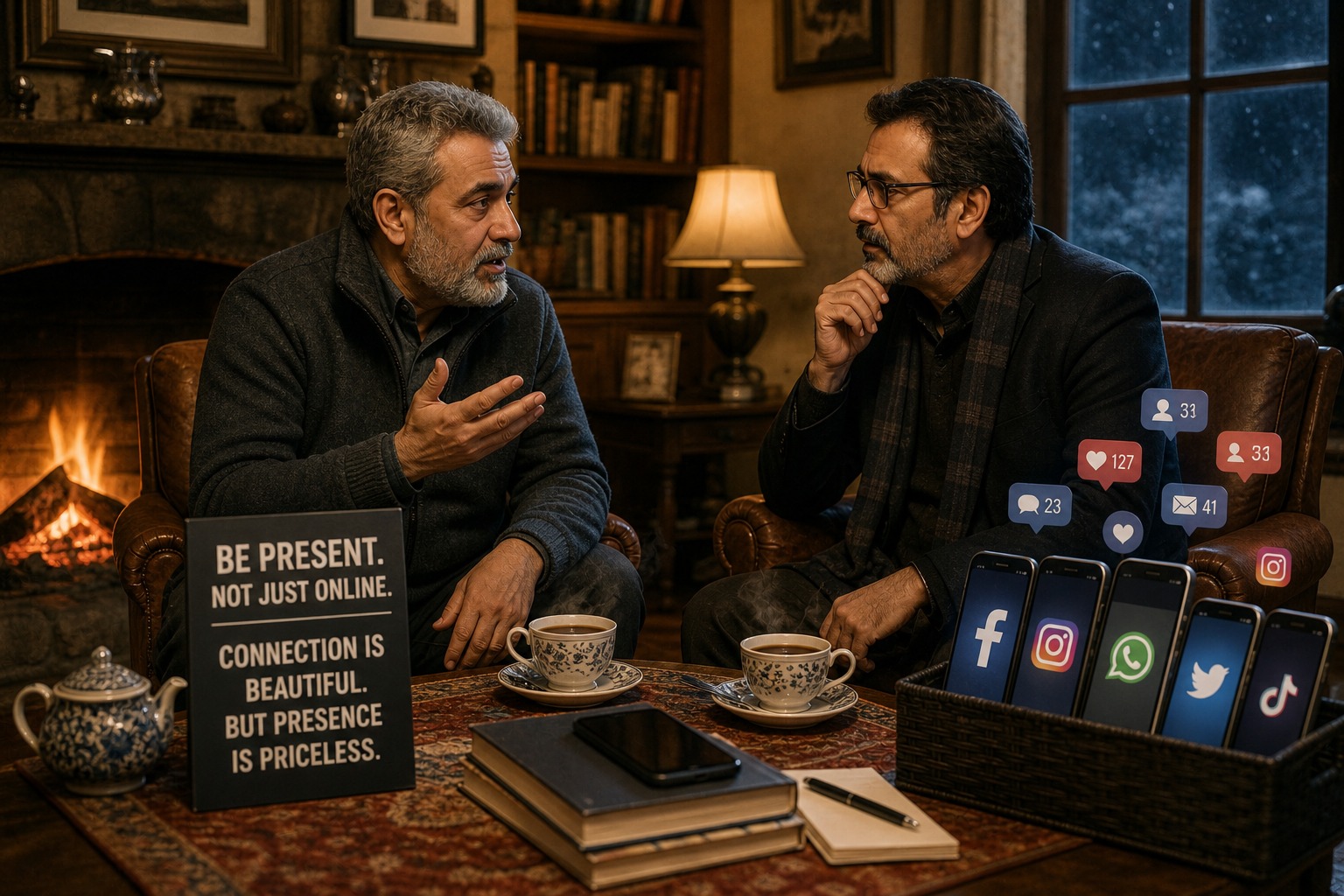
It was nine o’clock at night. In the biting cold of winter, the fireplace in Sahil’s room was spreading a gentle warmth. The room had been specially arranged, as an old friend of his had returned from abroad. Both had crossed the age of fifty—experience, composure, and a deep understanding of life reflected in their presence.
With sips of tea and a calm silence around them, the conversation began—memories of the past, shared laughter, and stories from distant lands. But as the night deepened, the discussion gradually shifted… and settled on social media.
Smiling, Sahil said, “You know, many years ago I wrote a story… titled ‘Offline’.” His friend asked with interest, “What was it about?”
Sahil began: “It was the story of a boy whose father had passed away. At home, there were only the two of them—he and his mother. She was a simple, uneducated woman whose entire world revolved around her son. Every evening, she would quietly enter his room and say, ‘Son, come sit with me for a while… let’s talk.’
But the boy remained absorbed in his mobile phone. Sometimes he would get irritated, sometimes he would ignore her. For him, those were just a few moments… but for his mother, they were her entire world.
Time passed. She kept coming… but less often. Her voice grew softer, her hopes began to fade.
One day, she entered his room and saw him sitting alone, talking and smiling as if he were in a gathering. Surprised, she asked, ‘Who are you talking to?’
“Social media has given us the illusion of constant connection, but in doing so, it has quietly eroded the depth of real relationships. We are no longer alone in the traditional sense—we are surrounded, yet emotionally distant.”
Casually, he replied, ‘Friends… online.’
That very day, the boy decided to make his mother a part of this world. He brought her an Android phone, taught her how to use it, and created a Facebook account for her—so that she could stay engaged throughout the day and not feel lonely.
Gradually, she learned… and then she stopped coming to his room in the evenings.
The house grew silent.
Now both were busy—both were connected… yet both were alone.
One day, the boy began to feel that the person he talked to, the one who kept postponing meeting him… seemed strangely familiar.
And then suddenly, the truth was revealed— it was no one else… but his own mother.”
Silence filled the room. Softly, Sahil said, “In that moment, he realized what he had lost. He put his phone aside and went to sit with his mother… in real life, not online. He… went offline.”
His friend took a deep breath. “This is not just a story… it is becoming our reality.” There was a brief silence. Then Sahil asked, “How can you say all this with such certainty?” His friend replied seriously, “Because I have studied it.”
He continued: “I stayed away from social media for some time, and then reactivated myself to understand it better. I started posting and sharing pictures. On the very first day, I received around two thousand friend requests, and within a week, the number reached five thousand. I accepted all of them without verification.
Then the messages began. Some were normal—but many were not.
Around 215 people insisted on meeting, while nearly 354 asked for my home address or location.
Some gained trust first, then tried to deceive or blackmail. A few foreign profiles asked for financial help. A local woman claimed her father had passed away, someone mentioned a child’s accident, others requested mobile recharges.
And then there were those who crossed all limits— inappropriate proposals, paid video calls, and unethical behavior.
Most profiles were fake, intentions were doubtful… and truth was rare.
They were not looking for friendship— they were looking for opportunity.”
The room grew heavy. He added, “There is another aspect as well—unemployment. When young people have no meaningful engagement, they get entangled in such things. Fake news spreads, misleading content circulates, and people unknowingly become part of it.”
Sahil nodded in agreement. “What is the solution?” he asked.
His friend said, “Young people must be guided towards positive and purposeful activities—learning skills, becoming self-reliant, and developing a clear direction and purpose in life. And when it comes to children, we must be even more careful. At least children under twelve should be kept away from social media and smartphones.”
Deep in thought, Sahil said, “If we fail to guide them today, we will hand them over tomorrow to a world we ourselves do not fully understand.”
His friend nodded. Sahil quietly placed his phone aside. “We need to be cautious,” he said.
“When used wisely, social media connects people—but its misuse has already affected many homes.”
The night had grown deeper. As they parted, Sahil smiled and said, “Tomorrow evening… no phones.” His friend replied, “Just conversation.”
And in that simple decision, they chose something rare— to truly be present with each other.
Comments are closed.