


Shoiab Mohmmad Bhat
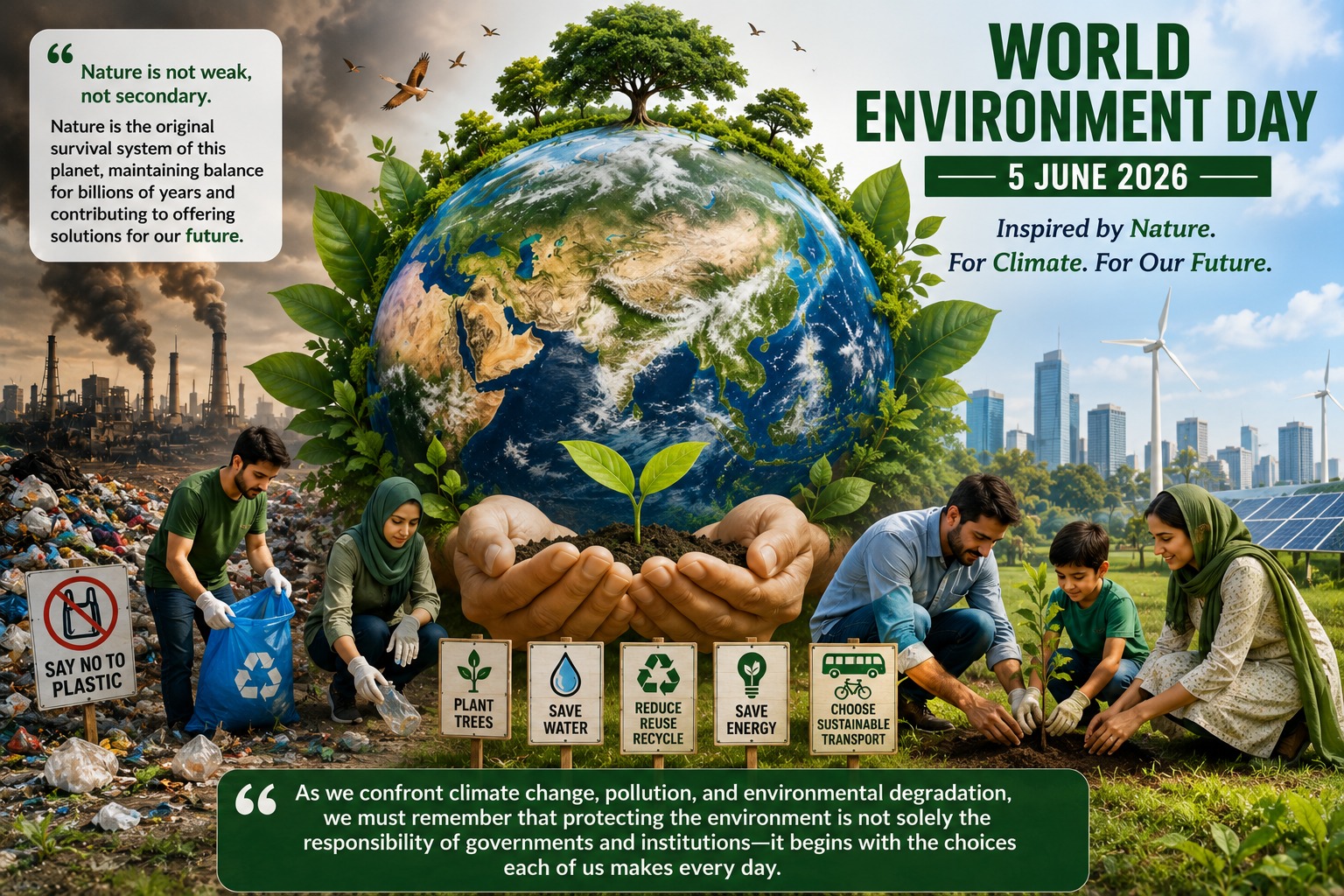
Nature is now weak, not secondary. Nature is the original survival system of this planet, maintaining balance for billions of years and contributing to offering solutions for our future
Every year on June 5, the world observes World Environment Day, a global occasion dedicated to raising awareness about environmental issues and encouraging action to protect our planet. As we talk about climate change, pollution, protecting nature, reducing environmental degradation, and building a sustainable future, it is important to understand that environmental protection is not only the responsibility of governments and organizations. It begins with each one of us.
We are now experiencing visible changes in weather patterns in the world. This involves an increase in temperatures around the globe, the occurrence of heat waves, melting glaciers, and many other forms of extreme weather conditions. The following are some obvious indications of climate change that should not be ignored anymore.
Pollution and the Growing Environmental Crisis
Pollution is also increasing and creating various problems for human beings as well as animals living on land and in water. One of the major concerns is the growing use of non-biodegradable materials such as plastic, polythene, and certain metals. These materials do not easily mix with or decompose in the soil. As a result, they remain in the environment for years, causing land pollution and affecting countless species that depend on healthy ecosystems for survival.
Air pollution and water pollution are both of equal importance. Fossil fuel consumption by means of transport, factories, and electricity generation results in the emission of poisonous gases like carbon dioxide, carbon monoxide, sulfur dioxide, and nitrogen oxides in the atmosphere. This causes global warming, respiratory disorders, and ecological imbalance through acid rain. Acid rain affects vegetation, forests, rivers, and the earth’s soil.
Water: The Foundation of Life
Water, one of the most precious gifts of God, is also under threat due to human activities. Although nearly 71 per cent of the Earth’s surface is covered with water, only about 2.5 per cent is freshwater. Of this, less than 1 per cent is readily available for human consumption and daily use. Despite its limited availability, water continues to be polluted through the dumping of waste, untreated sewage, industrial discharge, and other harmful practices. Protecting water resources is therefore essential for both present and future generations.
A Healthy Environment Begins Around Us
Together, these components form what is known as the environment. If these things are maintained in a state of cleanliness, balance, and availability for usage, then we can say that the environment is healthy. Regrettably, the majority of our surrounding areas are littered with garbage and plastics. Apart from being unsightly, such an environment leads to health hazards as well. The garbage pits tend to invite stray animals, including dogs.
Small Actions Can Create Big Change
Even though these problems may appear to be too much for us to handle, we can start making changes in our lives and in our community, and they can come from very small steps that we take. For starters, we need to stop littering our environment with garbage and dispose of waste in an appropriate manner. The biodegradable waste needs to be disposed of in compost pits, where it can be made into fertilizer.
Similarly, pollution can be reduced by making responsible transportation choices. Whichever is feasible, individuals are supposed to walk around when going places or using public transport and sharing rides with their peers and associates. This will help minimize fuel usage and emissions. Individuals are advised to conserve water, turn off the tap after using it, and ensure that there are no wastes dumped into waterways and other water bodies.
Many other simple steps can help protect the environment. Planting trees, conserving water, reducing waste, recycling materials, saving electricity, avoiding single-use plastics, and keeping public spaces clean can make a significant difference. Communities can organize cleanliness drives, schools can strengthen environmental education, and citizens can participate in awareness campaigns. Every small effort contributes to a larger positive impact.
Nature- Based Solutions: Learning from Nature
Nature is not weak, Nature is not secondary, Nature is the original survival system of this planet. For billions of years, it has maintained balance without human intervention. Forests do not grow- they store carbon at scale. Oceans do not just exist- they regulate planetary temperature. Biodiversity is not decoration- it is stability itself. But when the systems collapse, everything built on top of them becomes unstable. That is why the world is now turning towards nature-based solutions. Reforestation, Ecosystem restoration, Sustainable agriculture, and biodiversity protection. These are not environmental policies. They are survival strategies written by nature itself.
The Power of Collective Action
As the host of World Environment Day 2026, Azerbaijan represents a wider global transition. A shift towards responsibility, towards accountability, towards action. Its commitment reflects this change: reducing emissions significantly by 2035. Expanding Renewable energy capacity by 2030. Building zero-emission zones, transforming urban sustainability in Baku. But this is not about one country: this is about global realization, because climate does not recognize borders, Carbon does not respect politics, and temperature does not wait for agreements. Which means the response will be collective, or it will fail individually. Even in a global crisis of this scale, one truth remains powerful: systems change when behaviour changes, and millions of individuals act together.
Every time someone reduces waste, saves energy, chooses sustainability or raises awareness, they are contributing to a global shift that no single institution can create alone. On its own, one action feels small, but multiplied across billions of people, it becomes the foundation of global transformation. At this point, the question is no longer whether change happens: change is already happening. The real question is something far more important. How past it will happen, and whether we will guide it with intelligence, coordination and urgency, or be forced into crisis, damage or loss. Because the planet will respond either way, the only thing remain the unknown is the cost of delay.
Building a Sustainable Future for Generations to Come
World Environment Day 2026 is not a celebration; it is a turning point in human history. A moment where awareness is no longer enough, where information must become action, where warnings must become decisions. The Earth is not asking for permission anymore. It is a demandable balance, and yet, it is still offering solutions. That is what makes this moment critical. We are not too late to act, but we are no longer early.
The theme is inspired by Nature for Climate, for our Future is not symbolic language. It is a direction for survival. If we align with nature, learn from intelligence, and act with urgency, a stable future is possible. But if we delay, the consequences will no longer be reversible. The planet has already spoken; now the response is no longer optional; it is ours.
On World Environment Day, one needs to keep in mind that the survival of the planet lies in the decisions we take right now. It is important not only for our good but for those who will come in the years to come. If each one of us is responsible for our deeds and behaves in an eco-friendly manner, we would be contributing to a better world.
Protecting the environment does not always require grand actions. Sometimes, it begins with a simple decision—to plant a tree, save a litre of water, refuse a plastic bag, or keep our surroundings clean. When millions of people take such small steps together, they become a powerful force for change. On this World Environment Day, let us renew our commitment to protect nature and ensure a healthier future for present and upcoming generations.
Comments are closed.