
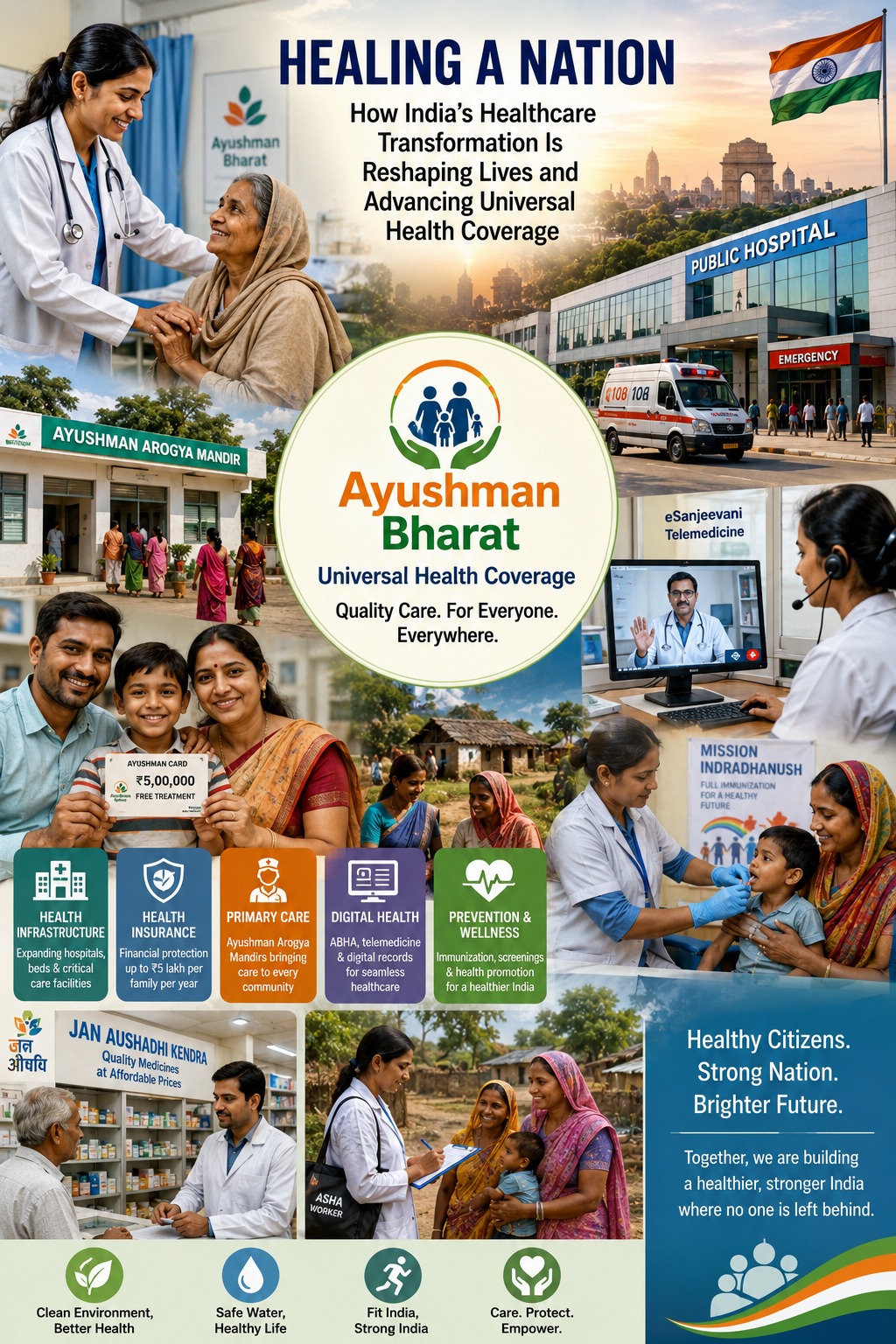
Healing a Nation: How India’s Healthcare Transformation Is Reshaping Lives and Advancing Universal Health Coverage

S Ahmad
For decades, access to quality healthcare in India was often determined by geography, income, and social status. Millions of families faced a difficult choice when illness struck: seek treatment and risk financial ruin, or delay care and suffer the consequences. Public hospitals were burdened, primary healthcare infrastructure remained inadequate in many regions, and specialized treatment was beyond the reach of a large section of society.
Over the last twelve years, however, India has embarked on one of the most ambitious healthcare transformations in its history. Through a combination of policy reforms, infrastructure expansion, digital innovation, health insurance coverage, and targeted public health interventions, the country has steadily moved closer to the goal of universal health coverage. While challenges undoubtedly remain in a nation of more than 1.4 billion people, the scale and scope of progress achieved during this period have fundamentally altered the healthcare landscape.
The story of India’s healthcare transformation is not merely one of statistics and schemes. It is a story of families protected from catastrophic medical expenses, pregnant women receiving safer maternal care, children being immunized against preventable diseases, senior citizens accessing treatment without fear of financial hardship, and remote communities connecting with specialists through digital technology. At its heart, it is a story about expanding dignity, opportunity, and security for millions.
Building the Foundation of Universal Health Coverage
Universal health coverage is often described as a healthcare system in which all individuals can access quality health services without suffering financial hardship. Achieving such a goal in a country as large and diverse as India is a monumental challenge. Yet the past decade has witnessed a determined effort to build the foundations necessary to make this vision a reality.
The transformation has been driven by sustained investments in healthcare infrastructure, increased accessibility of services, expansion of medical education, and greater emphasis on preventive care. The results are becoming increasingly visible across urban centers, small towns, and rural communities.
One of the clearest indicators of this shift is the growing reliance on public healthcare institutions. Recent surveys indicate that an increasing number of Indians are seeking treatment in government hospitals and health facilities, often at little or no cost. This growing trust reflects improvements in service delivery, infrastructure, availability of medicines, diagnostics, and the overall quality of care.
Healthcare is no longer being viewed solely as a welfare measure. It is increasingly recognized as a cornerstone of economic development. A healthier population contributes more effectively to productivity, education, innovation, and national growth. Every investment in healthcare creates long-term dividends for society.
Ayushman Bharat: A Transformational Initiative
Perhaps no initiative symbolizes India’s healthcare transformation more than Ayushman Bharat. Launched in 2018, the programme represents one of the largest public health coverage efforts ever undertaken anywhere in the world.
The vision behind Ayushman Bharat extends beyond providing insurance coverage. It seeks to create a comprehensive healthcare ecosystem that integrates preventive, promotive, curative, rehabilitative, and digital healthcare services.
The first pillar of this initiative, Ayushman Bharat–Pradhan Mantri Jan Arogya Yojana (AB-PMJAY), has emerged as a lifeline for economically vulnerable families. By providing health insurance coverage of up to ₹5 lakh per family annually, the scheme has significantly reduced the financial burden associated with serious illnesses.
For countless households, a major surgery or prolonged hospitalization once meant selling assets, borrowing money, or falling into debt. Today, millions of beneficiaries can access treatment for critical illnesses including cancer, cardiac diseases, and other complex conditions through a vast network of empanelled public and private hospitals.
The significance of the programme lies not merely in the number of beneficiaries covered but in the security it provides. Healthcare expenses are among the leading causes of poverty worldwide. By shielding vulnerable families from catastrophic expenditure, Ayushman Bharat contributes not only to better health outcomes but also to economic stability.
The expansion of coverage to all citizens above seventy years of age through the Ayushman Bharat Vay Vandana initiative represents another important milestone. As India’s elderly population grows, ensuring accessible healthcare for senior citizens becomes increasingly critical. This measure recognizes healthcare as a right that should remain accessible throughout all stages of life.
Strengthening Healthcare at the Grassroots
Insurance coverage alone cannot deliver universal healthcare. People must have access to facilities located within reasonable distance of their homes. Recognizing this reality, India has undertaken an unprecedented expansion of primary healthcare infrastructure.
The establishment of Ayushman Arogya Mandirs has transformed the way healthcare reaches communities. These centers serve as the first point of contact for millions seeking medical attention. They offer a wide range of services including disease screening, maternal and child healthcare, mental health support, management of chronic illnesses, diagnostics, essential medicines, and teleconsultation facilities.
The importance of primary healthcare cannot be overstated. Strong primary care systems reduce pressure on tertiary hospitals, promote early diagnosis, improve disease prevention, and lower healthcare costs. They also foster trust between communities and healthcare providers.
The impact is particularly visible in rural and underserved regions. Communities that once had limited access to healthcare services are now benefiting from comprehensive care closer to home. The expansion of these facilities has strengthened preventive healthcare while improving early intervention and continuity of treatment.
Equally important has been the role of community health workers and Accredited Social Health Activists (ASHAs). These frontline workers serve as the bridge between healthcare institutions and local communities. Their contributions extend beyond treatment to awareness generation, maternal care, immunization campaigns, disease surveillance, and health education.
In many villages, ASHA workers are often the first healthcare representatives people encounter. Their work has helped improve healthcare-seeking behavior and strengthen public confidence in government health programmes.
The Digital Revolution in Healthcare
One of the most remarkable aspects of India’s healthcare transformation has been the integration of digital technology into service delivery.
The Ayushman Bharat Digital Mission represents a bold attempt to create a unified digital health ecosystem. Through the Ayushman Bharat Health Account (ABHA), citizens can maintain secure digital health records accessible across participating healthcare facilities.
This digital architecture has the potential to fundamentally improve healthcare delivery. Patients no longer need to repeatedly carry paper records from one facility to another. Healthcare professionals can access relevant medical histories with consent, improving diagnosis and treatment decisions. Continuity of care becomes easier, particularly for patients with chronic illnesses.
The digital transformation extends far beyond electronic records. Telemedicine has emerged as one of the most powerful tools for expanding healthcare access.
India’s eSanjeevani platform has demonstrated how technology can bridge geographical barriers. A patient living in a remote village no longer has to travel hundreds of kilometers to consult a specialist. Through digital consultations, expert medical advice can be delivered directly to communities that traditionally faced significant access challenges.
The significance of telemedicine became especially evident during the COVID-19 pandemic. At a time when physical movement was restricted, digital healthcare platforms ensured continuity of care for millions. What began as a necessity during a crisis has now evolved into a permanent component of India’s healthcare infrastructure.
Mental healthcare has also benefited from technological innovation. Tele-MANAS has expanded access to mental health counseling and support services across the country, helping address one of the most neglected aspects of public health. By making mental health assistance available through telephone and digital platforms, the programme has reduced barriers associated with distance, stigma, and limited specialist availability.
Maternal and Child Health: A Quiet Revolution
Perhaps some of the most profound achievements of India’s healthcare journey can be seen in improvements in maternal and child health.
Maternal mortality and child mortality rates serve as key indicators of a healthcare system’s effectiveness. Over the past decade, India has recorded significant improvements in both areas through sustained policy interventions and community outreach.
Initiatives such as Pradhan Mantri Surakshit Matritva Abhiyan, Janani Suraksha Yojana, and Janani Shishu Suraksha Karyakram have collectively strengthened the continuum of care available to pregnant women.
These programmes ensure access to antenatal check-ups, institutional deliveries, free diagnostics, medicines, transportation, and postnatal care. More importantly, they have encouraged women to seek timely medical attention during pregnancy and childbirth.
The role of frontline health workers has been crucial in this success. Through regular home visits, risk identification, counseling, and follow-up care, they help ensure that mothers receive the support necessary for safe pregnancies and deliveries.
At the same time, child health programmes have expanded newborn care, nutritional support, developmental screening, and immunization coverage. Together, these interventions have laid the foundation for healthier childhoods and stronger future generations.
The transformation is not merely statistical. Behind every decline in maternal mortality is a mother who survives childbirth. Behind every reduction in infant mortality is a child given the opportunity to live, learn, and contribute to society. These outcomes represent some of the most meaningful measures of national progress.
Immunization and Disease Prevention
Healthcare systems are strongest when they prevent illness before it occurs. India’s immunization programmes have played a central role in achieving this objective.
The Universal Immunisation Programme and Mission Indradhanush have expanded vaccine coverage across the country, particularly among populations that previously remained underserved. Millions of children and pregnant women have received life-saving vaccines that protect against preventable diseases.
The success of these efforts extends beyond coverage numbers. Increased vaccination rates reduce disease outbreaks, lower healthcare costs, improve life expectancy, and strengthen overall public health resilience.
The near elimination of zero-dose children—those who receive no vaccinations at all—demonstrates how sustained public health interventions can produce transformative results. Similarly, India’s achievement in eliminating maternal and neonatal tetanus reflects the effectiveness of coordinated immunization strategies.
Vaccination remains one of humanity’s most successful public health tools. By strengthening immunization systems, India is investing in a healthier future for generations to come.
Fighting Diseases Through Targeted Public Health Programmes
While expanding access to healthcare is essential, building a healthier nation also requires confronting diseases that continue to burden communities. Over the past decade, India has intensified efforts to combat both communicable and non-communicable diseases through targeted interventions under the National Health Mission and allied programmes.
Tuberculosis, long one of India’s most persistent public health challenges, has witnessed significant attention through the National Tuberculosis Elimination Programme. Enhanced screening, improved diagnostics, community engagement, nutritional support, and stronger treatment adherence mechanisms have accelerated progress against the disease. The involvement of volunteers and community-based support networks has transformed tuberculosis control from a government initiative into a broader social movement.
Similarly, India has made notable advances in reducing malaria cases and deaths through improved surveillance systems, real-time monitoring, and the adoption of a “test, treat, and track” strategy. Diseases such as kala-azar, leprosy, lymphatic filariasis, Japanese encephalitis, and dengue have also seen encouraging declines due to focused interventions and better healthcare outreach.
These achievements demonstrate the value of sustained public health investments. Disease elimination is rarely achieved through a single breakthrough. Rather, it requires years of coordinated action involving healthcare workers, local communities, researchers, and policymakers. India’s progress across multiple disease categories highlights the effectiveness of such long-term commitment.
Lessons from the Pandemic
No assessment of India’s healthcare transformation would be complete without examining the lessons of the COVID-19 pandemic.
The pandemic tested healthcare systems around the world, exposing vulnerabilities even in some of the most advanced nations. For India, it became both a challenge and an opportunity to strengthen healthcare infrastructure on an unprecedented scale.
Testing capacity expanded dramatically. Intensive care facilities, oxygen-supported beds, and emergency medical infrastructure were rapidly enhanced. Domestic production of personal protective equipment, which was virtually nonexistent before the pandemic, grew into a major manufacturing capability within a short period.
Perhaps the most visible achievement was the execution of one of the world’s largest vaccination campaigns. The rapid deployment of vaccines across a vast and diverse population demonstrated the strength of India’s administrative capacity, healthcare workforce, and digital systems.
The experience also reinforced an important lesson: healthcare preparedness is not a luxury but a necessity. Investments in disease surveillance, laboratory networks, emergency response systems, and healthcare infrastructure yield benefits long before the next crisis arrives.
Recognizing this reality, the Pradhan Mantri Ayushman Bharat Health Infrastructure Mission was launched to strengthen health systems across every level of care. By expanding laboratories, critical care facilities, public health units, and disease surveillance mechanisms, the programme aims to build a more resilient healthcare system capable of responding effectively to future emergencies.
Tackling the Rising Burden of Lifestyle Diseases
India’s healthcare challenges are evolving. While infectious diseases remain important, non-communicable diseases such as diabetes, cardiovascular illnesses, hypertension, stroke, and cancer are now responsible for a majority of deaths in the country.
Addressing these conditions requires a different approach—one focused on prevention, early detection, and long-term management.
The large-scale screening programmes conducted through Ayushman Arogya Mandirs represent a major step in this direction. Millions of individuals are being screened for hypertension, diabetes, oral cancer, breast cancer, and cervical cancer. Early detection significantly improves treatment outcomes and reduces healthcare costs.
This shift toward preventive healthcare marks an important evolution in public health policy. Traditionally, healthcare systems often concentrated on treating illness after symptoms appeared. Modern healthcare increasingly emphasizes identifying risks before they develop into severe conditions.
The government’s efforts to expand cancer care infrastructure further reflect this commitment. The establishment of specialized cancer institutes, tertiary treatment centres, and enhanced surveillance systems has improved access to diagnosis and treatment.
Likewise, initiatives such as the Pradhan Mantri National Dialysis Programme have provided critical support to patients suffering from chronic kidney disease. For thousands of economically vulnerable families, free dialysis services have transformed what was once an unaffordable necessity into an accessible healthcare service.
Making Healthcare Affordable
Access to healthcare means little if medicines, diagnostics, and treatment remain financially out of reach. One of the most significant aspects of India’s healthcare reforms has therefore been the effort to reduce out-of-pocket expenditure.
The expansion of Jan Aushadhi Kendras has made quality generic medicines available at substantially lower prices. For families managing chronic conditions that require lifelong medication, these savings can be transformative.
Similarly, AMRIT pharmacies have improved access to life-saving medicines and medical implants at heavily discounted rates. These initiatives collectively address one of the most common barriers to healthcare access—the cost of treatment itself.
Diagnostic services have also become more accessible through the Free Essential Diagnostics Initiative. Earlier, many patients visiting public health facilities were compelled to spend significant amounts on laboratory tests and imaging services at private centres. Expanding free diagnostics has reduced this burden while encouraging timely diagnosis and treatment.
Healthcare affordability extends beyond medicines and tests. Transportation during emergencies can mean the difference between life and death. The expansion of emergency ambulance services under Dial 108 and Dial 102 has significantly strengthened emergency response capabilities, particularly in rural and difficult-to-reach areas.
By reducing financial barriers at multiple points of the healthcare journey, these reforms have moved India closer to the principle that quality healthcare should depend on need rather than economic status.
Reaching the Last Mile
One of the defining features of India’s healthcare transformation has been its focus on inclusion. Progress cannot be measured solely by improvements in major cities; it must also be evaluated by the ability to reach remote villages, mountainous regions, tribal communities, and underserved populations.
Technology has emerged as a powerful equalizer in this regard.
Telemedicine platforms have connected patients with specialists regardless of physical location. Digital health records have improved continuity of care. Innovative initiatives such as drone-based delivery of medicines and medical supplies have demonstrated how technology can overcome geographical barriers that once seemed insurmountable.
The use of artificial intelligence is further expanding healthcare possibilities. AI-assisted screening tools are supporting the detection of tuberculosis, diabetic retinopathy, and other conditions. Clinical decision-support systems are helping healthcare professionals make faster and more informed decisions.
While technology cannot replace doctors, nurses, or community health workers, it can amplify their effectiveness. In a country where healthcare demand continues to grow rapidly, technological innovation will play an increasingly important role in improving efficiency, accessibility, and quality of care.
Expanding Medical Education and Human Resources
Healthcare systems are only as strong as the people who operate them. Infrastructure, technology, and policies matter, but trained healthcare professionals remain the backbone of effective service delivery.
Recognizing this, India has significantly expanded medical education capacity over the past decade. New medical colleges, nursing institutions, and training facilities have been established to address workforce shortages and meet rising healthcare demands.
The increase in medical and nursing seats represents a strategic investment in the future. As the population grows and healthcare needs become more complex, the country will require a larger pool of doctors, nurses, specialists, technicians, and public health professionals.
The expansion of premier institutions such as AIIMS has also strengthened access to advanced healthcare services while contributing to medical education and research.
At the same time, the integration of traditional systems through the Ministry of AYUSH reflects an effort to create a more holistic healthcare ecosystem. By combining modern medicine with evidence-based traditional practices, India is exploring diverse approaches to wellness and preventive care.
Health as an Engine of Development
Healthcare is often discussed as a social sector issue, but its implications extend far beyond hospitals and clinics. A healthy population is a prerequisite for sustainable economic growth.
Children who receive proper nutrition, immunization, and healthcare are more likely to succeed in school. Adults who remain healthy are more productive and contribute more effectively to the economy. Families protected from catastrophic medical expenses are better able to invest in education, housing, and entrepreneurship.
In this sense, healthcare investments generate benefits that extend across generations. They improve not only health outcomes but also social mobility, economic resilience, and national productivity.
The past twelve years have demonstrated that healthcare reform is not merely about treating disease. It is about strengthening human capital and creating conditions in which individuals and communities can thrive.
The Road Ahead
India’s healthcare journey is far from complete. Challenges remain in areas such as healthcare quality, workforce distribution, urban-rural disparities, rising lifestyle diseases, and the need for continued investment in infrastructure and innovation.
However, the progress achieved over the last decade provides a strong foundation for the future.
The expansion of insurance coverage, strengthening of primary healthcare, digital transformation, disease prevention programmes, medical education reforms, and investments in healthcare infrastructure collectively represent one of the most comprehensive public health efforts in the country’s history.
The true measure of success lies not only in the number of hospitals built, insurance cards issued, or consultations conducted. It lies in the confidence of a family that no longer fears financial ruin because of illness. It lies in a mother who receives safe maternity care, a child protected through vaccination, a senior citizen able to access treatment with dignity, and a patient in a remote village connected to specialist care through technology.
These are the human stories behind India’s healthcare transformation.
As the nation advances toward the vision of Viksit Bharat 2047, healthcare will remain one of its most important pillars. A developed nation is not defined solely by economic indicators or infrastructure projects. It is defined by the well-being of its people.
The journey toward universal health coverage is long and complex, but the direction is clear. Through sustained commitment, innovation, and inclusive policies, India is steadily building a healthcare system that seeks to leave no citizen behind. In doing so, it is not merely improving health outcomes—it is strengthening the foundation of a healthier, more equitable, and more prosperous future for generations to come.
Comments are closed.