

PoJK: The Unfinished Chapter of India’s Integration

Sawan


Our ancestors were forced to abandon this land. We will always remember this land. To all the people of PoJK who face bullets in the streets of Rawalakot and Muzaffarabad, India says, you are not alone, and your motherland has and will always remember you. We will take back PoJK and will always protect your interest.

Soon after the partition of British India, on 22nd October 1947, Pakistan launched an invasion of the erstwhile princely state of Jammu & Kashmir under the code name: “Operation Gulmarg”. The invasion, carried out by Pakistani military with the help of tribals of North-West Frontier Province (NWFP) now known as Khyber Pakhtunkhwa, resulted in the occupation of a significant portion of the state, which remains under Pakistan’s illegal occupation known as Pakistan-occupied Jammu and Kashmir (PoJK).

It has now been 79 years since the invasion, and the wound it inflicted has still not healed. As India marks another anniversary of the aggression, it is important to reflect on the truth that every Indian should hold in their heart. Pakistan-occupied Jammu and Kashmir (PoJK) is Indian and India has not and will not forget it.

       From the start, India’s case is extremely compelling. Maharaja Hari Singh was drawn to India from the start. At the 1931 Round Table Conference in London, he stated, “I am an Indian first, then a Maharaja.” On October 26th, 1947, the entire Jammu and Kashmir State, including the areas now under Pakistan’s illegal control, acceded to India. Administering Muzaffarabad and Gilgit from Islamabad cannot transform an unlawful occupation by Pakistan into a lawful one.


A Land Torn Away: The facts of the occupation are clear. The occupied region is now comprised of three parts. The first part is Pakistan-occupied Jammu and Kashmir (PoJK), a narrow southern strip of 13,297 sq km which is occupied by Pakistan from Muzaffarabad and is subdivided into 10 districts: Muzaffarabad, Neelum, Hattian Bala, Bagh, Poonch, Sudhnoti, Kotli, Mirpur, Bhimber and Haveli.

The second part is Pakistan-occupied Territories of Ladakh (POTL) comprising Gilgit-Baltistan which covers an area of 64,817 sq km and includes Gilgit, Hunza, Nagar, Ghizer, Skardu, Ghanche, Shigar, Kharmang, Diamer and Astore, part of Union Territory of Ladakh today. The third part is China-occupied Territories of Ladakh (COTL) comprising Aksai Chin and the Shaksgam Valley, covering an area of 42,735 sq km.

Pakistan gave away the Shaksgam Valley to China in 1963. It also illegally claims that this region is part of Pakistan and therefore has the right to give it away. In the aggregate, this represents an illegal carving out of a major portion of the Indian Union.

       This region is not a barren stretch of mountains. Gilgit-Baltistan contains substantial deposits of gold, silver, platinum group metals and precious gemstones. Around 95 percent of Pakistan’s gemstones come from this region. However, the region’s people do not benefit from this wealth. It is home to over 5,000 glaciers. The region could generate around 40,000 MW of hydropower, but in 2025 it produced only around 300-400 MW.

Being a vital section of the China-Pakistan Economic Corridor (CPEC), it represents a major strategic interest of China, and poses a major threat to India’s sovereignty and security. Pahari-speaking Jats, Rajputs, Gujjars, Syeds and Sudhans inhabit the southern region, while Gilgit-Baltistan is the most ethnically complex part of the region, with Baltis, Shina and all three sects of Muslims, i.e. Shia, Ismailis and Sunnis living side by side. All these people are part of India’s extended family.

PoJK in Revolt: If there was any ambiguity about how the people of PoJK feel about their occupiers, 2026 has cleared that up. The region has a deep human rights and governance crisis that stems from Rawalpindi and Islamabad.

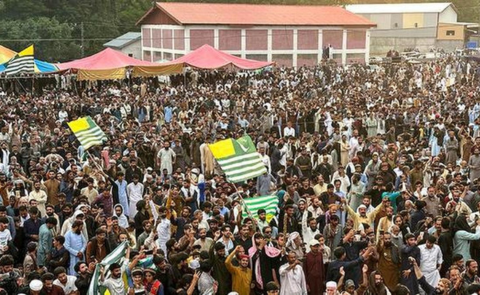
The people of PoJK are not just looking for economic relief. They want freedom from Pakistani military occupation. In June 2026, protests against electricity bills, the price of wheat and unemployment erupted in Rawalakot, Poonch division. These protests were led by the Jammu Kashmir Joint Awami Action Committee (JAAC). These protests quickly spread throughout the region.

       Instead of listening, Pakistan declared JAAC a banned organisation, after which activist Shahzeb Habib was shot in an encounter with police that night and later died. Rawalakot erupted after this. Brutal repression by Pakistan followed.

More than 100 residents have been killed since June, and hundreds more have been wounded by the firing of the Pakistani security forces. Some of the protesters displayed the Indian tricolor, made appeals to India for humanitarian aid, and demanded the Line of Control (LoC) to be opened.

There is no doubt as to the meaning of their messages. Decades of Pakistani rule has resulted in the people, kept hostage by Pakistan’s illegal occupation of India’s Jammu and Kashmir and Ladakh, only exploitation, poverty and bullets.


A Nation’s Unbreakable Resolve:

After independence, India’s resolve to complete its national integration was exemplary. This was illustrated by how it addressed Hyderabad, Junagadh, Goa and Bangladesh in 1947-48 and 1971. PoJK, however, remains under illegal occupation. Most rightfully consider it the most important unfinished chapter of post-independence India’s national integration and an objective for a long-term national goal.

On 22nd February 1994, the Indian Parliament unanimously passed a resolution stating that the entire territory of Jammu and Kashmir and Ladakh is a part of India; reiterated India’s position on PoJK, Gilgit-Baltistan and Akais Chin and demanded Pakistan & China to withdraw from the areas under its illegal occupation.

The resolution also stated that the Indian Government will uphold the country’s unity, integrity and sovereignty and protect the historical, national and regional interests of the country. The resolution reflected the sentiment of the people and Parliament of India and was the best and the clearest statement on India’s national will.

Since 2014, the Government of India has turned this resolve into concrete action. In 2016, it approved a Rupees 2,000 crore rehabilitation package for 36,384 families displaced from PoJK and Chhamb. By 31st January 2020, Rs 1,277.31 crore had been credited to 29,490 families. The scheme was later extended to the families who left Jammu and Kashmir in 1947 and returned thereafter.

On 6th August 2019, during the discussion in the Parliament on the reorganization of the state of Jammu and Kashmir, the Hon’ble Home Minister Shri Amit Shah while speaking on Jammu and Kashmir, mentioned PoJK.

On 2nd November 2019, after the reorganization of the state of Jammu and Kashmir, the Government of India released India’s new official map which included the areas of Mirpur-Muzaffarabad, Gilgit-Baltistan, Aksai Chin and other areas of Jammu and Kashmir. On 24th July 2022, the Hon’ble Defence Minister Shri Rajnath Singh invoked Baba Amarnath and Maa Sharada Peeth and said that Shiv and Shakti will not be separated.

PoJK affects the entire nation’s sense of identity and cultural heritage, not just Jammu and Kashmir. We will communicate this to every nook and corner of India. We will pass on the history of PoJK to our future generations, the history of their ancestral land, and the legacy of Maa Sharada Peeth.

We will celebrate one day every year to remember the history and legacy of the displaced families. We will protect and promote the history and the spiritual and religious importance of Sharada Peeth. We will never give up hope of reuniting with our ancestral land and never sever our ties with our cultural identity.

       Our ancestors were forced to abandon this land. We will always remember this land. To all the people of PoJK who face bullets in the streets of Rawalakot and Muzaffarabad, India says, you are not alone, and your motherland has and will always remember you. We will take back PoJK and will always protect your interest.


Author is a Research Scholar

Comments are closed.