

Muhammad Talha Amin Baruah
Muhammad Ibn Abdul Wahhab was the founder of a revivalist and reformist religious movement centered in Najd in central Arabia and commonly referred to as the Wahhabiyya or Wahhabis. Muhammad b. ‘Abd al-Wahhab belonged to a prominent family of Hanbali scholars, the Al Musharraf of Ushayqir.¹ He was Hanbali In fiqh (meaning that he did taqleed of Imam Ahmad bin Hanbal).² The core of Ibn ‘Abd al-Wahhab’s teachings and writings center on the theological doctrine of tawhid. Other than the Qur’an and the hadith, his principal sources of inspiration were the writings of Ibn Taymiyya and Ibn Qayyim al-Jawziyya.¹
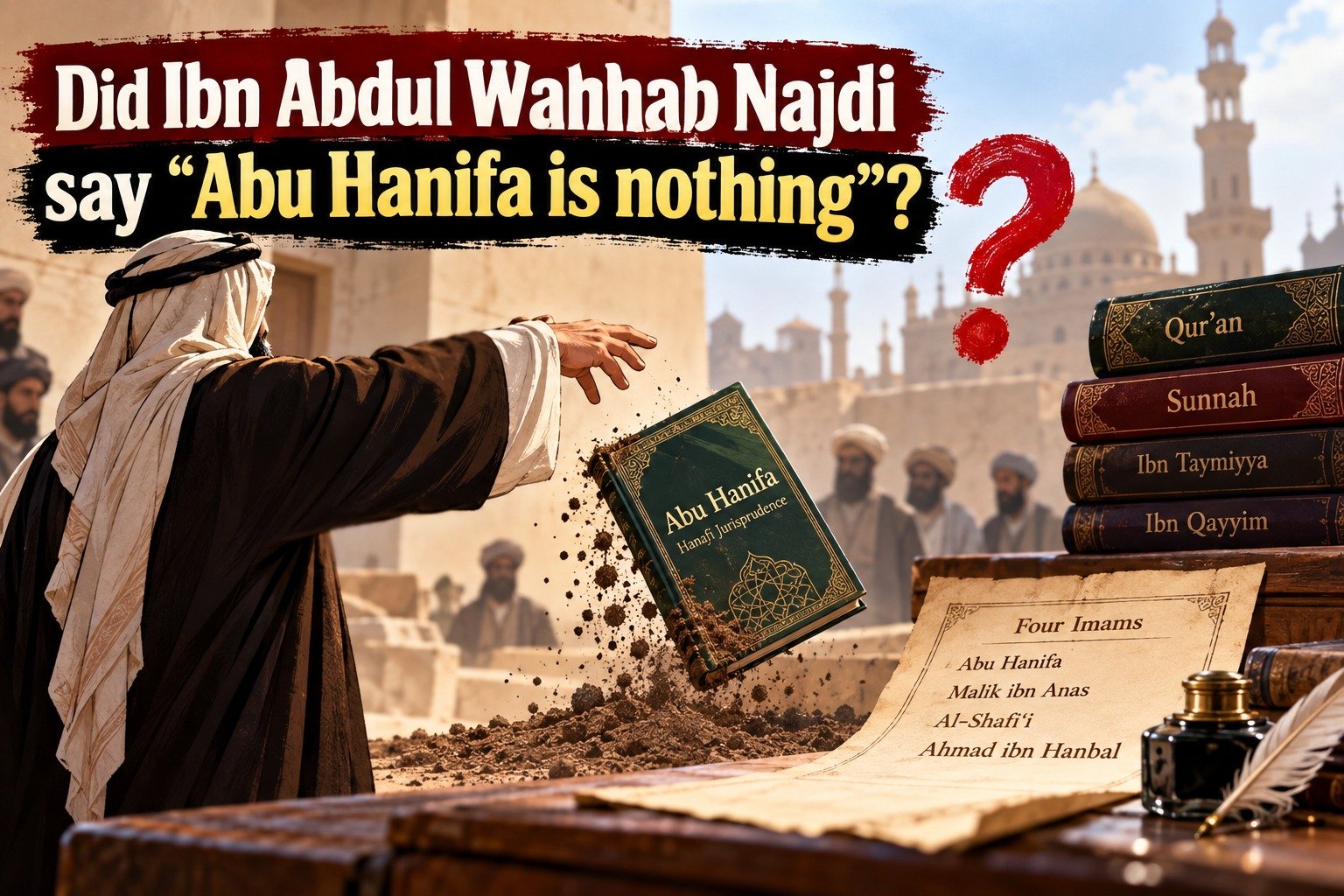
Today we shall discuss whether Muhammad Ibn Abdul Wahhab really spoke ill of Imam Abu Hanifa as reported in the book ‘Radd al-‘Allamah Ibn Dawud ‘ala al-Wahhabiyyah al-musamma Yunin al-Sawa‘iq wa al-Ru‘ud’ by Abd Allah ibn Dawud al-Zubayri al-Hanbali. In page 189, he mentions “A reliable person told us that about forty years ago, a Hanafi man visited Ibn Abd al-Wahhab and gave him a book on summary of Hanafi jurisprudence and asked him to read the books. He took It in his hand, looked at It, then threw it in the dirt and said: Abu Hanifa is nothing.”
How true is this narrative? We find this statement of Ibn Abdul Wahhab contradictory to his own sayings. In the book ‘al-Durar al-Saniyyah al-Ajwibah al-Najdiyyah’ by Abd al-Rahman ibn Muhammad ibn Qasim al-‘asimi al-Najdi al-Hanbali, which includes a letter of Muhammad Ibn Abdul Wahhab (in volume 1 page 94-97) written by Muhammad Ibn Abdul Wahhab and Abdulaziz bin Muhammad Al Saud which was sent to the ruler of Yemen named Ahmad bin Muhammad Al-Adili Al-Bakili. The part of the letter (in page 97) states the words written by Ibn Abdul Wahhab “As for what you mentioned about the reality of Ijtihad, we are followers of the Qur’an and Sunnah, the salaf-e-saliheen of this ummah, and what is relied upon from the opinions of the four imams: Abu Hanifa al-Nu’man ibn Thabit, Malik ibn Anas, Muhammad ibn Idris, and Ahmad ibn Hanbal, may God Almighty have mercy on them.”
Al-Rasa’il al-Shakhsiyyah (matbu dimn mu’allafat al-Shaykh Muhammad ibn ‘Abd al-Wahhab) which is a collection of letters by Muhammad Ibn Abdul Wahhab verified by Shaykh Saleh al-Fawzan and Muhammad ibn Salih al-Uthaymin. Letter 14 which is in between page 94-96, we find the letter with th exact words as we mentioned before.
Now we look at Abd Allah ibn Dawud al-Zubayri’s words, he doesn’t mention his source except saying the words ‘a reliable person’. Clearly this story In his book is contradictory and seems unreal since in the letters we find, It in itself is written evidence that Ibn Abdul Wahhab endorsed Imam Abu Hanifa. Even though Ibn Abdul Wahhab was Hanbali, we can notice that the first among the four Imams he mentions is indeed Abu Hanifa Numan ibn Thabit.
Muhammad Ibn Abdul Wahhab is a person who is even praised by many Hanafi scholars. Co-founder of Deobandi movement, Maulana Rashid Ahmad Gangohi wrote in his Fatawa-e-rashidiya (in page 292) about his opinion on Muhammad Ibn Abdul Wahhab : “Muhammad Ibn Abdul Wahhab is called Wahabi by people, he was a good man, I have heard that his madhab was Hanbali and a master of hadith who used to oppose Bid’ah (innovation) and shirk (polytheism). But the problem is that he was ardent (regarding his opinions).”
Maulana Muhammad Manzoor Nomani who was a prominent Deobandi scholar, wrote a book titled ‘Shaikh Muhammad Bin Abdul Wahab Or Hindustan K Ulama E Haq’ which almost feels like a book in defence of Muhammad Ibn Abdul Wahhab. He has expressed the opinions of Deobandi scholars regarding Muhammadu Ibn Abdul Wahhab and also mentioned multiple instances where Deobandi scholars who were haters of Ibn Abdul Wahhab, changed their opinions regarding him and started to speak good of Ibn Abdul Wahhab. If Muhammad Ibn Abdul Wahhab has disrespected Imam Abu Hanifa, then certainly the Deobandi scholars would have pointed it out and would not speak good of him. Even today, we find a fatwa on Darul ifta – Darul Uloom Deoband (ID : 37703) which says “His book Kitab al-Tauhid is a nice book on the subject, but one should avoid where he has gone strict.”
References :
-
The Princeton Encyclopedia of Islamic Political Thought, by Richard Bulliet, page 231
-
Majmoo‘ Fatawa wa Maqalat Mutanawwi‘ah lil-Shaykh Ibn Baaz, by Bin Baaz, volume 1 page 374
Comments are closed.