
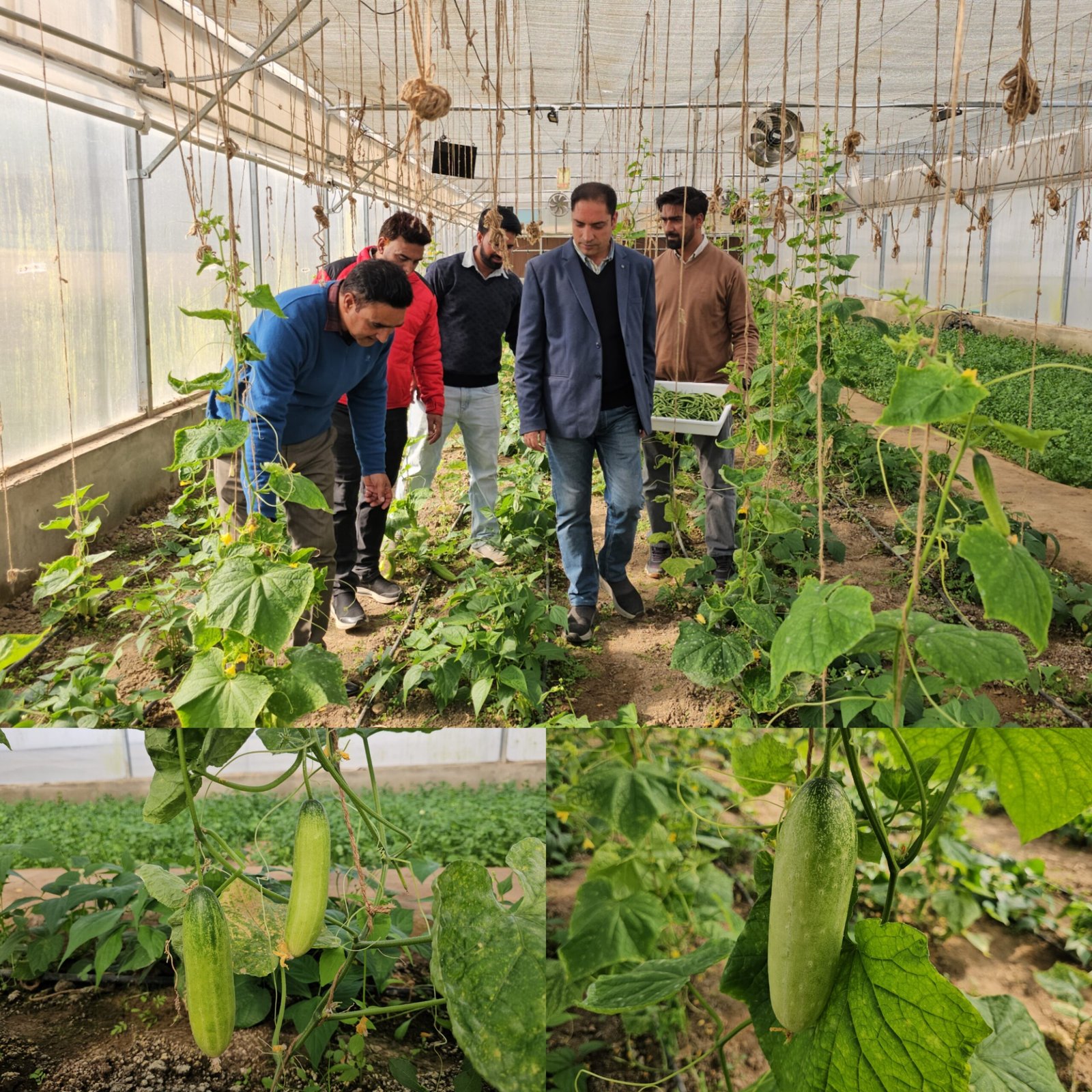
Cucumbers defy Kashmir winter at Pulwama polyhouse

KVK Malangpora harvests fresh produce in November, earns over Rs 3 lakh

Bilal Habib


Awantipora, November 12: At a time when vegetable cultivation in Kashmir’s open fields largely comes to a halt with the onset of winter, a high-tech polyhouse at Krishi Vigyan Kendra (KVK) Malangpora in Pulwama is producing fresh cucumbers, demonstrating how protected farming can extend the growing season and open new income opportunities for farmers.


The facility, established under the Sher-e-Kashmir University of Agricultural Sciences and Technology of Kashmir (SKUAST-K), is currently harvesting cucumbers in November, a period when the fresh vegetable is generally unavailable from open-field cultivation in the Valley.

The experiment has yielded encouraging results, with KVK Malangpora earning more than Rs 3 lakh from successive vegetable crops grown in its polyhouse this year.

The initiative is part of the centre’s winter management efforts to demonstrate the potential of protected cultivation and encourage farmers to adopt modern agricultural practices for year-round vegetable production.

Beyond extending the growing season, the experiment also holds significance for Kashmir’s vegetable economy, which relies heavily on supplies from outside the Valley during the winter months.

Speaking to Kashmir Convener, Head of KVK Malangpora, Prof. Zaffar Afroz Badri, credited the Holistic Agriculture Development Programme (HADP), launched in Jammu and Kashmir under the leadership of Lieutenant Governor Manoj Sinha, for creating opportunities to improve farmers’ livelihoods through modern agricultural interventions.

He also appreciated SKUAST-Kashmir Vice-Chancellor Prof. Nazir Ahmad Ganai for his vision in promoting agricultural initiatives aimed at generating employment and improving the income of the farming community.

Prof. Badri said protected cultivation was an important component of HADP, under which high-tech polyhouses had been provided to farmers and agricultural institutions. KVK Malangpora has also received two protected polyhouses for demonstrating the benefits of the technology.

He said the centre was using these facilities to showcase how scientific farming practices could help farmers diversify production, extend cultivation beyond the conventional season and earn better returns.

“Our primary objective is to explore how farmers can generate sustainable livelihoods and derive maximum benefits from modern agricultural techniques. Through these polyhouses, we are demonstrating the economic potential of protected cultivation,” he said.

Explaining the seasonal limitations of vegetable cultivation in Kashmir, Prof. Badri said open-field production generally continued until September, after which the availability of locally grown vegetables declined and dependence on supplies from outside the region increased.

However, the polyhouse experiment has demonstrated that fresh vegetables can be cultivated even during the winter months.

He said the centre had adopted a multiple-cropping approach rather than depending on a single vegetable, allowing it to utilise the facility throughout the year.

The cycle began with raising and selling seedlings in February, followed by tomato cultivation and then beans. Cucumber is the latest crop being harvested at the facility.

He said the November cucumber harvest was particularly significant as open-field production in Kashmir generally continued only until the end of August or the first week of September.

“Although the present production is not as high as during the regular growing season, we are successfully providing fresh cucumbers even at this time of the year,” he said.

Prof. Badri said cucumber was introduced on a trial basis after sowing in September, with the crop beginning to produce within two months.

The experiment was undertaken on a limited area of around five marlas rather than across the entire polyhouse. While the initial results have been encouraging, the centre will assess the crop’s overall production potential before expanding the practice.

He said KVK Malangpora planned to organise awareness programmes next year for farmers who had received polyhouses under HADP and other departmental schemes.

The programmes would familiarise farmers with the cultivation of different vegetables during winter and demonstrate how successive crop cycles could generate additional income.

“Through these programmes, we will educate farmers about cultivating different vegetables during the winter season, as our successful experiment has demonstrated that they can earn additional income by adopting such practices,” he said.

Director Extension, SKUAST-Kashmir, Prof. Rihana Habib Kant, said Krishi Vigyan Kendras played a crucial role in taking agricultural technologies from research institutions to farmers and ensuring their practical applicability under local conditions.

Speaking to Kashmir Convener, she said technologies developed by the university were first tested at KVKs to assess their suitability, farmer-friendliness and potential for adoption in different agro-climatic conditions.

Since agricultural technologies were not necessarily developed to meet the specific requirements of every location, she said KVKs evaluated them at their respective centres and on farmers’ fields before recommending wider adoption.

Referring to the initiative at KVK Malangpora, Prof. Kant said the centre had established high-tech polyhouses and greenhouses to demonstrate the economic potential of protected cultivation and encourage farmers to take up the technology.

She said the government was providing subsidies of more than 90 per cent for setting up high-tech polyhouses to encourage investment in modern agricultural infrastructure. However, many farmers remained apprehensive about the returns they could generate from such investments.

“At KVK Malangpora, we are demonstrating how farmers can recover their investment through year-round vegetable production. The cucumber crop being harvested here is already in its fourth cycle. These are hybrid, seedless cucumbers, and farmers can take up to four crops in a year. The centre has maintained continuous production and harvesting throughout the year without a break,” she said.

Prof. Kant said an investment of around Rs 20–25 lakh was required to establish a high-tech polyhouse, but the substantial government subsidy significantly reduced the financial burden on farmers.

The demonstrations at KVK Malangpora, she said, were aimed at building farmers’ confidence in the technology by showing that such infrastructure could generate sustainable returns through successive crop cycles.

Apart from cucumbers, she said, farmers could cultivate tomatoes, capsicum and several other vegetables throughout the year under protected conditions. Depending on the variety, some cucumber crops could also provide up to three production cycles annually.

Highlighting the importance of the technology during winter, Prof. Kant said protected cultivation could help overcome the seasonal limitations of open-field farming and ensure the availability of vegetables even when conventional cultivation was no longer possible.

“Today is November, and cucumbers are still being harvested here. This means we do not necessarily have to depend on supplies from outside Jammu and Kashmir when these vegetables can be produced locally through high-tech greenhouses,” she said.

She said the technologies demonstrated at KVK Malangpora had been tested keeping in view the agricultural conditions of Pulwama district and could serve as a model for encouraging farmers to adopt protected cultivation.

The broader objective, she added, was to improve farm incomes, generate additional livelihood opportunities and ensure a more consistent supply of locally grown vegetables across Kashmir, including during the winter months.

Comments are closed.