
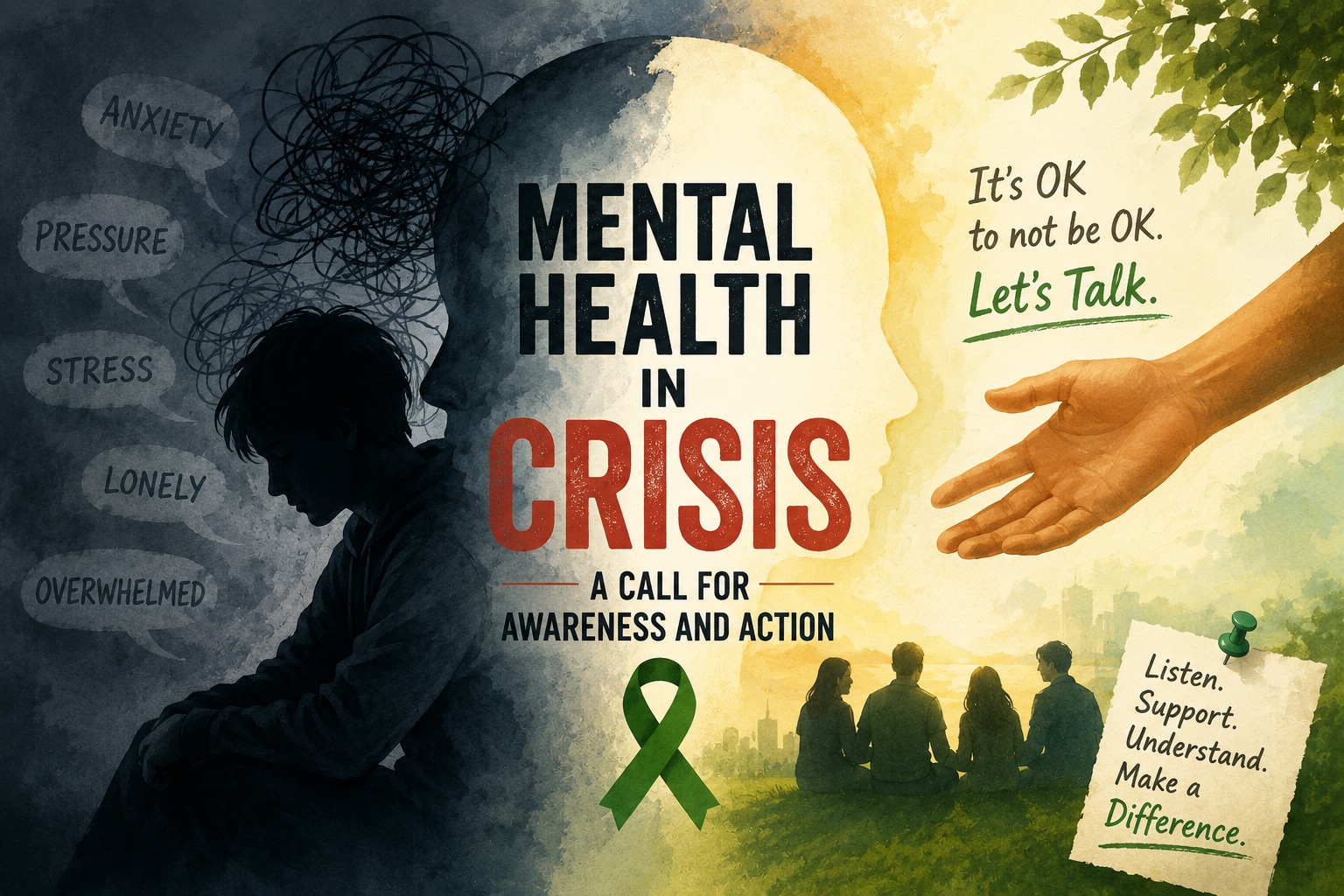
Mental Health in Crisis: A Call for Awareness and Action
Every smile hides a story, “I’m Fine” masks a struggle: millions are suffering in silence, and it’s time for us to listen.

Aira Javaid
“Families, schools, and workplaces all have a role in protecting mental well-being. Mental health is not an individual burden—it is a shared responsibility.”
Millions of people silently live with mental health struggles every day. People are encouraged to be strong and to keep their emotions inside from a young age. However, being silent does not solve the problem. Mental health struggles affect people from all ages, backgrounds, and professions.
The World Health Organisation (WHO), reported that over 300 million people worldwide live with anxiety disorders, and over 280 million people live with depression. Suicide is a major cause of death among young adults between the age of 15 and 29 years old. The world is a very tough place right now. People are struggling with money issues, social media comparison, work, school, and pressure about the future. However, people are having hard time talking about mental health. Emotional struggles are being dismissed as a weakness.
“People tell you to ‘just be grateful,’ as if that will magically cure months of anxiety,” said one individual. Do they not see that being grateful is not a solution? Being grateful is a feeling. And being grateful does not mean that you are a contented person all the time. “I once heard ‘You look fine,’ when I hadn’t slept in weeks,” said one individual. I felt like my suffering hadn’t been ‘real’ after reading that one statement. Suffering from mental health issues is not visible to the people around us. One individual shared that they were kept up by anxiousness, out of sight from all around them, including after all work-related deadlines were finished. “The hardest part is to keep acting as if everything is fine around you when no one is asking about your actual well-being,” said one individual. Suffering from mental health issues is often ignored because it is not visible. But suffering from mental health issues does not become any less lonely or hurtful by being ignored.
Families are a good source of mental health support. Parents should try to create a family environment where their children are comfortable discussing their problems and feelings. Children should be comfortable discussing their problems without any sort of judgment and criticism from their parents. Sometimes, just listening to the child can be of greater benefit than giving any advice.
However, it is also important that children understand that their parents are also facing their own challenges in life. They are also facing a lot of pressure and stress due to work. At times, it is better that we do not expect a lot from our parents so that we do not put them in a position of pressure within our own family.
Support from our societies is also very important. We need to understand that if we are feeling helpless, we are not alone; help is always available.
Families, schools, societies, and work environments can be a source of support for individuals by encouraging a healthy discussion about mental health. People should be comfortable discussing their problems without any sort of judgment from others.
Mental health is a collective responsibility.
If families, schools, and society work together in a caring and understanding manner, problems of loneliness, frustration, and depression can be minimized or controlled before they become more serious.
Communities can help in spreading awareness about mental health and helping people talk more openly about their emotions. If talking about mental health becomes a normal part of society, people will not be afraid of seeking help.
A person says, “When a person listened to me without judgment, I felt understood for the first time in my life. These may be small moments in life, but sometimes these moments can mean a lot to a person who feels alone in the world.”
Mental health problems do not mean a person is weak. It is a part of the human experience. If people can talk about their problems and get help, healing can happen.
If we build a society where people are treated with understanding rather than judgment, more people will be able to ask for help when they need it.
Breaking the silence today may give hope for tomorrow.
Comments are closed.