
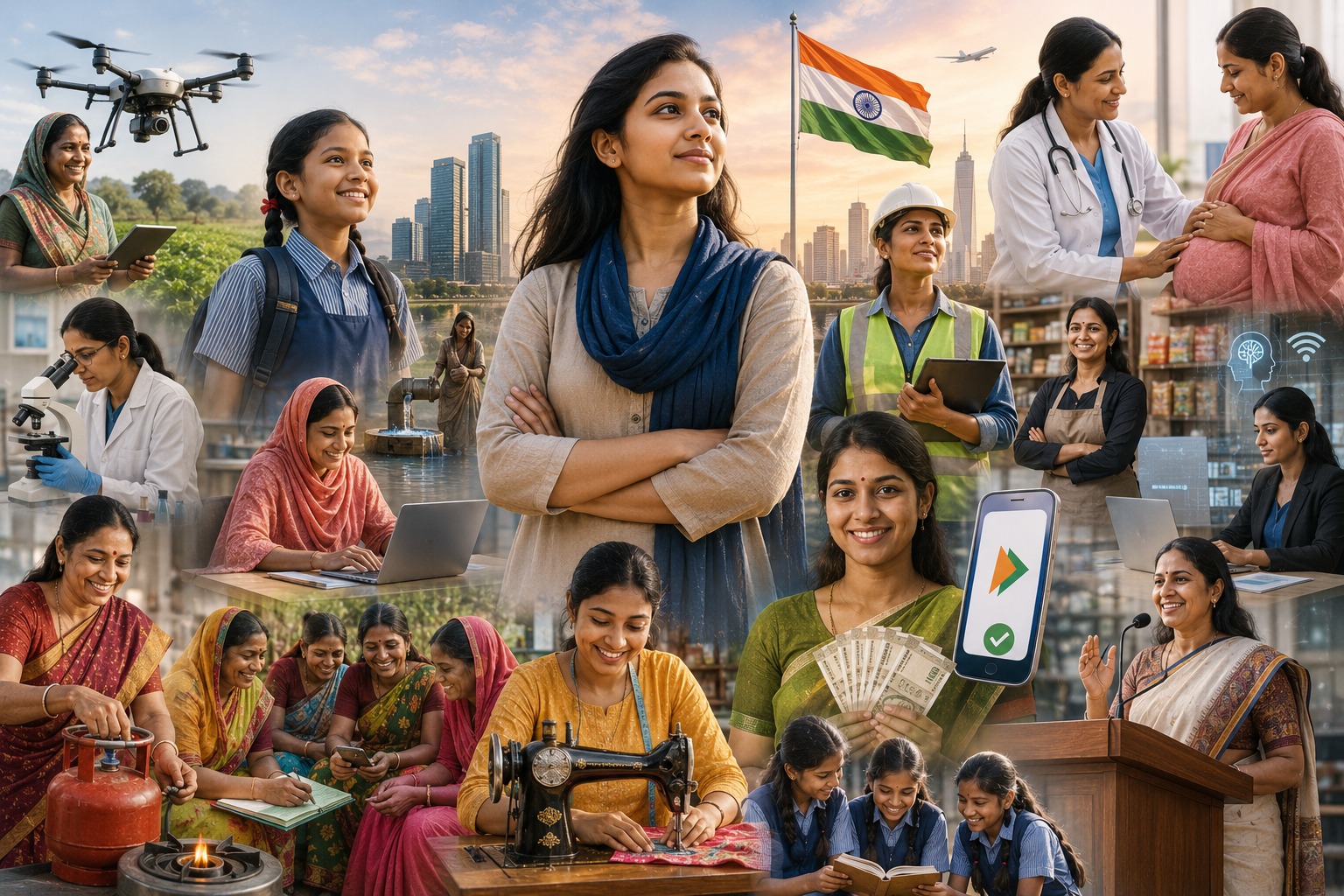
From Welfare to Women-Led Development
How India's Women Are Shaping the Journey Towards Viksit Bharat

S Ahmad
Between 2014 and 2026, India has shifted focus from ‘Women’s welfare’ to ‘Women-led development’ across sectors and institutions. A lifecycle approach adopted by the Government has strengthened women’s access to healthcare, education, nutrition, livelihoods, financial inclusion, and leadership opportunities. Programmes supporting Self Help Groups (SHGs), entrepreneurship, and digital inclusion have expanded women’s economic participation significantly. Improved access to sanitation, housing, clean fuel, and tap water has strengthened dignity, safety, and quality of life. Growing participation in governance, public institutions, and decision-making reflects the expanding role of women in nation-building.
Over the last decade, India has witnessed a remarkable transformation in the way women’s development is perceived and pursued. The conversation has moved beyond welfare-oriented interventions toward a more ambitious and empowering vision of women-led development. Women are no longer viewed merely as beneficiaries of government schemes; they are increasingly recognized as leaders, entrepreneurs, decision-makers, innovators, and drivers of economic and social progress.
This shift reflects a broader understanding that the development of a nation cannot be achieved without the active participation of half its population. As India advances toward the goal of becoming a Viksit Bharat (Developed India) by 2047, women are emerging not only as contributors but as architects of that future.
The transformation is visible across multiple sectors—from healthcare and education to entrepreneurship, governance, technology, agriculture, and finance. It is a story of expanding opportunities, breaking barriers, and creating systems that support women at every stage of life.
A Lifecycle Approach to Women’s Empowerment
One of the most significant features of India’s approach to women’s development has been the adoption of a lifecycle framework. Rather than addressing women’s issues in isolation, policies increasingly recognize the interconnected challenges faced by girls and women from birth through adulthood.
The journey begins with efforts to ensure the survival, protection, and education of the girl child. It continues through access to quality healthcare, nutrition, skill development, employment opportunities, financial inclusion, entrepreneurship support, and leadership roles.
This integrated approach acknowledges a simple reality: empowering women requires sustained support throughout their lives rather than one-time interventions. It is this continuity that has enabled millions of women to move from dependence to participation and from participation to leadership.
Protecting and Nurturing the Girl Child
The foundation of women’s empowerment is laid during childhood. For decades, gender discrimination, son preference, and unequal access to education hindered the progress of girls in many parts of India. Addressing these challenges became a national priority through initiatives such as the Beti Bachao Beti Padhao (BBBP) campaign.
Launched in 2015, BBBP aimed to tackle the declining child sex ratio while promoting the survival, protection, and education of girls. Beyond government programs and awareness campaigns, the initiative sought to challenge deeply entrenched social attitudes that undervalued daughters.
The impact of these efforts can be seen in improving demographic indicators. The National Family Health Survey (NFHS-5) recorded a sex ratio of 1,020 women per 1,000 men, reflecting significant progress compared to previous decades. Equally important has been the growing acceptance of girls’ education and aspirations across communities.
Today, daughters are increasingly encouraged to pursue higher education, careers, sports, science, and leadership positions—areas that were often inaccessible to previous generations.
Strengthening Maternal Health and Safe Motherhood
Women’s empowerment begins with ensuring their health and well-being. Over the past decade, India has invested heavily in maternal healthcare through schemes that support pregnant and lactating women.
The Pradhan Mantri Matru Vandana Yojana (PMMVY) provides financial assistance to pregnant women, helping them access nutritious food, healthcare services, and antenatal care. By linking benefits to health milestones such as early registration and immunization, the scheme promotes better maternal and child health outcomes.
Similarly, the Pradhan Mantri Surakshit Matritva Abhiyan (PMSMA) offers free antenatal check-ups for pregnant women, enabling early identification of high-risk pregnancies. Millions of women have benefited from these services, contributing to a significant decline in India’s Maternal Mortality Ratio.
Other initiatives such as the Janani Suraksha Yojana (JSY) and Janani Shishu Suraksha Karyakram (JSSK) have further expanded access to institutional deliveries and free healthcare services for mothers and newborns.
These interventions have transformed maternal healthcare from a privilege available to a few into an accessible public service for millions of women, particularly those in rural and underserved areas.
Education as the Foundation of Empowerment
No society can achieve meaningful progress without educating its women. Education not only equips women with knowledge and skills but also enhances confidence, independence, and decision-making ability.
India’s educational landscape has undergone substantial change in recent years. The implementation of the National Education Policy (NEP) 2020 has emphasized gender inclusion and equitable access to quality education.
Infrastructure improvements under Samagra Shiksha, including separate toilets for girls, safe school environments, digital classrooms, and improved learning facilities, have helped reduce dropout rates and encourage continued education.
The expansion of Kasturba Gandhi Balika Vidyalayas (KGBVs) has been particularly significant for girls from disadvantaged backgrounds. These residential schools have provided educational opportunities to girls who might otherwise have been excluded from formal schooling.
Financial support through scholarships such as the Central Sector Scholarship Scheme, National Scholarship for Postgraduate Studies, and AICTE Pragati Scholarship has enabled thousands of young women to pursue higher education without placing additional financial burdens on their families.
As a result, female enrolment in schools and universities has increased steadily, reflecting a broader social transformation in attitudes toward girls’ education.
Breaking Barriers in Science and Technology
For generations, science, technology, engineering, and mathematics (STEM) were often perceived as male-dominated fields. Today, that perception is changing rapidly.
Initiatives such as Vigyan Jyoti are encouraging girls to pursue careers in STEM by providing mentoring, exposure to laboratories, workshops, and career guidance. Additional seats for women in premier institutions such as the IITs and NITs have further expanded opportunities.
Women are increasingly entering professions in engineering, research, artificial intelligence, biotechnology, data science, and innovation. Their growing presence in these fields is not only diversifying the workforce but also contributing to India’s scientific and technological advancement.
The rise of women scientists, researchers, and innovators demonstrates that talent flourishes when barriers are removed and opportunities are made accessible.
Building Skills for the Future Economy
Education alone is not sufficient without pathways to employment and entrepreneurship. Recognizing this, India has expanded skill development initiatives aimed at preparing women for emerging sectors of the economy.
The Pradhan Mantri Kaushal Vikas Yojana (PMKVY) has trained millions of individuals, with women constituting a significant share of beneficiaries. The latest phase of the program focuses on future-ready skills including artificial intelligence, drone technology, green energy, electronics, and digital services.
Programs such as NAVYA (Nurturing Aspirations through Vocational Training for Young Adolescent Girls) are specifically designed to equip young women with technical skills, financial literacy, and confidence to participate in modern industries.
These initiatives are helping women transition from traditional occupations into new sectors that offer better income opportunities and long-term career growth.
Financial Inclusion: Bringing Women into the Formal Economy
One of the most transformative developments of the last decade has been the expansion of financial inclusion.
Historically, millions of women lacked access to bank accounts, formal credit systems, and financial services. The launch of the Pradhan Mantri Jan Dhan Yojana (PMJDY) changed this landscape by providing accessible banking services to millions of households.
For many women, owning a bank account represented more than financial access—it symbolized independence and control over personal finances.
The growth of digital payments, direct benefit transfers, and mobile banking has further strengthened women’s participation in the formal financial system. Financial inclusion has enabled women to save, invest, access government benefits, and manage economic resources more effectively.
Women Entrepreneurs Driving Economic Growth
Women’s entrepreneurship has emerged as one of the strongest pillars of India’s development story.
The Pradhan Mantri Mudra Yojana (PMMY) has enabled millions of women to access collateral-free loans for small businesses. Women have used these loans to establish enterprises ranging from tailoring units and retail shops to food processing ventures and service-based businesses.
Similarly, the Stand-Up India scheme has encouraged women to establish larger enterprises by providing loans and mentorship support.
The expansion of the Self-Help Group (SHG) movement under the Deendayal Antyodaya Yojana–National Rural Livelihood Mission (DAY-NRLM) has been particularly transformative. Women across rural India have formed collective groups that facilitate savings, access to credit, skill development, and entrepreneurship.
These groups have evolved into powerful engines of rural economic growth, enabling women to participate actively in local markets and household decision-making.
The Lakhpati Didi initiative further seeks to create millions of women earning sustainable annual incomes exceeding ₹1 lakh, strengthening economic independence and financial resilience.
Technology and Agriculture: New Frontiers for Women
The role of women in agriculture is also undergoing significant change.
The Namo Drone Didi initiative represents a new chapter in rural empowerment by training women to operate drones for agricultural applications such as fertilizer and pesticide spraying. What was once considered highly specialized technology is now becoming a source of income and leadership for rural women.
Similarly, digital marketplaces and platforms such as Womaniya on GeM are helping women entrepreneurs connect directly with buyers, government institutions, and larger markets.
These initiatives demonstrate how technology can become a powerful tool for reducing gender gaps and expanding economic opportunities.
Improving Quality of Life and Dignity
Women’s empowerment is not limited to education and employment. It also involves improving daily living conditions and ensuring dignity, safety, and well-being.
Programs such as the Pradhan Mantri Ujjwala Yojana have provided clean cooking fuel to millions of households, reducing indoor air pollution and easing the burden of traditional cooking methods.
The Swachh Bharat Mission has expanded access to toilets and sanitation facilities, significantly enhancing privacy, dignity, and safety for women.
The Jal Jeevan Mission has brought tap water connections to millions of rural households, reducing the time and physical effort spent collecting water. For many women, this has freed hours each day that can now be devoted to education, livelihoods, childcare, or community participation.
Housing support through Pradhan Mantri Awas Yojana has further improved living standards, with a significant proportion of houses being allotted in the names of women.
Together, these interventions have transformed everyday experiences for millions of women, making empowerment tangible rather than symbolic.
Women in Governance and Leadership
A truly inclusive society requires women’s voices in decision-making processes. Over the past decade, women’s participation in governance has expanded considerably.
Millions of women now serve as elected representatives in Panchayati Raj Institutions, bringing grassroots perspectives into local governance. Their leadership has often strengthened focus on critical issues such as sanitation, water supply, health, education, and nutrition.
The passage of the Nari Shakti Vandan Adhiniyam, 2023, providing 33 percent reservation for women in the Lok Sabha and State Legislative Assemblies, marks a significant milestone in political empowerment.
Women are also entering sectors that were once largely closed to them. The induction of women cadets into the National Defence Academy represents an important step toward gender inclusion within the armed forces.
These developments reflect a broader societal shift where women are increasingly viewed as leaders capable of shaping institutions and public policy.
Towards a Women-Led Viksit Bharat
The story of women’s development in India over the past decade is not simply one of welfare schemes or statistical achievements. It is a story of changing mindsets, expanding opportunities, and enabling women to participate fully in national life.
The transition from welfare to women-led development reflects a deeper understanding that empowering women is not merely a social obligation—it is an economic and developmental necessity.
When women are educated, families become stronger. When women earn incomes, communities prosper. When women lead, governance becomes more inclusive. When women participate fully in society, nations progress more rapidly and sustainably.
As India advances toward the vision of Viksit Bharat 2047, women will remain at the center of this journey. They are shaping classrooms and laboratories, leading businesses and farms, governing villages and institutions, and transforming communities through resilience and innovation.
The future of India will not simply include women. It will increasingly be shaped by them. The rise of Nari Shakti is not merely a chapter in India’s development story—it is becoming the foundation upon which the nation’s future is being built.
Comments are closed.