


Sidrat Mehraj
“The most horrifying reality is that domestic violence has been normalized to such an extent that many women genuinely believe it is their duty to silently endure abuse, sacrificing their dignity, safety, and even their lives to protect an artificial sense of family honour.
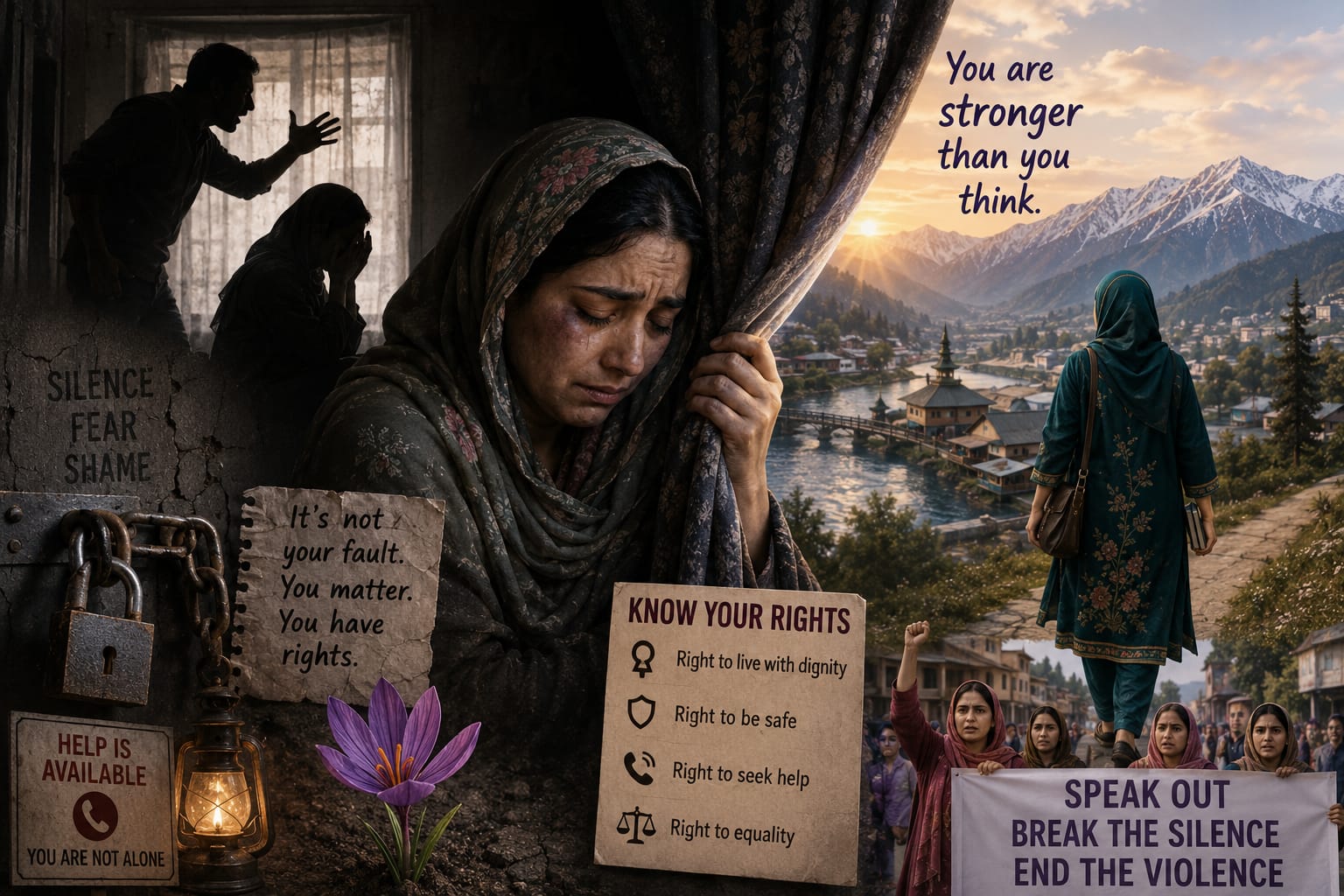
Domestic violence or private violence, across the world is something which not always prospers in secrecy but often comes out in sight and is silently endured, withstood and normalized. In Kashmir this reality is not very different rather carries unique sores shaped by social stigma, limited awareness and support, education & empowerment gaps and patriarchal social norms.
It is never that a simple factor is responsible for it but a combination of family, community, individual or societal influences. The most horrifying and concerning concept is that it has been normalised to an extent where many women for real believe that it is their duty to silently endure this abuse.
Well, this silence is not just born of weakness only but the root cause is fear and what provides a backbone to this endurance is the haunting question “what will society Society say” or a common Kashmiri phrase “lukh kya wanan or lukh kya soochan” but honeslty, these lukh (people) least concern about the pain and humiliation that abused women go through so why to pay heed to their opinions while on other hand your life is at stake.
This so-called concept has trapped in a great many Kashmiri women inside violent homes where there is no door to knock on and no voice to call for help. My question is: where does the people of this society disappear when one is being beaten and humiliated & why do they let this happen knowing how inhumane this is?
Men, who have been bestowed with a great physical strength could be a means of protection has become a source of control and intimidation. In Kashmir, the traditional gender roles are deeply entrenched and men grow up believing that strength grants authority and this authority gives a permit to dominance.
This is an utter betrayal to the purpose of the strength. That strength was meant not to strike but to shelter, not to punish but to protect. Yet, routinely this blessing becomes a weapon that aids in creating a distressing dynamic of Strength VS vulnerability and of course vulnerability has no defence majority of the times.
Growing up in Kashmir as a woman, we become habitual to hearing that patience is a women’s greatest and ultimate virtue and the honour and dignity of the family rests upon a women’s shoulders and speaking out about the abuse would cause harm to the family reputation which unfortunately many times costs the lives of women just to preserve what I call as “artificial reputation”.
Women are compelled to internalize this abuse & shame as a result of years of conditioning by family and society and most importantly the altered and mispresented religious facts to justify the abuse. Talking in the context of uneducated and unaware women who are never enlightened about their legal and religious rights face the most consequences.
Many women often see themselves as a burden and quietly confess to themselves “ may be my life was meant to be this way or maybe I was meant to be exploited” or “women are supposed to live like this”.
Where does this delusion come from? No wonder it is deeply embedded in the minds of the women from the concepts such as kori gachi sabar aasun (girls are obliged to be patient and have endurance). In Kashmir domestic violence often becomes invisible because as a region it is scattered by political violence and economic instability.
The focus of the state majorly stays on outer security leaving the homes unconsidered. Practically Legal aid is not much available even though on paper there’s access to legal support framework for such violence and keeping in view the remote areas, women majorly receive inconsistent responses from the authorities.
In some police stations domestic complaints are often treated as “ Family matters” and what do these family matters really mean? To me, privacy is very much understandable however when it comes to such cases, sufferings shall not be coated with something that enables the unjust and pain to be continued since this will eventually end up eroding our society from within. And what needs to change is bringing awareness to all and not just women but men as well very equally.
Women must enlighten themselves of the facts that they’re not objects or curses and they’re not left out but an equal and a crucial part of this society since they’re the ones who shape this society and this world. Islam never justified abuse and for that matter women must educate themselves of the Islamic rights they have. They’re bound to men only until they’re treated with respect and care and have the liberty to free themselves if they don’t receive what they deserve as humans.
Men shall be taught and understand that strength lies in gentleness, protection and respect and women are their partners not servants or play toys. Viewing domestic violence as a private matter is a mistake since it is an acute societal problem which is taking place out of public view or behind the scenes. The silence shall break and the voices shall come out. Women must realize that they’re not created to suffer but they as humans matter the most and so does their voice.
This is to every woman who has gone through this trauma and suffered due to this societies’ unjust norms_ You are not left out and you’re not to be blamed, it is the society that has failed not you.
“The silence must break. Women must realize that they were not created to suffer in silence, and society must understand that domestic violence is not the failure of its victims—it is the failure of the community that allows it to continue.”
Comments are closed.