
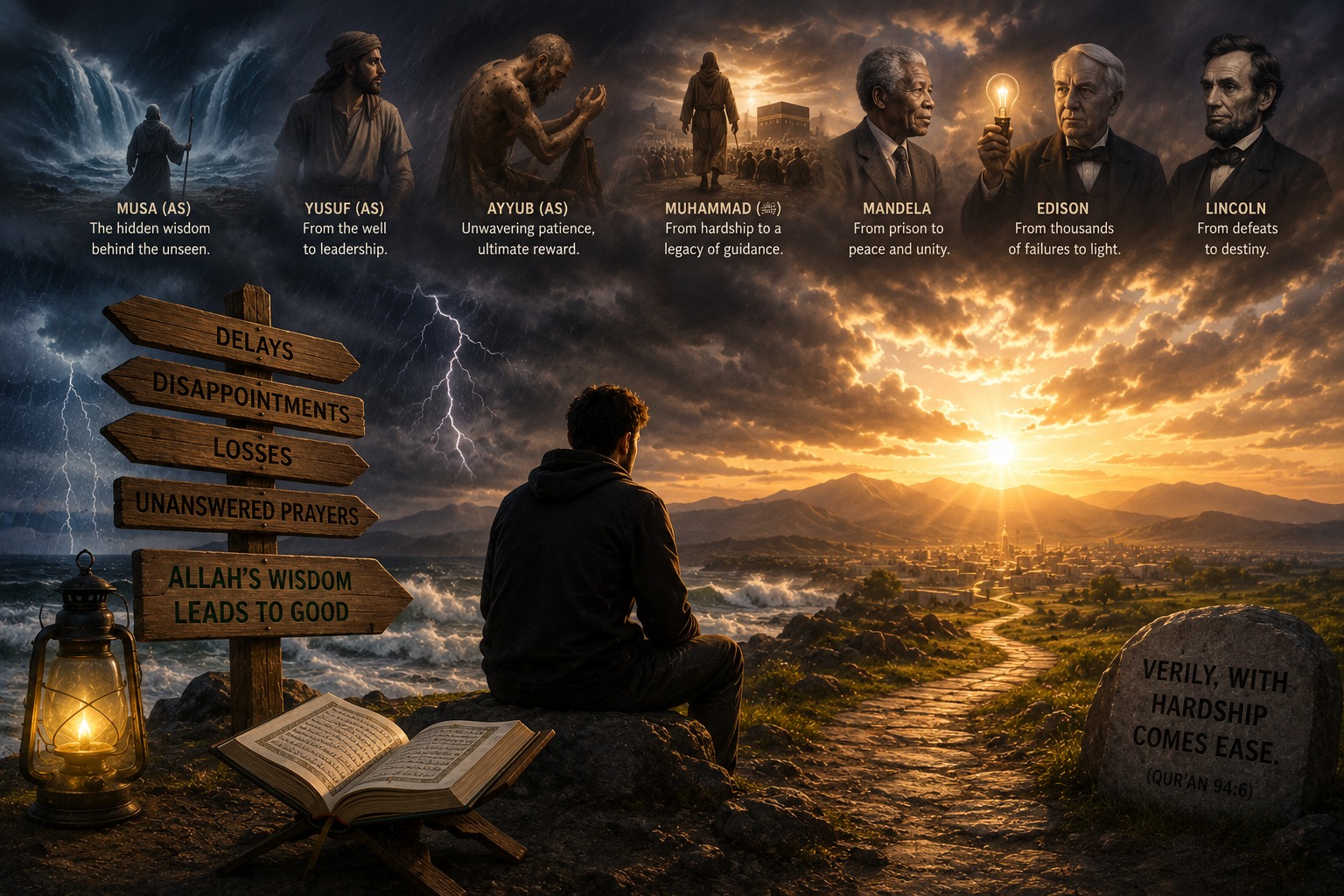
The Wisdom Behind the Storm: Finding Allah’s Mercy in Life’s Delays, Losses, and Unanswered Prayers


Dr. Rizwan Rumi
“Perhaps you hate a thing and it is good for you, and perhaps you love a thing and it is bad for you. Allah knows while you know not.”
— Qur’an 2:216
Life does not always unfold according to our plans. There are moments when dreams crumble without warning, relationships end unexpectedly, opportunities disappear just when we need them most, and prayers seem to remain unanswered despite our sincere supplications. In such moments, the human heart naturally searches for answers. We ask why certain doors close, why certain people leave, and why some struggles linger longer than we think we can bear.
Yet faith teaches us that not every answer is revealed immediately. Sometimes Allah, in His infinite wisdom, allows us to walk through a storm before showing us the purpose behind it.
I remember sharing my struggles with a friend during a particularly difficult phase of life. Listening patiently, he offered a simple response: “What happens, happens for a reason. Allah does everything with wisdom.” At the time, those words felt difficult to accept. Pain often clouds perspective, and when the heart is wounded, wisdom can seem distant. But as days turned into months and months into years, I began to see truths that had once remained hidden.
The disappointments I considered punishments were often forms of protection. The delays I perceived as neglect were moments of preparation. The losses I mourned eventually became lessons that guided me toward growth, maturity, and a deeper connection with Allah.
The Dual Lenses of Knowledge
This realization lies at the heart of one of the most profound teachings of Islam: Allah’s wisdom extends far beyond human understanding. We see a single page; He sees the entire book. We witness a chapter; He knows the complete story.
In Islamic theology, this is understood through the distinction between absolute divine knowledge (Al-Alim) and limited human perception. Islamic scholars have long noted that human sight operates on Al-Zahir (the apparent, outward reality), whereas divine decree operates through Al-Batin (the hidden, inward truth). We lack the vantage point to see how the threads of our current sorrow weave into the tapestry of our ultimate good.
One of the most powerful illustrations of this truth is found in the story of Prophet Musa (AS) and Khidr in Surah Al-Kahf. During their journey together, Musa (AS) witnessed actions that appeared unfair and incomprehensible. A boat belonging to poor fishermen was damaged, an apparently innocent young boy was killed, and a wall was repaired in a town whose people had shown no hospitality or kindness. To Musa (AS), these actions seemed wrong, even unjust.
Yet by the end of the journey, Allah revealed the hidden wisdom behind each event:
-
The Damaged Boat: A tyrannical king was seizing every functional boat by force; the defect saved the fishermen’s livelihood.
-
The Loss of the Child: The boy was destined to bring immense grief and spiritual ruin to his righteous parents; Allah replaced him with a child who would bring them purity and affection.
-
The Repaired Wall: It concealed a treasure belonging to two orphan boys; repairing it preserved their inheritance until they reached maturity.
What appeared harmful was actually protective. What seemed unjust was part of a greater divine plan. The story offers a lesson that remains relevant today. Human beings often judge events based on what they can immediately see. Allah’s wisdom, however, encompasses realities hidden from our sight.
The Architecture of Prophetic Trials
The life of Prophet Yusuf (AS) offers another remarkable example of this divine choreography. Betrayed by his own brothers, thrown into a dark well, sold into slavery for a miserable price, falsely accused of a crime he did not commit, and forgotten in a dungeon for years despite his innocence, Yusuf (AS) endured one hardship after another.
Yet every trial became a stepping stone toward a greater purpose. Had he not been thrown into the well, the passing caravan would never have picked him up. Had he not been brought to Egypt and subsequently imprisoned, he would never have encountered the King’s cupbearer, nor would he have been in a position to interpret the King’s dream. What appeared to be a tragic series of betrayals and structural injustices ultimately became the exact pathway that elevated him to become the Grand Minister of Egypt, enabling him to save entire nations from a devastating seven-year famine.
Likewise, Prophet Ayyub (AS) endured immense suffering that tested the absolute limits of human endurance. He lost his vast wealth, his lands, his children, and his physical health, leaving him afflicted with a severe skin disease for nearly two decades. Throughout this prolonged isolation, he remained patient and steadfast in his faith, famously supplicating, “Indeed, adversity has touched me, and you are the Most Merciful of the merciful” (Qur’an 21:83). His story reminds us that hardship is not a sign of Allah’s abandonment or anger. Rather, it can be a means of spiritual elevation, purification, and an unparalleled closeness to the Creator.
Redefining Success Through Adversity
These stories challenge a common misconception prevalent in modern society—the secular, materialist belief that success means living a linear life completely devoid of difficulty, pain, or discomfort. In reality, Islamic history and the broader human experience demonstrate that every meaningful achievement is preceded by struggle. Every great character is shaped by adversity.
History offers countless secular and spiritual examples of this universal law:
Figure |
The Adversity Endured |
The Ultimate Outcome |
Prophet Muhammad (ﷺ) |
Experienced the Year of Sorrow (Aam al-Huzn), losing his beloved wife Khadijah and protector Abu Talib, alongside intense persecution in Ta’if. |
Built the foundational model of spiritual, ethical, and societal governance that transformed global history. |
Nelson Mandela |
Spent 27 years in rigorous imprisonment, isolated on Robben Island under a brutal apartheid regime. |
Emerged as a global symbol of reconciliation and successfully transitioned South Africa into a multi-racial democracy. |
Thomas Edison |
Faced thousands of unsuccessful attempts—frequently cited as nearly 10,000 failures—while developing a filament. |
Revolutionized global industry by creating a practical, long-lasting electric incandescent light bulb. |
Abraham Lincoln |
Suffered the sudden death of his mother, the loss of his fiancé, multiple business bankruptcies, and at least ten distinct political defeats. |
Preserved the Union during the American Civil War and permanently abolished slavery through the 13th Amendment. |
Their stories demonstrate a universal truth: setbacks are not dead ends; they are often the necessary structural preparations for future success.
The Psychology of Adversity: Post-Traumatic Growth
Modern scientific research heavily validates these ancient spiritual truths. Psychologists today speak extensively of resilience and Post-Traumatic Growth (PTG)—a concept developed by psychologists Richard Tedeschi and Lawrence Calhoun in the mid-1990s. Their empirical data shows that up to 70% of trauma survivors report positive psychological growth after experiencing profound adversity, manifesting in a deeper appreciation for life, altered priorities, and enhanced personal strength.
Long before these concepts entered modern academic literature, Islam taught believers that trials can strengthen faith, refine character, and deepen trust in Allah. The Prophet Muhammad (ﷺ) beautifully summarized this psychological and spiritual state when he said:
Indeed, many of life’s greatest lessons emerge from hardship. Patience is learned through waiting. Gratitude is appreciated after loss. Courage develops in the presence of fear. Trust in Allah becomes strongest when worldly supports seem weakest.
Moreover, difficulties often reveal the true nature of human relationships. Times of ease attract many companions, but hardship acts as a natural sifter, distinguishing sincere friends from temporary acquaintances. The people who stand beside us during our darkest moments often become among Allah’s greatest blessings.
The Concept of Tawakkul and Holy Redirection
As we move through life, we gradually realize that some of the things we once desperately wanted would not have benefited us. Certain relationships, opportunities, and ambitions that occupied our thoughts may have carried hidden harms known only to Allah. What felt like rejection was often divine redirection. What seemed like loss was frequently protection.
Consider the mother of Musa (AS), Sayyidatuna Yukhabid. From a human perspective, placing her newborn infant into a fragile wooden chest and casting him into the fast-flowing Nile River seemed like an act of absolute danger and despair. She could never have imagined that this very river would safely carry her son into the palace of the Pharaoh—the very tyrant who was hunting him down—forcing the enemy to fund, feed, and protect the Prophet who would eventually overthrow him. Allah transformed what appeared to be certain doom into perfect protection.
Similarly, many of the events, job rejections, or broken engagements we fear today may eventually reveal themselves as part of Allah’s profound mercy.
Faith does not require us to understand everything immediately. Rather, it asks us to trust the One who understands everything completely. This trust—tawakkul—is not a passive, fatalistic resignation, but an active, psychological confidence in Allah’s wisdom, mercy, and perfect timing. True tawakkul means tying your camel with excellence, doing your absolute best with the means provided, and leaving the psychological burden of the outcome entirely to the Creator.
When we reflect upon our lives honestly, many of us can identify blessings that first arrived disguised as disappointments. The career opportunity that never materialized led to a completely different, far more fulfilling path. The friendship that ended abruptly taught us invaluable lessons about self-worth and boundaries. The delay that frustrated us prepared us emotionally and mentally for a responsibility we were not yet ready to handle. Life often makes sense only when viewed in retrospect.
Embracing the Unfinished Story
There will always be chapters we do not understand. There will be storms whose purpose remains hidden for months, years, or perhaps even until the Hereafter, when all veils are lifted. Yet the believer finds comfort in knowing that Allah never acts without wisdom, never decrees without purpose, and never abandons those who place their trust in Him.
As the classical scholar Ibn al-Qayyim beautifully remarked:
One day, we may look back upon the trials that once brought bitter tears to our eyes and realize that they were among Allah’s greatest mercies. The closed doors protected us from realities that would have broken us. The delays prepared our characters. The storms strengthened our spiritual resolve. The unanswered prayers guided us toward something infinitely better.
Until then, we continue to move forward with faith, whispering through every difficulty:
“Ya Allah, I may not understand Your plan today, but I trust Your wisdom tomorrow.”
For Allah’s timing is never late, His wisdom is never flawed, and His mercy reaches places that our human understanding cannot even conceive. The storm may not make sense today. But one day, by Allah’s grace, we may discover that what we thought was a storm was actually mercy in disguise.
Comments are closed.