

S Ahmad
Every pregnancy carries within it the promise of a new beginning. For families, it represents hope, continuity, and joy. For nations, it symbolizes the future. Yet pregnancy, despite being a natural process, remains one of the most vulnerable periods in a woman’s life. Complications can arise unexpectedly, and without timely medical attention, the consequences can be devastating for both mother and child.
For decades, maternal mortality remained a significant public health challenge in India. Thousands of women, particularly those from rural and economically disadvantaged backgrounds, faced barriers in accessing quality antenatal care. Many pregnancies went unmonitored, high-risk conditions remained undetected, and preventable complications often led to tragic outcomes. Against this backdrop, the launch of the Pradhan Mantri Surakshit Matritva Abhiyaan (PMSMA) on June 9, 2016, marked a turning point in India’s maternal healthcare journey.
As the programme completes ten years in 2026, it stands as one of the most significant public health interventions aimed at ensuring safer pregnancies and healthier childbirths across the country. More importantly, it demonstrates how targeted healthcare policies, when implemented systematically and consistently, can save lives and strengthen the foundations of a nation’s healthcare system.
The Importance of Maternal Health
Maternal health is more than a medical concern; it is a measure of social progress and healthcare equity. A country that cannot ensure the safety of mothers during pregnancy and childbirth cannot claim to have achieved comprehensive healthcare development.
The health of mothers directly influences infant survival, childhood development, family well-being, and community prosperity. Healthy mothers are more likely to give birth to healthy babies, contribute to the workforce, and participate actively in social and economic life. Conversely, maternal illness or death often plunges families into financial hardship and emotional trauma.
Globally, reducing maternal mortality has remained a major development objective. The United Nations Sustainable Development Goals call for reducing maternal mortality to fewer than 70 deaths per 100,000 live births by 2030. India, with its vast population and diverse healthcare challenges, faces a unique responsibility in contributing to this global target.
Before PMSMA was introduced, maternal mortality in India remained unacceptably high. Between 2014 and 2016, the Maternal Mortality Ratio (MMR) stood at 130 maternal deaths per one lakh live births. Behind each statistic was a woman, a family, and a future lost.
While previous initiatives had improved institutional deliveries and healthcare access, gaps persisted in antenatal care, especially in the timely identification and management of high-risk pregnancies. It became evident that reducing maternal mortality required not only access to healthcare facilities but also regular, quality monitoring throughout pregnancy.
A Vision for Safe Pregnancy
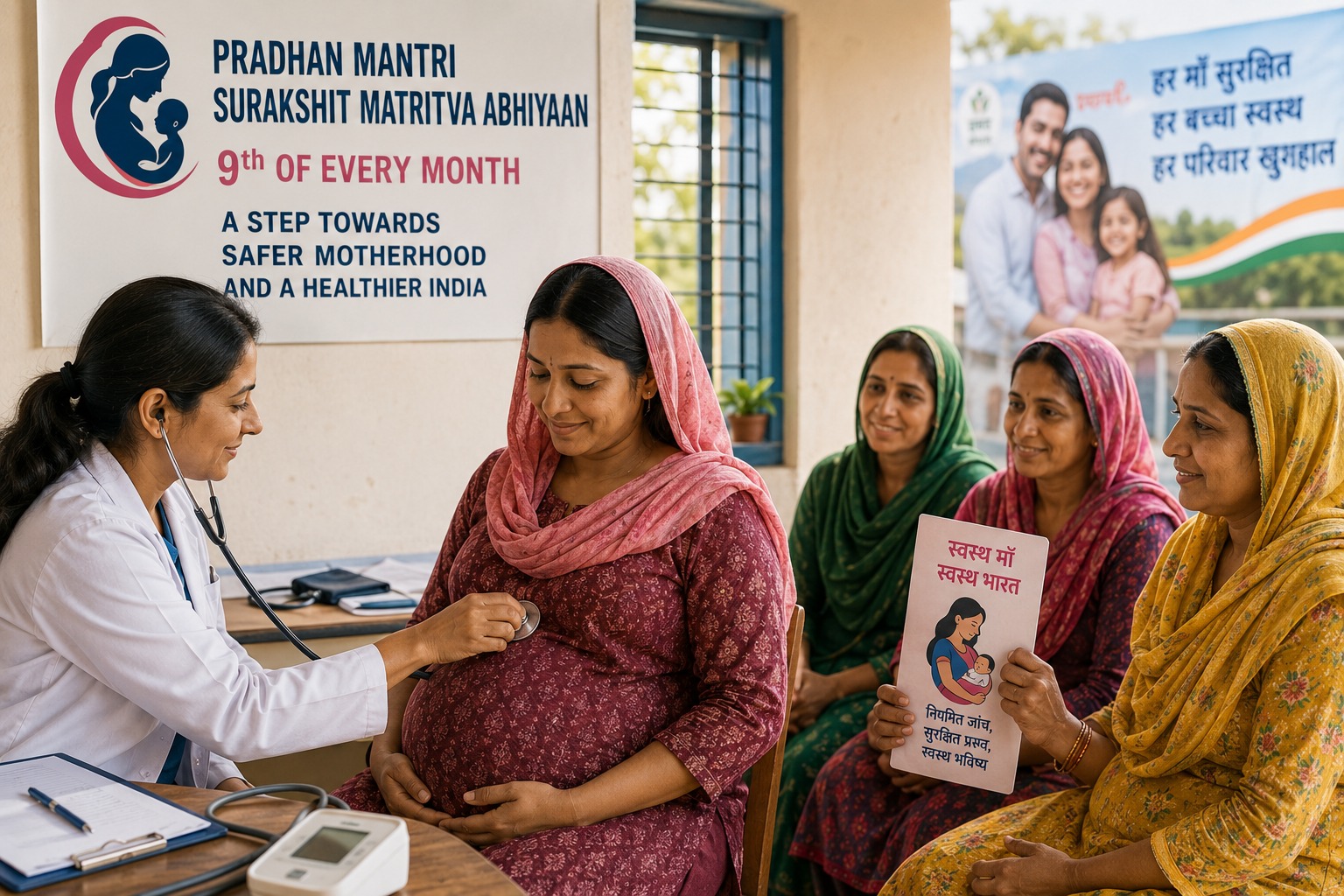
Recognizing these challenges, the Government of India launched PMSMA with a simple yet powerful objective: ensuring that every pregnant woman receives at least one comprehensive antenatal check-up by a specialist during the second or third trimester.
The initiative introduced a dedicated day— the 9th of every month—when pregnant women could access free, quality antenatal services at designated government health facilities. This seemingly straightforward innovation created a predictable and organized system through which women across the country could receive specialized care regardless of their geographical location or economic status.
The programme focused particularly on women in their second and third trimesters, periods when many pregnancy-related complications become more apparent and require close medical monitoring.
Unlike routine check-ups that often vary in quality and availability, PMSMA sought to standardize maternal healthcare by ensuring access to trained specialists, diagnostic investigations, counselling services, and referral mechanisms.
Over the years, this model has evolved into a nationwide movement, reaching millions of women and strengthening maternal healthcare delivery at every level.
Beyond Routine Check-Ups
One of the key strengths of PMSMA lies in its comprehensive approach. Pregnancy is not simply monitored through basic examinations; rather, women receive a complete package of services designed to identify risks and support healthy outcomes.
The programme includes clinical examinations, blood and urine investigations, ultrasonography, nutritional counselling, birth preparedness guidance, and education on danger signs during pregnancy.
Importantly, the programme emphasizes informed healthcare. Women are counselled on nutrition, safe pregnancy practices, birth planning, and complication readiness. Such counselling helps families make informed decisions and encourages timely healthcare-seeking behaviour.
For many women, especially those in underserved communities, these interactions often serve as their first exposure to specialized maternal healthcare advice.
The programme also actively encourages participation among women who may have missed routine antenatal visits. By creating a structured monthly opportunity for care, PMSMA helps bridge gaps in healthcare access and ensures that vulnerable populations are not left behind.
The Critical Role of High-Risk Pregnancy Identification
Perhaps the most transformative aspect of PMSMA is its focus on identifying high-risk pregnancies.
Pregnancy complications rarely emerge without warning. Conditions such as severe anaemia, gestational diabetes, hypertension, infections, thyroid disorders, multiple pregnancies, previous caesarean sections, and adverse obstetric histories can significantly increase risks during childbirth.
However, these risks can often be managed successfully if detected early.
PMSMA introduced systematic screening for twenty-five high-risk pregnancy categories. This proactive approach enables healthcare providers to identify women who require additional monitoring, specialist consultations, or referral to higher healthcare facilities.
The use of colour-coded stickers on Mother and Child Protection cards further improves continuity of care. These visual markers allow healthcare workers to quickly recognize risk factors and ensure appropriate follow-up during subsequent visits.
Such innovations may appear simple, but they can make a crucial difference in busy healthcare settings where timely recognition of risk is essential.
By moving from reactive treatment to preventive identification, PMSMA has helped transform maternal healthcare from crisis management to risk management.
Building a Culture of Follow-Up
Identifying high-risk pregnancies is only the first step. Effective healthcare requires continuous monitoring and sustained support.
Recognizing this need, the Government introduced the Extended PMSMA Strategy in January 2022. The initiative strengthened follow-up mechanisms for women identified as high-risk, ensuring they remain connected to healthcare services throughout pregnancy.
Under this strategy, each high-risk pregnancy is individually tracked until delivery. Additional antenatal visits are encouraged, and financial incentives are provided to both beneficiaries and Accredited Social Health Activists (ASHAs) who facilitate follow-up care.
Technology has also become an important ally. SMS alerts remind beneficiaries and ASHA workers about scheduled visits, helping reduce missed appointments and improving compliance with medical recommendations.
This shift reflects an important lesson in public health: diagnosis alone is insufficient unless accompanied by sustained care and monitoring.
The Extended PMSMA model acknowledges this reality and reinforces continuity as a cornerstone of maternal healthcare.
The Power of Public-Private Collaboration
Another notable feature of PMSMA is its innovative engagement with private healthcare professionals.
India faces a shortage of specialists in many regions, particularly in rural and remote areas. To address this challenge, PMSMA encourages obstetricians, gynaecologists, physicians, and radiologists from the private sector to volunteer their services on the 9th of every month.
The initiative gained momentum after the Prime Minister appealed to doctors through his “Mann Ki Baat” programme, urging them to dedicate just twelve days a year to maternal healthcare.
This call transformed healthcare delivery into a broader social mission. Through the “I Pledge for 9” campaign, medical professionals across the country have contributed their expertise to improving maternal outcomes.
The programme demonstrates how public health challenges can be addressed more effectively when government systems, healthcare professionals, and communities work together toward a common objective.
Measuring Success Through Outcomes
The true value of any healthcare programme lies in its impact.
Over the past decade, PMSMA has delivered antenatal care services to more than 7.5 crore pregnant women in addition to routine antenatal services. This extraordinary reach reflects not only administrative efficiency but also growing public trust in maternal healthcare systems.
More importantly, India has recorded significant progress in reducing maternal mortality.
The country’s Maternal Mortality Ratio declined from 130 maternal deaths per lakh live births during 2014–16 to 87 during 2022–24, representing a reduction of 43 points within a decade.
While this achievement cannot be attributed solely to PMSMA, the programme has undoubtedly played an important role by strengthening antenatal care, identifying risks early, and facilitating timely medical intervention.
Each reduction in maternal mortality represents lives saved, families preserved, and communities strengthened.
The progress also demonstrates that sustained investment in primary healthcare and preventive services yields measurable results.
Maternal Healthcare as an Ecosystem
One reason PMSMA has been successful is that it does not operate in isolation.
Instead, it functions as part of a broader ecosystem of maternal and child healthcare programmes designed to support women throughout pregnancy, childbirth, and the postnatal period.
The Janani Suraksha Yojana encourages institutional deliveries, helping women access skilled birth attendance. The Janani Shishu Suraksha Karyakram provides free healthcare services for mothers and newborns. The Surakshit Matritva Aashwasan initiative strengthens quality standards across maternal healthcare facilities.
Meanwhile, programmes such as POSHAN Abhiyaan address maternal nutrition, Pradhan Mantri Matru Vandana Yojana provides maternity benefits, and LaQshya focuses on improving labour room quality.
Together, these initiatives create a continuum of care that addresses multiple dimensions of maternal health.
PMSMA serves as a critical link within this ecosystem by ensuring that women enter childbirth with appropriate medical supervision and risk assessment.
Remaining Challenges
Despite remarkable progress, important challenges remain.
India continues to face disparities in healthcare access across regions, socio-economic groups, and rural-urban populations. Specialist shortages persist in many districts. Cultural barriers, low awareness levels, and transportation difficulties still prevent some women from accessing timely care.
Furthermore, maternal health cannot be viewed solely through a medical lens. Nutrition, sanitation, education, gender equality, and economic empowerment all influence maternal outcomes.
Addressing these broader determinants remains essential for achieving further reductions in maternal mortality.
Healthcare systems must also continue improving quality of care. Access alone is not enough; services must be respectful, evidence-based, and patient-centred. Women should feel safe, informed, and supported throughout their healthcare journey.
The next decade must therefore focus not only on expanding coverage but also on strengthening quality, equity, and dignity within maternal healthcare services.
A Decade Worth Celebrating
As PMSMA marks its tenth anniversary, the programme offers valuable lessons for public health policymakers.
It demonstrates that targeted interventions can produce meaningful outcomes when backed by political commitment, administrative coordination, community participation, and healthcare professional engagement.
The initiative has transformed antenatal care from an optional service into a structured public health priority. It has encouraged early detection of complications, improved referral systems, strengthened follow-up care, and increased access to specialist services.
Most importantly, it has brought maternal healthcare closer to millions of women who might otherwise have remained beyond the reach of quality medical services.
The journey is far from complete. Yet the achievements of the past decade provide reason for optimism.
As India advances toward its vision of Viksit Bharat@2047, ensuring safe motherhood must remain central to national development. Economic progress and social advancement lose meaning when women continue to face preventable risks during pregnancy and childbirth.
The success of PMSMA reminds us that investments in maternal health are investments in the nation’s future. Every safe delivery strengthens a family. Every healthy mother strengthens a community. And every life saved strengthens the foundation upon which a more prosperous and equitable India can be built.
A decade ago, PMSMA began with the promise of safer pregnancies. Ten years later, that promise has translated into millions of consultations, countless interventions, and thousands of lives saved. The challenge now is to build upon this success and ensure that every woman, regardless of geography or circumstance, receives the care, dignity, and support she deserves while bringing new life into the world.
Comments are closed.