

Malik Nazir
“Mobile vendors are a lifeline for many households, but convenience should not come at the cost of constant noise.”
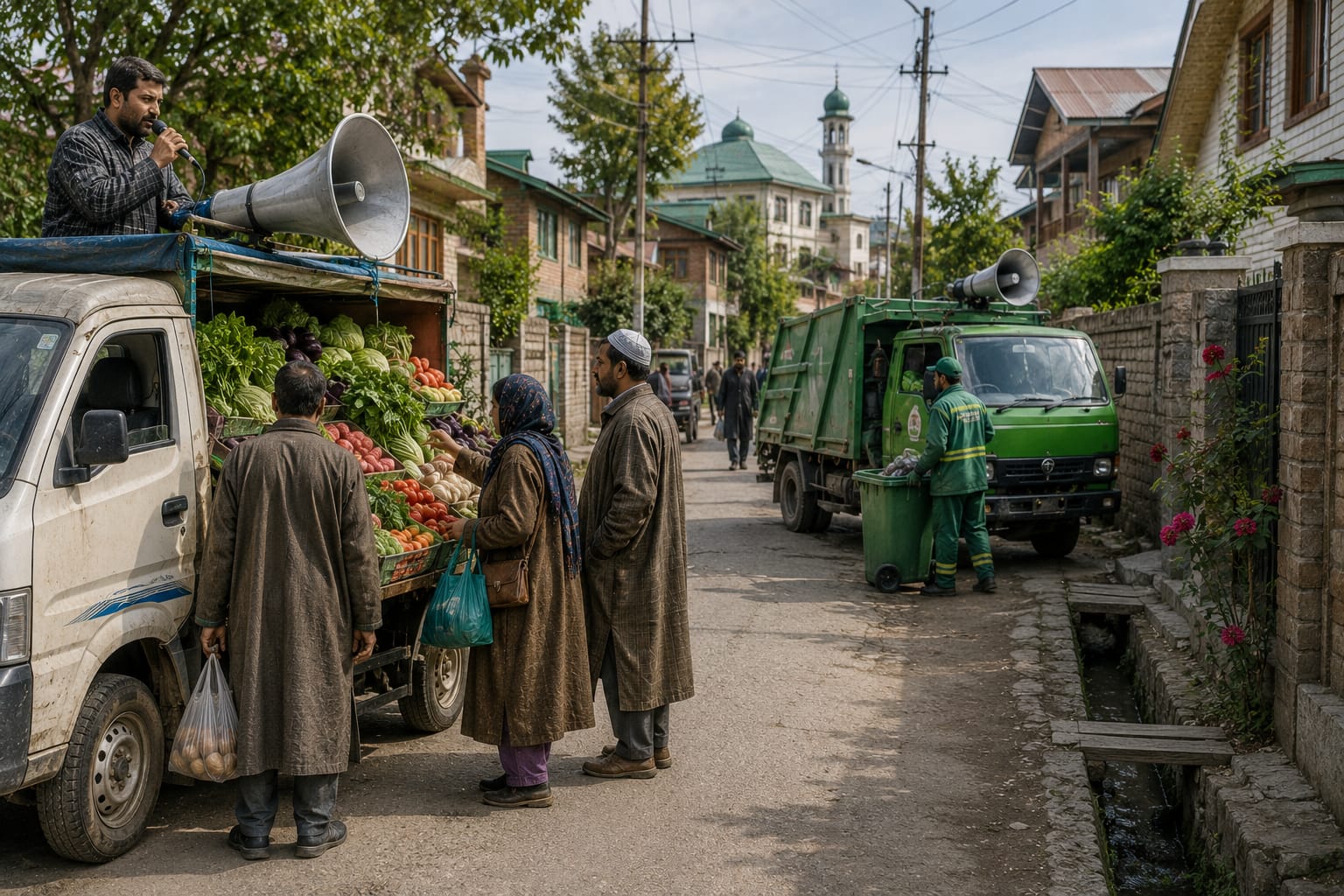
In the lanes and bylanes of Kashmir’s towns, villages, and residential colonies, a new form of mobile commerce has become an inseparable part of everyday life. From early morning until dusk, autos and vans carrying vegetables, fruits, and household essentials move through neighbourhoods, announcing their arrival over loudspeakers. For many households particularly the elderly, homemakers, and those unable to visit distant markets, these mobile vendors are a lifeline. At a time when formal employment opportunities remain limited, they also provide a vital source of income for hundreds of families. Their contribution to daily convenience and the local economy is undeniable and deserves appreciation.
Yet, alongside this convenience, another reality has quietly emerged: the growing problem of noise pollution caused by amplified announcements. What was once a simple call to attract customers has evolved into a relentless stream of loud, repetitive messages echoing through residential areas. Phrases such as “Sale, sale, sale” and “Hatas, five kilos” are broadcast repeatedly at high volume, often for long periods, turning otherwise peaceful neighbourhoods into zones of constant auditory disturbance.
A similar concern arises from the door-to-door garbage collection service operated by municipal bodies across Jammu and Kashmir. This initiative has greatly improved sanitation and waste management and deserves public appreciation. However, the daily repetition of loudspeaker announcements such as “Kachra dalo ji” often exceeds what is necessary, adding to the cumulative burden of noise in residential localities.
It is important to emphasise that the issue is not with mobile vendors or municipal garbage collection vans. Both provide essential public services that benefit society. The real concern is the absence of clear and enforceable regulations governing the use of loudspeakers in residential areas. Without such guidelines, a useful communication tool can gradually become a source of widespread inconvenience.
The impact of excessive noise is far from insignificant. Students preparing for examinations struggle to concentrate. Elderly residents, who are often more sensitive to loud sounds, experience unnecessary discomfort. Patients recovering at home need peace that is repeatedly interrupted, while infants and young children have their sleep disturbed. Over time, these repeated disruptions erode one of the most basic expectations of every citizen—the right to peace within one’s own home.
No occupation, however important, can reasonably claim an unrestricted right to disturb an entire community. The right to livelihood must coexist with the right to a peaceful environment. When one begins to overshadow the other, it becomes a legitimate civic concern.
The solution does not lie in banning mobile vendors or discontinuing municipal services. Such measures would be neither practical nor fair. Instead, what is needed is sensible regulation. Municipal bodies and district administrations should jointly establish clear guidelines on permissible loudspeaker volume, timing, and frequency of announcements. Silence zones around schools, hospitals, clinics, libraries, and other sensitive institutions must be strictly respected.
Equally important is creating awareness among service providers. In most cases, a brief announcement at a moderate volume is more than sufficient to inform residents without disturbing the entire neighbourhood.
Residents, too, must adopt a balanced perspective. Mobile vendors are not adversaries; they are individuals striving to earn an honest living under difficult economic circumstances. Municipal employees are not the source of the problem either; they are performing an essential public service. The issue is systemic, not personal.
A mature society does not force its citizens to choose between economic necessity and civic comfort. It creates systems that protect both. Our neighbourhoods should be places where people can earn their livelihoods with dignity while families can rest, study, recover, and live without unnecessary disturbance.
Ultimately, this is not a debate about convenience versus inconvenience. It is a question of balance. The right to earn a living is fundamental, but so is the right to peace and quiet. Good governance lies in ensuring that neither is compromised at the expense of the other.
“Our neighbourhoods should be places where people can earn their livelihoods with dignity while families can rest, study, heal, recover and live without unnecessary disturbance.”
Comments are closed.