India’s journey towards becoming a developed nation will not be determined by economic growth figures alone. It will also depend on how effectively the country harnesses the aspirations, creativity and enterprise of its people. A nation with one of the world’s youngest populations possesses an enormous advantage, but a demographic dividend does not automatically translate into economic prosperity. It requires opportunities, skills, access to finance, an environment that encourages innovation and, above all, the confidence to turn ideas into viable enterprises.
This is where entrepreneurship assumes particular significance. For a country where nearly 65 per cent of the population is below the age of 35, encouraging young people to become job creators rather than remain dependent entirely on conventional employment opportunities is both an economic necessity and a development imperative. India’s entrepreneurial landscape has undergone considerable change over the past decade, with startups, micro-enterprises, technology ventures and rural businesses increasingly becoming part of the country’s economic narrative.
The establishment of the Ministry of Skill Development and Entrepreneurship on November 9, 2014, marked an important institutional step towards recognising entrepreneurship as a distinct driver of national development. The observance of National Entrepreneurship Day on November 9 provides an opportunity to reflect on this journey, assess the progress made and consider what remains necessary to create an environment in which enterprise can flourish across every section of society.
The larger ambition is closely connected with the vision of Viksit Bharat @ 2047. As India approaches the centenary of its independence, entrepreneurship must become more than a policy objective. It must develop into a culture that encourages individuals to identify problems, devise solutions, take calculated risks and create economic opportunities for themselves and others.
A Changing Entrepreneurial Landscape
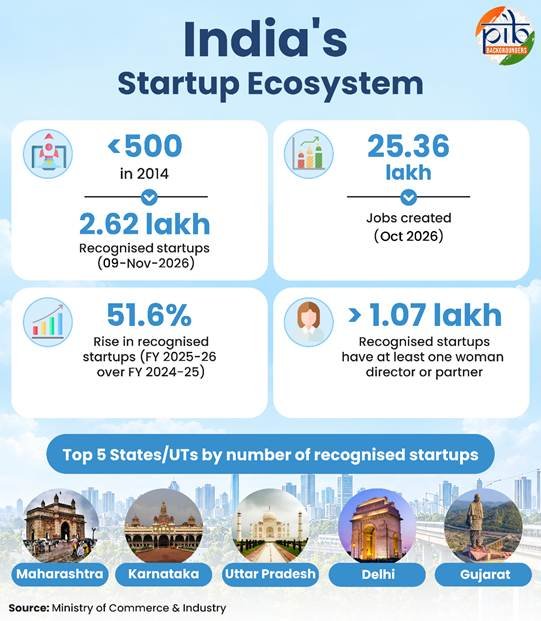
India’s startup ecosystem has expanded significantly since 2014. From fewer than 500 recognised startups at the beginning of the Startup India journey, the country had more than 2.62 lakh Department for Promotion of Industry and Internal Trade (DPIIT)-recognised startups by November 2026. This growth has established India as the world’s third-largest startup ecosystem.
The scale of this transformation is reflected not merely in the number of enterprises but also in their contribution to employment. More than 25 lakh direct jobs have been generated by recognised startups up to October 2026. During the financial year 2025-26, the number of recognised startups increased by 51.6 per cent year-on-year, while direct employment generated by them rose by 36.1 per cent.
These figures indicate that entrepreneurship is gradually becoming an important component of India’s employment landscape. Startups are no longer confined to a handful of technology companies operating from metropolitan offices. They are emerging in different sectors, addressing practical challenges and creating opportunities in areas ranging from manufacturing and healthcare to education, agriculture, financial services and transportation.
Another encouraging development is the geographical spread of entrepreneurship. Startups are now present across all States and Union Territories, while Maharashtra, Karnataka, Uttar Pradesh, Delhi and Gujarat have emerged as leading regions in recognised startup numbers and direct employment generation.
Equally significant is the participation of women. More than 1.07 lakh recognised startups had at least one woman director or partner as of March 2026, representing approximately 48 per cent of the total recognised startup ecosystem. This participation demonstrates that entrepreneurial ambitions are increasingly extending beyond traditional social and economic boundaries.
However, the real measure of success will not be the number of startups registered or the amount of investment announced. It will be the ability of these enterprises to survive, expand, generate stable employment and contribute meaningfully to the economy. Building a large startup ecosystem is an achievement; building a resilient one is the more difficult task.
From Policy Support to Practical Opportunities
One of the important reasons behind India’s entrepreneurial expansion has been the development of an institutional framework that supports enterprises at different stages of growth. The Startup India initiative, launched in 2016, has evolved into a broader platform offering financial assistance, mentorship, investor connections and institutional support.
The Fund of Funds for Startups, with an original corpus of ₹10,000 crore, was designed to channel capital into startups through SEBI-registered Alternative Investment Funds. By October 2026, SIDBI had committed ₹12,623 crore to 166 such funds, which had invested ₹28,254 crore in 1,475 startups. The notification of Startup India Fund of Funds 2.0 in April 2026, with another ₹10,000 crore corpus, further reflects the emphasis on mobilising investment, particularly for deep-tech, innovative manufacturing and early-growth-stage ventures.
Access to finance remains one of the biggest obstacles for aspiring entrepreneurs. A promising idea may have commercial potential, but without adequate capital, it can struggle to progress beyond the planning stage. This is particularly true of technology-based enterprises, which often require substantial investment in research, product development, testing and market entry before becoming commercially viable.
The Credit Guarantee Scheme for Startups addresses another important barrier by facilitating collateral-free loans through eligible financial institutions. Its guarantee cover was expanded from ₹10 crore to ₹20 crore per borrower during FY 2025-26. By October 2026, the scheme had guaranteed 532 loans worth ₹1,662.71 crore. Such mechanisms can make formal credit more accessible to enterprises that may possess innovative ideas but lack conventional collateral.
Similarly, the Startup India Seed Fund Scheme, with a corpus of ₹945 crore, supports startups during the crucial early stages of development, including proof of concept, prototyping, product trials and commercialisation. The approval of ₹775.67 crore for 4,194 startups through 244 incubators reflects the importance of supporting innovation before enterprises become attractive to mainstream investors.
Yet, financial assistance alone cannot guarantee entrepreneurial success. First-generation entrepreneurs often need guidance in preparing business plans, understanding regulatory requirements, managing finances, developing products and identifying customers. Mentorship and institutional handholding are therefore as important as capital.
Platforms such as the Startup India Hub, the MAARG mentorship programme and the Startup India Investor Connect Portal seek to address these requirements by connecting entrepreneurs with mentors, investors, incubators and other stakeholders. The effectiveness of such platforms will ultimately depend on how accessible and useful they are to entrepreneurs beyond established business networks.
Innovation Must Begin Before the Startup Is Born
A successful entrepreneurial ecosystem cannot be created merely by encouraging people to register businesses. It requires a broader culture of curiosity, experimentation and problem-solving, beginning in schools, colleges and universities.
This is where the Atal Innovation Mission assumes importance. Launched by NITI Aayog in 2016, it seeks to encourage innovation across educational institutions, research organisations, universities and industry. Its expanded second phase, AIM 2.0, approved in November 2024 with an outlay of ₹2,750 crore up to March 2028, aims to deepen participation and strengthen regional collaboration.
The underlying idea is important. Young people should not be encouraged merely to memorise information and compete for conventional jobs. They should also be given opportunities to experiment, question established practices, develop practical solutions and understand how ideas can be converted into useful products and services.
India’s technology entrepreneurship initiatives further strengthen this approach. The MeitY Startup Hub, established in 2016, connects startups, incubators and Centres of Excellence in emerging technologies. By November 2026, it supported more than 6,149 startups, 518 incubators and over 329 laboratories.
The Technology Incubation and Development of Entrepreneurs (TIDE) 2.0 scheme promotes enterprises working with emerging technologies such as artificial intelligence, robotics, blockchain and the Internet of Things. Its support across healthcare, education, agriculture, financial inclusion, transportation and clean technology illustrates how innovation can address practical development challenges.
Similarly, the GENESIS initiative focuses on strengthening technology startups, particularly in Tier-II and Tier-III cities. Its Entrepreneur-in-Residence programme offers aspiring innovators financial assistance of up to ₹10 lakh, alongside incubation, mentorship and product-development support.
The National Initiative for Developing and Harnessing Innovations (NIDHI) has also contributed to this ecosystem by supporting more than 12,000 startups and over 200 Technology Business Incubators, generating more than 1.30 lakh jobs and contributing to over 1,150 intellectual property assets.
These initiatives point towards an important transition: India’s future competitiveness will increasingly depend on its ability to transform knowledge into commercially and socially useful innovation. Universities, research institutions and industries must therefore work more closely together. Academic research should not remain confined to laboratories when it has the potential to solve problems in agriculture, medicine, manufacturing, energy and everyday life.
Entrepreneurship Cannot Be Limited to Technology Startups
While technology startups often dominate discussions about entrepreneurship, the country’s economic transformation must also include small businesses, local manufacturers, service providers, artisans, traders and other micro-enterprises.
For millions of Indians, entrepreneurship does not begin with venture capital or an advanced technological innovation. It may begin with a small shop, a tailoring unit, a dairy business, a food-processing enterprise, a repair service or a local manufacturing activity.
Such enterprises may appear modest individually, but collectively they contribute significantly to livelihoods, local economic activity and employment generation. Their importance is particularly pronounced in smaller towns and rural areas, where access to formal employment may be limited.
The Pradhan Mantri Mudra Yojana, introduced in 2015, recognises this reality by providing collateral-free loans of up to ₹20 lakh to eligible micro and small enterprises in the non-corporate, non-farm sector. Its four categories—Shishu, Kishor, Tarun and Tarun Plus—allow financial assistance to correspond with the size and stage of business development.
As of October 30, 2026, the scheme had sanctioned more than 2.44 crore loans amounting to over ₹3.3 lakh crore during FY 2026-27, according to the supplied figures.
The importance of such credit lies in its potential to help small entrepreneurs purchase equipment, arrange working capital, expand operations and move towards more organised business practices. For a person seeking to establish a small enterprise, access to affordable institutional finance can make the difference between abandoning an idea and giving it a chance.
The Prime Minister’s Employment Generation Programme (PMEGP) provides another avenue by supporting the establishment of new micro-enterprises through margin money subsidies linked to bank loans. With project cost limits of ₹50 lakh in manufacturing and ₹20 lakh in services, it seeks to encourage self-employment while providing additional support to designated special categories.
Similarly, the ASPIRE initiative promotes rural industries and entrepreneurship through Livelihood Business Incubators. By October 2026, 109 such incubators had been approved, with more than one lakh beneficiaries receiving skill development support.
These programmes highlight an important principle: entrepreneurship must not be viewed exclusively through the lens of high-growth startups. A small enterprise that sustains a family, employs local workers and strengthens a village economy is also contributing to national development.
Taking Enterprise Beyond Metropolitan India
For a long time, India’s entrepreneurial imagination was closely associated with metropolitan centres such as Bengaluru, Mumbai, Delhi, Hyderabad and Pune. These cities offered access to investors, specialised talent, established business networks and relatively developed infrastructure.
That concentration, however, is gradually changing. Approximately 52 per cent of recognised startups now originate from non-metropolitan cities. Lower operating costs, emerging industrial clusters, improving infrastructure and the availability of skilled talent are encouraging entrepreneurs to establish businesses beyond traditional startup hubs.
This geographical expansion is important for a country as diverse as India. Economic opportunities cannot remain concentrated in a few urban centres while smaller towns and rural regions depend largely on migration for employment.
The next phase of entrepreneurial growth must therefore be inclusive of India’s smaller cities, towns and villages. This requires more than encouraging business registration. Entrepreneurs in emerging regions need accessible incubation facilities, reliable internet connectivity, quality education, banking services, market linkages and guidance on regulatory compliance.
Rural entrepreneurship deserves particular attention because it can address two challenges simultaneously: unemployment and economic migration. When people are able to establish sustainable enterprises within their communities, they can create local employment while making better use of locally available resources.
The Start-up Village Entrepreneurship Programme under the National Rural Livelihoods Mission offers an example of this approach. By June 2026, it had supported 4.32 lakh rural enterprises. Around 86 per cent of the entrepreneurs belonged to Scheduled Castes, Scheduled Tribes, Minority and Other Backward Classes communities, highlighting the programme’s emphasis on social inclusion.
The National Campaign on Entrepreneurship-II under DAY-NRLM, launched in August 2026 for another three months until November 21, seeks to strengthen rural women’s entrepreneurship and contribute to the ambition of creating six crore Lakhpati Didis.
The broader significance of these programmes lies in recognising rural women not merely as beneficiaries of development schemes but as potential business owners, producers, service providers and economic decision-makers.
Women as Drivers of Economic Transformation
Women’s participation in entrepreneurship is not simply a question of representation. It is directly connected with economic growth, household prosperity and social empowerment.
When women establish enterprises, the benefits often extend beyond their individual incomes. They can strengthen household financial security, create employment for other women, improve children’s educational prospects and influence economic decision-making within their communities.
However, women entrepreneurs frequently face barriers that extend beyond access to finance. Limited property ownership, social expectations, mobility constraints, unequal access to professional networks and the additional burden of unpaid care responsibilities can make business development more difficult.
The Swavalambini Scheme, launched in 2025, seeks to address some of these challenges by supporting young women from the ideation stage to enterprise creation. Its approach includes entrepreneurship training, financial and market guidance, legal assistance and 21 weeks of mentorship and handholding.
Such initiatives are important because confidence and knowledge are essential components of entrepreneurship. A woman with a promising business idea must have access to the same institutional guidance, financial opportunities and market connections available to other aspiring entrepreneurs.
The growing participation of women in recognised startups is encouraging, but the next objective should be to increase their presence in leadership positions, ownership, innovation-driven businesses and higher-value economic activities.
A developed India cannot be built by leaving a substantial part of its potential entrepreneurial workforce on the margins.
Bringing Informal Enterprise into the Formal Economy
Street vendors and small traders represent another important dimension of India’s entrepreneurial landscape. Their businesses provide essential goods and services, sustain families and contribute to the daily functioning of towns and cities.
Yet, many operate with limited working capital and little access to formal banking facilities. The PM Street Vendor’s AtmaNirbhar Nidhi (PM SVANidhi), launched in June 2020, was designed to address this gap through collateral-free working capital loans.
The scheme provides progressively higher loan facilities of ₹15,000, ₹25,000 and ₹50,000, supported by interest subsidies and credit guarantees. Eligible vendors who repay the second loan can also qualify for a UPI-linked RuPay credit card with a limit of ₹30,000.
Digital participation is another important feature, with cashback incentives of up to ₹1,600 for retail and wholesale digital transactions. Through SVANidhi se Samriddhi, vendors and their families can also be facilitated in accessing eight selected Central welfare schemes.
By November 9, 2026, the scheme had reached more than 80.7 lakh beneficiaries, with over ₹20,400 crore sanctioned.
The larger opportunity is to help informal businesses become more financially secure and institutionally connected without undermining their independence. Access to digital payments, affordable credit and social protection can gradually improve their ability to manage risks and expand their businesses.
However, formalisation must remain accessible. Small entrepreneurs should not find themselves overwhelmed by complicated documentation, technological requirements or compliance procedures that they lack the resources to manage.
The Challenges That Must Not Be Overlooked
Despite the considerable expansion of India’s entrepreneurial ecosystem, it would be premature to assume that the availability of schemes automatically translates into equal opportunities for every aspiring entrepreneur.
One of the most persistent challenges is the gap between access to financial assistance and the ability to build a sustainable business. Credit can help establish an enterprise, but it cannot guarantee customers, profitability or long-term survival.
Many first-generation entrepreneurs lack experience in financial management, market research, pricing, taxation, marketing and business planning. Without adequate guidance, even well-intentioned ventures can struggle.
The government, financial institutions, universities and industry bodies must therefore strengthen the support available after an enterprise is established. Entrepreneurship programmes should not end with loan disbursement, registration or initial training. They should also facilitate market access, business development, technology adoption and professional guidance.
Another challenge is the uneven distribution of entrepreneurial infrastructure. Although startups are increasingly emerging outside metropolitan areas, access to investors, specialised mentors, research facilities and advanced technology remains more limited in many smaller towns and rural regions.
Digital connectivity has opened new possibilities, but digital access alone cannot compensate for the absence of reliable physical infrastructure, skilled manpower, transportation networks and institutional support.
There is also a need to encourage innovation that addresses India’s own development priorities. Startup success should not be measured only by valuation, funding rounds or the ability to attract international investment. Enterprises that develop affordable healthcare solutions, improve agricultural productivity, strengthen local manufacturing, reduce environmental damage or provide better educational access deserve equal recognition.
The long-term strength of the ecosystem will depend on how many businesses become economically viable, how many generate meaningful employment and how effectively they contribute to solving real problems.
India must also strengthen the relationship between education and entrepreneurship. Educational institutions should provide students with exposure to practical business challenges, financial literacy, innovation and problem-solving. A young graduate should not necessarily view entrepreneurship as an unfamiliar or excessively risky alternative to conventional employment.
Equally, society must develop a healthier attitude towards failure. Every business idea will not succeed, and not every venture will become a large enterprise. What matters is creating an environment in which responsible risk-taking is encouraged, lessons from unsuccessful ventures are valued and aspiring entrepreneurs are not permanently discouraged by setbacks.
Building the Entrepreneurial Foundation for Viksit Bharat
India’s ambition of becoming a developed economy by 2047 will require sustained productivity growth, technological advancement, stronger manufacturing, higher employment and more inclusive economic participation.
Entrepreneurship can contribute to each of these objectives. It can encourage innovation, create new industries, improve competition, generate employment and bring economic activity to regions that have traditionally remained outside major development centres.
The country’s projected economic growth trajectory, including the aspiration of becoming a $7.3 trillion economy by 2030, provides an important context for this transition. But the quality of that growth will matter as much as its scale.
A developed economy cannot be built solely through large corporations and major infrastructure projects. It also requires thousands of small and medium-sized enterprises, innovative startups, village-level businesses, women-led ventures and skilled individuals who can convert opportunities into productive economic activity.
This is why the entrepreneurial journey must be viewed as a collective national effort. Government schemes can create enabling conditions, financial institutions can improve access to capital, universities can nurture innovation, industries can provide mentorship and markets, and communities can encourage aspiring entrepreneurs.
The role of young Indians will be particularly important. The Amrit Peedhi must be equipped not only with qualifications but also with the confidence, skills and practical understanding required to build enterprises. Their aspirations should be supported by an ecosystem that rewards creativity, encourages responsible innovation and makes opportunities accessible regardless of geographical or economic background.
National Entrepreneurship Day, therefore, should serve as more than an occasion to celebrate the number of startups established or the financial assistance distributed. It should remind us that entrepreneurship is ultimately about human potential—the ability of individuals to identify opportunities, overcome constraints and create something of lasting value.
India has made important progress in building the institutional and financial foundations of an entrepreneurial economy. The expansion of startups, increasing participation of women, growth of non-metro enterprises and support for rural businesses all point towards a more diversified development model.
The task ahead is to ensure that these opportunities translate into sustainable enterprises, productive employment and broader prosperity. The real success of India’s entrepreneurial transformation will be measured not merely by how many businesses are launched, but by how many survive, how many lives they improve and how widely their benefits are shared.
If the country can combine its demographic advantage with innovation, skills, accessible finance and inclusive opportunities, entrepreneurship can become one of the strongest pillars of Viksit Bharat @ 2047.
The journey from job seekers to job creators is not simply an economic transition. It represents a change in mindset—from waiting for opportunities to creating them, from depending on established systems to building new possibilities, and from individual ambition to collective national progress.
The article is based on the inputs and background information provided by the Press Information Bureau (PIB). Author is Writer, Policy Commentator. He can be mailed at kcprmijk@gmail.com


Comments are closed.