


Mahendra Tiwari
“Voluntarily embracing a religious tradition and having the state forcibly impose it are two entirely different things. A person’s attire can never be the measure of their morality, character, or civil rights.”
Music is the gentlest and most universal expression of human civilization, reaching straight to the heart beyond any boundary, language, or ideology. However, when a state’s legal apparatus classifies a woman’s singing as a crime and responds by lashing her body, it ceases to be a mere legal proceeding; it raises a profound question before the entire human conscience. What transpired in the Iranian city of Qom on November 23, 2026, has deeply shaken art lovers and thinkers across the globe. Renowned Iranian singer Parastoo Ahmadi and four of her companions were subjected to seventy-four lashes each. Confirmed by their lawyer, Mostafa Nili, this punishment is not limited to corporal penalty alone; they have also been barred from participating in any artistic activities and from traveling abroad for two years.
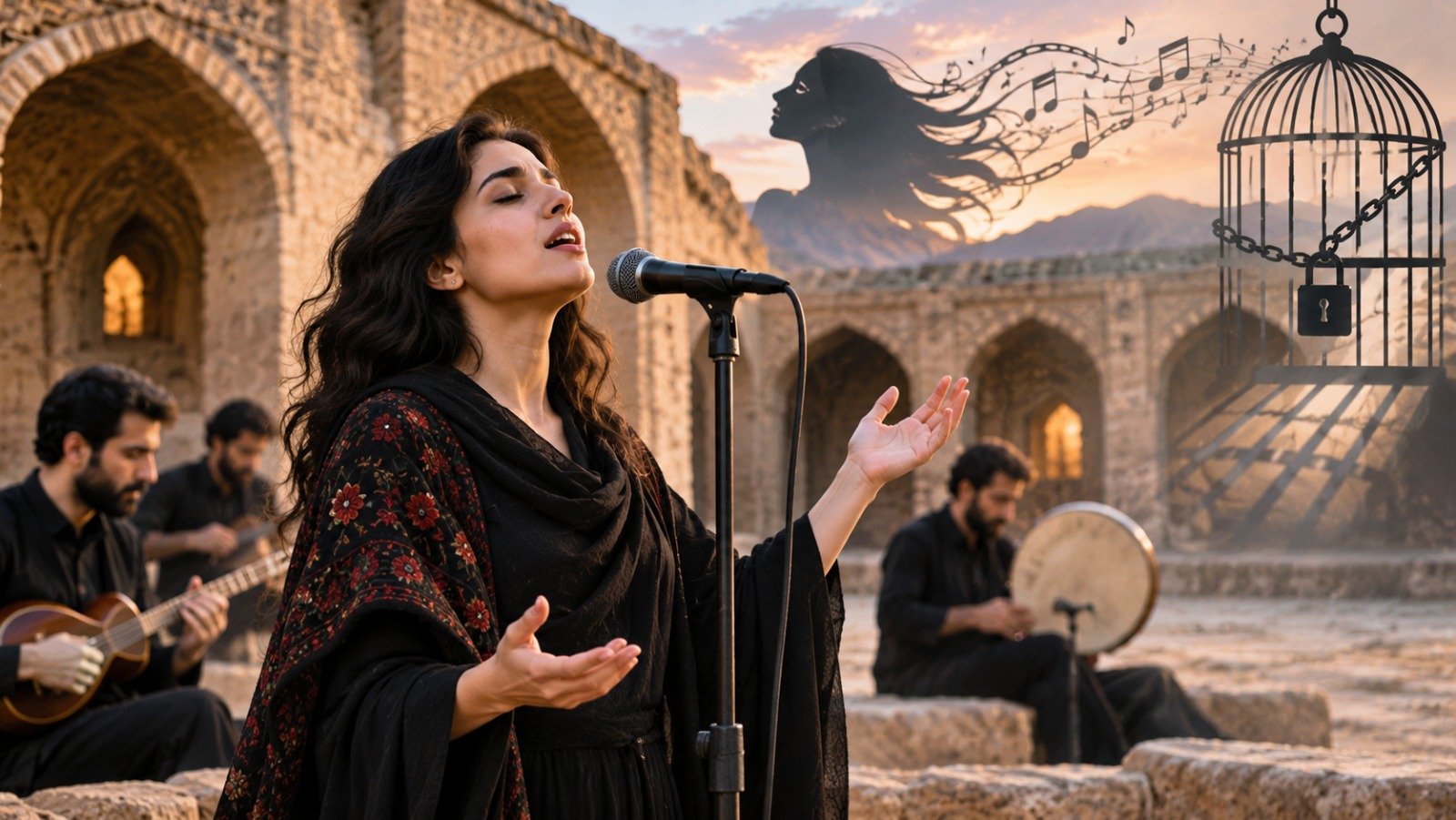
The roots of this entire episode lie in a quiet, artistic performance from December 2024. Parastoo Ahmadi had chosen the historic Deir-e Gachin Caravanserai in Iran’s Qom province for her musical evening. A witness to ancient trade routes, this caravanserai stands as a symbol of Iran’s rich architectural and cultural heritage. There was no crowd there, nor any live audience-only a few musical instruments, male musicians, recording equipment, and Parastoo, dressed in black with her hair uncovered, singing her song. Conceived as an imaginary concert, its video was shared with the world through the digital realm. In no time, the performance gained popularity among millions, yet this very acclaim became a source of peril for the artists.
Born in 1997 in Nowshahr, Iran, Parastoo Ahmadi formally studied film direction and has maintained a deep connection with traditional Iranian music. This was not the first time her art faced administrative hurdles. Earlier, during the “Woman, Life, Freedom” movement in Iran, security agencies had raised objections to her musical activities. Against this backdrop, the caravanserai performance cannot be viewed as an isolated or accidental event. It was the natural extension of a sensitive artist’s ongoing creative journey, through which she sought to keep the music of her soil alive in a new context.
As soon as the performance was broadcast, Iran’s judicial system swung into action, filing criminal charges against the artists. Parastoo and some of her colleagues were initially detained and later released on bail. In June 2026, a court in Qom convicted the singer and her companions of violating public decency and publishing inappropriate content online. Their appeal was rejected in September, leading to the enforcement of the sentence in November. Along with Parastoo, those who faced the punishment include musicians Soheil Faghih Nasiri, Amin Taheri, Amirali Pirnia, and event organizer Mohsen Lashkari. Although other names were linked to the initial case, the implementation of the sentence has been confirmed for these five individuals.
To grasp the depth of these events, one must look at Iran’s social and legal background. Following the 1979 Islamic Revolution, religious rules were codified into law in public life. Under this framework, covering the head in public became mandatory for women, and strict bans were imposed on solo female singing in public. Parastoo’s performance presented a quiet yet clear challenge to both of these established norms. She neither covered her head nor confined her voice within four walls.
Here, a subtle and essential distinction must be understood. Voluntarily embracing a religious tradition and having the state forcibly impose it are two entirely different things. Across the world, millions of women cover their heads out of personal faith and conviction, while countless others choose not to. It is the duty of a civilized society to respect a woman’s free will and dignity in both circumstances. A person’s attire can never be the measure of their morality, character, or civil rights.
This discourse on women’s personal freedom in Iran intensified sharply in 2022 following the death of twenty-two-year-old Mahsa Amini in police custody. That incident, stemming from an alleged violation of dress codes, sparked widespread public outrage across the country. In its wake, numerous Iranian women registered both silent and vocal resistance against mandatory dress laws. While Parastoo’s singing appears connected to this broader social awakening, viewing her art solely through the lens of political protest would do an injustice to its beauty. Music has an independent existence of its own, giving voice to human memories, love, pain, and hope. Parastoo’s voice echoing within the walls of that historic caravanserai was adding a new, living chapter to Iran’s ancient cultural tradition.
At the international level, human rights organizations have condemned the sentence of flogging as cruel and inhumane. Global human rights principles leave no room for physical torture and degrading punishment. Although the Iranian administration continues to dismiss Western criticism as double standards, the question of a citizen’s bodily dignity and freedom of expression far transcends geopolitical debates.
It is here that reflecting on the fundamental difference between law and justice becomes pertinent. Law is a framework of rules constructed by authority, whereas justice is a living moral touchstone that continually tests the legitimacy of those rules over time. History bears witness that many practices once deemed criminal by law were eventually recognized as fundamental rights as human consciousness evolved. Therefore, questioning an oppressive rule is not an insult to a nation or its ancient culture, but rather proof of concern for its humane future.
The punishment handed to Parastoo and her companions is not confined to the physical agony of seventy-four lashes. Being deprived of one’s art for two years is a direct blow to an artist’s livelihood and creative identity. The travel ban blocks their avenues for the future. This situation demands serious contemplation on where the limits of state power should stop regarding an individual’s private life, profession, and creativity.
While reflecting on this entire episode, we must avoid the mistake of confining Iranian society to a single narrow mold. Both traditionalists and modernists live there. An entire nation’s people cannot be held responsible for the harsh decisions of their government. The voices of support rising for Parastoo from within Iran itself testify to how diverse and sensitive its society truly is.
This incident also holds a profound message for citizens of a pluralistic country like India. Our strength lies in our linguistic, religious, cultural, and ideological diversity. This occasion offers us an opportunity for self-reflection: to examine whether we, too, are growing intolerant toward someone’s attire, views, or artistic expression in our own surroundings. True freedom is not merely the right to voice one’s own opinion, but also the patience to listen respectfully to a dissenting voice.
Through state power, an artist’s stage can be dismantled, their instruments silenced, and their body tortured. Yet a song that has once settled into the hearts of its listeners cannot be erased by any lash. Parastoo Ahmadi’s voice has now transcended the walls of that old caravanserai to become a global symbol of human dignity. The true measure of any civilization’s progress is not its material prosperity or military might, but how it protects the rights of a woman who sings fearlessly in its midst.
“The true measure of any civilisation’s progress is not its material prosperity or military might, but how it protects the rights of a woman who sings fearlessly in its midst.”
Comments are closed.