India’s food security begins not in its granaries or markets, but beneath the feet of its farmers. Every bumper harvest, every successful cropping season and every promise of agricultural prosperity rests upon an often overlooked resource—healthy soil. While discussions on Indian agriculture frequently revolve around minimum support prices, irrigation, farm incomes or procurement policies, the condition of the country’s soils rarely commands similar public attention. Yet it is the quality of soil that ultimately determines productivity, resilience against climate change, profitability for farmers and sustainability for future generations.
For decades, India’s agricultural success has largely been measured by production figures. The Green Revolution transformed the country from a food-deficit nation into one capable of feeding more than 1.4 billion people. However, that remarkable achievement also exposed the limits of an input-intensive farming model dependent on excessive chemical fertilisers, groundwater extraction and monocropping. Continuous cultivation without adequate replenishment of soil nutrients has gradually weakened soil fertility across large parts of the country. Declining organic carbon, micronutrient deficiencies, salinity, erosion and shrinking biodiversity beneath the surface have emerged as silent threats to agricultural sustainability.
This is why the government’s renewed emphasis on soil health deserves closer attention. The recently intensified focus on scientific soil management, balanced fertiliser application, natural farming, digital agriculture and climate-resilient practices reflects a recognition that future agricultural growth cannot simply rely on increasing inputs. Instead, productivity must increasingly emerge from restoring the health of the very resource that supports farming itself.
The significance of this shift becomes clearer when viewed against the scale of Indian agriculture. Nearly 59 per cent of the country’s reported geographical area is under agriculture, while almost half of India’s workforce continues to depend directly or indirectly on farming and allied activities. Any deterioration in soil quality therefore has consequences extending well beyond agriculture. It affects rural employment, food inflation, nutritional security, export competitiveness and environmental sustainability.
Healthy soils perform functions that go far beyond supporting plant growth. They regulate water movement, recycle nutrients, store carbon, sustain microorganisms and help crops withstand droughts, floods and temperature extremes. A fertile soil reduces dependence on expensive external inputs while improving productivity and farm profitability. Conversely, degraded soils demand larger quantities of fertilisers and irrigation merely to maintain existing levels of production, increasing cultivation costs without guaranteeing better returns.
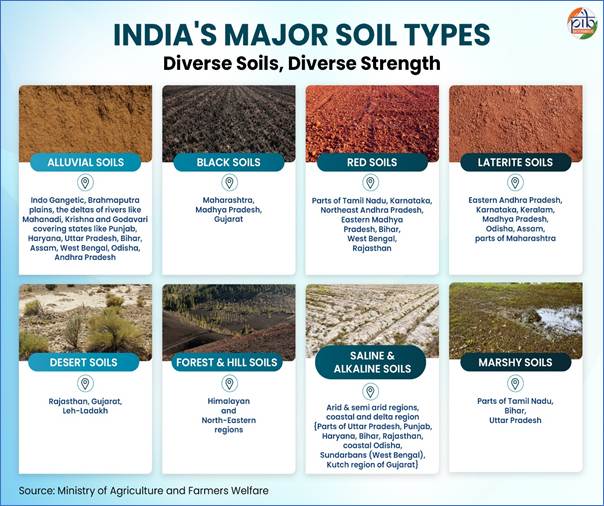
India’s diverse agro-climatic conditions make soil management even more complex. The country possesses one of the world’s richest varieties of soils, each shaped by geography, climate and geological history. The fertile alluvial plains stretching across northern India continue to sustain the country’s grain basket. The moisture-retentive black soils of central and western India support cotton cultivation. Red soils dominate large parts of the Deccan Plateau, while laterite soils characterise regions with heavy rainfall. Desert soils, forest soils, marshy lands and saline-alkaline tracts each present unique challenges requiring region-specific management strategies.
This diversity makes a uniform approach to agriculture both impractical and inefficient. The nutrient requirements of a wheat field in Punjab differ substantially from those of a cotton farm in Maharashtra or a paddy field in Odisha. Scientific soil management therefore demands localised solutions built upon detailed understanding of nutrient composition, organic matter, water availability and climatic conditions.
Recognising this need, India has gradually shifted towards evidence-based soil management over the past decade. The Soil Health Card Scheme represents perhaps the most ambitious attempt to translate scientific knowledge into farm-level decision-making. By providing farmers with crop-specific recommendations based on laboratory analysis of soil samples, the programme seeks to replace blanket fertiliser application with balanced nutrient management.
The scale of the initiative is remarkable. More than 25 crore Soil Health Cards have been generated, enabling millions of farmers to understand the nutrient profile of their fields. Equally important are the accompanying demonstrations conducted through Krishi Vigyan Kendras and Agricultural Technology Management Agencies, which attempt to bridge the persistent gap between scientific recommendations and on-ground farming practices.
The experience of farmers adopting soil-test-based fertiliser management offers valuable lessons. Evidence emerging from field demonstrations indicates that balanced nutrient application not only improves crop yields but also reduces cultivation costs by avoiding unnecessary fertiliser use. Farmers who previously relied heavily on nitrogen-based fertilisers have reported better crop health after introducing secondary nutrients such as potash and lime based on scientific recommendations. Such outcomes suggest that sustainability and profitability need not always be competing objectives; often they reinforce one another.
The challenge, however, extends beyond nutrient deficiencies. Climate change has introduced an entirely new dimension to soil management. Rising temperatures, erratic rainfall, prolonged droughts and intense precipitation events are accelerating soil degradation in many regions. Topsoil erosion, declining organic matter and reduced moisture retention threaten long-term agricultural productivity. Protecting soil has therefore become as much a climate adaptation strategy as an agricultural intervention.
Here lies one of the most significant aspects of India’s evolving agricultural policy. Increasing attention is being paid to the role of soils as natural carbon sinks. Healthy soils absorb atmospheric carbon dioxide through vegetation and microbial activity, storing it as soil organic carbon over extended periods. This process contributes not only to climate mitigation but also improves soil structure, water retention and nutrient availability.
Consequently, several national programmes increasingly intersect around the common objective of strengthening soil resilience. The National Mission for Sustainable Agriculture promotes climate-resilient farming systems through integrated water management and improved soil conservation. The Green India Mission seeks to enhance ecosystem services and carbon sequestration. Meanwhile, the National Mission on Natural Farming encourages practices that improve soil biology while reducing dependence on synthetic inputs.
Natural farming, in particular, has generated considerable public debate. Supporters argue that reducing chemical dependence improves long-term soil health, lowers cultivation costs and strengthens ecological resilience. Critics question whether productivity can be maintained at scale, particularly for staple crops critical to national food security. The reality perhaps lies somewhere between these positions. Rather than viewing natural farming and conventional agriculture as mutually exclusive models, policymakers increasingly appear to favour context-specific approaches that combine scientific innovation with ecological sustainability.
The rapid expansion of the National Mission on Natural Farming reflects this evolving policy direction. The programme has reportedly enrolled over 18 lakh farmers across nearly nine lakh hectares through thousands of farmer clusters. Equally significant is the creation of local Bio-input Resource Centres that produce natural farming inputs while providing practical demonstrations and farmer training. Such decentralised institutions may prove crucial in determining whether natural farming can move beyond pilot projects into mainstream agricultural practice.
Awareness campaigns have also assumed greater importance in recent months. Initiatives such as the Khet Bachao Abhiyan indicate recognition that policy success depends not merely on financial support or institutional programmes but also on behavioural change among farmers. Encouraging balanced fertiliser use, reducing excessive dependence on chemical inputs and promoting soil testing require sustained extension efforts capable of translating scientific concepts into practical field-level decisions.
Perhaps the most transformative aspect of India’s soil strategy, however, lies in the integration of digital technologies. Agriculture, traditionally regarded as one of the least digitised sectors, is increasingly adopting geospatial mapping, satellite imagery, artificial intelligence and integrated data platforms to improve decision-making. Soil management is emerging as one of the principal beneficiaries of this technological transformation.
High-resolution soil mapping projects are gradually creating village-level soil inventories capable of guiding crop planning, irrigation strategies and nutrient management. Simultaneously, digital platforms under the Digital Agriculture Mission seek to integrate soil information with farmer databases, land records and crop surveys, enabling highly localised advisory services. Artificial intelligence systems further analyse weather patterns, soil characteristics and crop conditions to generate location-specific recommendations.
Such technologies hold considerable promise, particularly in a country where extension services often struggle to reach millions of smallholders scattered across diverse agro-climatic regions. Digital advisory systems can potentially democratise access to scientific expertise, allowing even marginal farmers to make informed decisions based on reliable data rather than traditional assumptions alone.
Yet technology cannot substitute for institutional capacity. Soil laboratories require regular upgrading, extension personnel need continuous training and farmers must have confidence in advisory systems if recommendations are to influence actual farming practices. Bridging the gap between scientific capability and grassroots implementation remains one of the most important challenges facing agricultural policy.
Ultimately, India’s soil health initiatives reflect a broader philosophical shift in agricultural thinking. The emphasis is gradually moving away from maximising short-term production through increasing external inputs towards improving long-term productivity by strengthening natural resource foundations. That transition is neither simple nor immediate. It requires balancing productivity with sustainability, scientific innovation with traditional knowledge, and environmental stewardship with economic viability.
The stakes could hardly be higher. As climate uncertainties intensify and natural resources become increasingly stressed, healthy soils will determine whether Indian agriculture remains resilient enough to sustain future generations. Beneath every successful harvest lies not merely hard work or technological advancement, but living soil capable of supporting crops season after season. Protecting that invisible foundation may well prove to be one of the defining agricultural challenges of the twenty-first century.
The success of any soil conservation strategy ultimately depends on one crucial question: can farmers improve soil health without compromising productivity and incomes? This is where fertiliser reforms become central to India’s agricultural transformation. The objective is no longer to discourage fertiliser use altogether but to encourage smarter, more balanced and scientifically informed nutrient management.
For decades, Indian agriculture has been characterised by the excessive application of nitrogenous fertilisers, particularly urea. While nitrogen undoubtedly plays an essential role in plant growth, disproportionate use often leads to nutrient imbalances, declining soil fertility and lower efficiency of other essential elements such as phosphorus, potassium and micronutrients. Excessive nitrogen also contributes to groundwater contamination, greenhouse gas emissions and long-term degradation of soil biology.
Recognising these concerns, policymakers have gradually shifted towards balanced nutrient management. The Nutrient Based Subsidy (NBS) regime represents one such attempt to move beyond a one-dimensional fertiliser policy. By linking subsidies to nutrient content rather than individual products, the system encourages farmers to adopt more balanced fertiliser combinations suited to crop and soil requirements. While implementation challenges remain, the broader direction reflects an important policy evolution—from subsidising inputs to promoting nutrient efficiency.
Technology has significantly strengthened this reform process. Aadhaar-linked Point of Sale systems now enable real-time tracking of fertiliser sales, reducing leakages while improving transparency in subsidy delivery. The Direct Benefit Transfer mechanism for fertilisers ensures that subsidies are released only after actual sales to verified farmers, creating greater accountability across the supply chain. Equally important has been the nationwide adoption of neem-coated urea, which slows nitrogen release, improves nutrient absorption and discourages diversion of subsidised fertiliser for industrial use.
These administrative reforms may appear technical, but their cumulative impact extends beyond governance. They help shift the focus from simply making fertilisers cheaper to ensuring they are used more efficiently. For farmers facing rising cultivation costs, higher nutrient-use efficiency translates directly into lower input expenditure and better returns on investment.
However, the future of soil health cannot depend on fertiliser management alone. Restoring degraded soils increasingly requires rebuilding the biological systems that sustain fertility over the long term. Organic matter, beneficial microorganisms and improved soil structure are becoming as important as chemical nutrient availability. This is where the growing emphasis on carbon farming acquires strategic significance.
Globally, agriculture is being reimagined not merely as a contributor to greenhouse gas emissions but also as a potential solution to climate change. Healthy soils possess remarkable capacity to capture atmospheric carbon and store it as soil organic carbon. This process not only reduces carbon dioxide concentrations but simultaneously improves moisture retention, nutrient cycling and resilience against climatic stress.
India’s policy framework increasingly reflects this understanding. Programmes such as the National Mission for Sustainable Agriculture, the Green India Mission and the National Mission on Natural Farming all encourage practices that enhance soil organic carbon through better land management, crop diversification, agroforestry and reduced dependence on intensive chemical inputs. Rather than treating climate policy and agricultural policy as separate domains, these initiatives recognise their growing convergence.
Perhaps the most innovative development is the emergence of carbon markets as a potential source of supplementary farm income. Under the Carbon Credit Trading Scheme, farmers adopting scientifically verified climate-friendly agricultural practices may eventually earn tradable carbon credits. While India’s voluntary carbon market remains at a relatively early stage, the concept introduces a fundamentally new economic dimension to environmental stewardship. Soil conservation is no longer viewed solely as an ecological obligation; it can gradually become an economic opportunity.
If implemented transparently, carbon markets could reward farmers for adopting sustainable practices that deliver measurable environmental benefits. Improved soil carbon, reduced emissions and better resource management may generate financial returns alongside higher productivity. Nevertheless, success will depend on establishing reliable verification systems, reducing transaction costs and ensuring that small and marginal farmers are not excluded from emerging carbon markets because of technical or institutional barriers.
Natural farming also intersects with this broader climate agenda. Although debates continue regarding productivity, there is growing recognition that practices encouraging biological activity, crop residue recycling and locally prepared bio-inputs contribute positively to soil structure and long-term resilience. The expanding network of Bio-input Resource Centres established under the National Mission on Natural Farming seeks to make such practices more accessible by combining local production with farmer training and field demonstrations.
Equally significant is the growing role of women in these knowledge ecosystems. Community Resource Persons and Krishi Sakhis increasingly function as local agricultural extension agents, translating scientific recommendations into practical guidance for farming households. Their participation illustrates that sustainable agriculture is not only about technological innovation but also about strengthening rural institutions and community-based knowledge systems.
If biological restoration represents one pillar of future soil management, digital transformation represents the other. Agriculture has historically relied upon farmers’ experience accumulated over generations. While such traditional knowledge remains invaluable, contemporary farming increasingly requires decisions based on complex interactions among weather, soil conditions, crop characteristics and market dynamics. Digital technologies now make it possible to integrate these variables with unprecedented precision.
The Nationwide Soil Resource Mapping programme exemplifies this transformation. High-resolution soil mapping using satellite imagery, remote sensing and field observations is gradually creating detailed village-level inventories capable of guiding crop selection and land-use planning. Instead of applying generic recommendations across entire districts, advisory systems can increasingly generate location-specific guidance tailored to individual soil conditions.
This integration becomes even more powerful when combined with platforms such as AgriStack under the Digital Agriculture Mission. By linking soil information with land records, crop surveys and farmer databases, digital systems create a comprehensive agricultural information architecture. Such integrated datasets enable advisory services that account simultaneously for soil characteristics, cropping patterns and climatic conditions.
Artificial intelligence further expands these possibilities. AI-based soil diagnostics can identify nutrient deficiencies, detect early signs of soil stress and recommend timely corrective measures based on satellite imagery and field-level data. Decision-support systems incorporating weather forecasts, soil profiles and crop information enable farmers to optimise fertiliser application, irrigation schedules and sowing decisions with greater accuracy than ever before.
Precision agriculture, once considered relevant primarily to developed countries, is gradually finding Indian applications. Site-specific nutrient management allows fertilisers to be applied only where required and in quantities appropriate to local conditions. Such approaches improve resource efficiency while reducing environmental impacts and cultivation costs. Autonomous equipment, intelligent sensors and robotic systems currently under development may further transform agricultural operations over the coming decade.
Yet digital agriculture also raises important policy questions. Technology remains meaningful only when it reaches those who need it most. India’s agricultural landscape is dominated by small and marginal farmers cultivating fragmented holdings, often with limited digital literacy and uneven internet connectivity. Bridging this digital divide will require sustained investments in rural infrastructure, affordable digital services and farmer capacity-building.
Data governance presents another emerging challenge. As agricultural databases expand, questions regarding ownership, privacy and responsible use of farmer information will become increasingly important. Transparent regulatory frameworks must ensure that digital innovations strengthen farmer autonomy rather than creating new forms of dependence or exclusion.
Institutional coordination will equally determine the success of India’s soil agenda. Soil health intersects with agriculture, fertilisers, water resources, climate policy, rural development and scientific research. Effective implementation therefore requires stronger convergence across ministries, state governments, research institutions and extension agencies. Fragmented policy execution could dilute the impact of otherwise well-designed programmes.
Research priorities must also continue evolving. Climate change, emerging pest pressures, declining groundwater availability and changing market demands require continuous innovation in soil science. Universities, ICAR institutions and state agricultural departments will need to develop region-specific solutions capable of addressing highly diverse agro-ecological conditions across the country. Equally important is ensuring that scientific discoveries reach farmers through responsive and well-equipped extension systems.
Ultimately, India’s renewed focus on soil health represents something larger than another agricultural programme. It signals an important shift in development thinking. For decades, agricultural policy largely sought to maximise production through increasing external inputs. Today’s challenge is fundamentally different. It is about sustaining productivity while restoring ecological balance, conserving natural resources and preparing agriculture for an uncertain climatic future.
This transition demands patience because soil regeneration is inherently gradual. Unlike irrigation projects or procurement operations that produce immediate and visible outcomes, improvements in soil biology, organic carbon and ecosystem resilience often unfold over several years. Policymakers therefore face the difficult task of sustaining political and financial commitment to interventions whose greatest benefits may become visible only in the long term.
The broader lesson is equally important. India’s agricultural future will not be secured merely by producing more food but by producing it more sustainably. Healthy soils reduce production risks, strengthen climate resilience, improve nutritional quality and support rural livelihoods. They also contribute to national objectives extending far beyond agriculture, including food security, environmental conservation, water management and climate mitigation.
The phrase “beneath every harvest lies healthy soil” is therefore more than an evocative slogan. It captures a simple but profound truth. Every agricultural success ultimately depends upon an invisible ecosystem that takes centuries to form but can be degraded within a generation. Restoring that foundation requires scientific knowledge, responsible public policy, technological innovation and, above all, the participation of millions of farmers whose daily decisions determine the health of India’s land.
If the Green Revolution demonstrated India’s ability to overcome food scarcity through technology and policy, the coming decades may demand a different kind of revolution—one rooted not merely in higher yields but in healthier soils. The true measure of agricultural progress will increasingly lie not only in the quantity of grain harvested each season, but in whether the land remains fertile enough to nourish generations yet to come.
The article is based on the inputs and background information provided by the Press Information Bureau (PIB). Author is Writer, Policy Commentator. He can be mailed at kcprmijk@gmail.com


Comments are closed.