

Shabeer Ahmad Lone
“Military strength may dominate headlines for a season, wealth may purchase influence for a generation, and political power may shape an era — but only wisdom, justice, and compassion possess the ability to outlive time itself.”
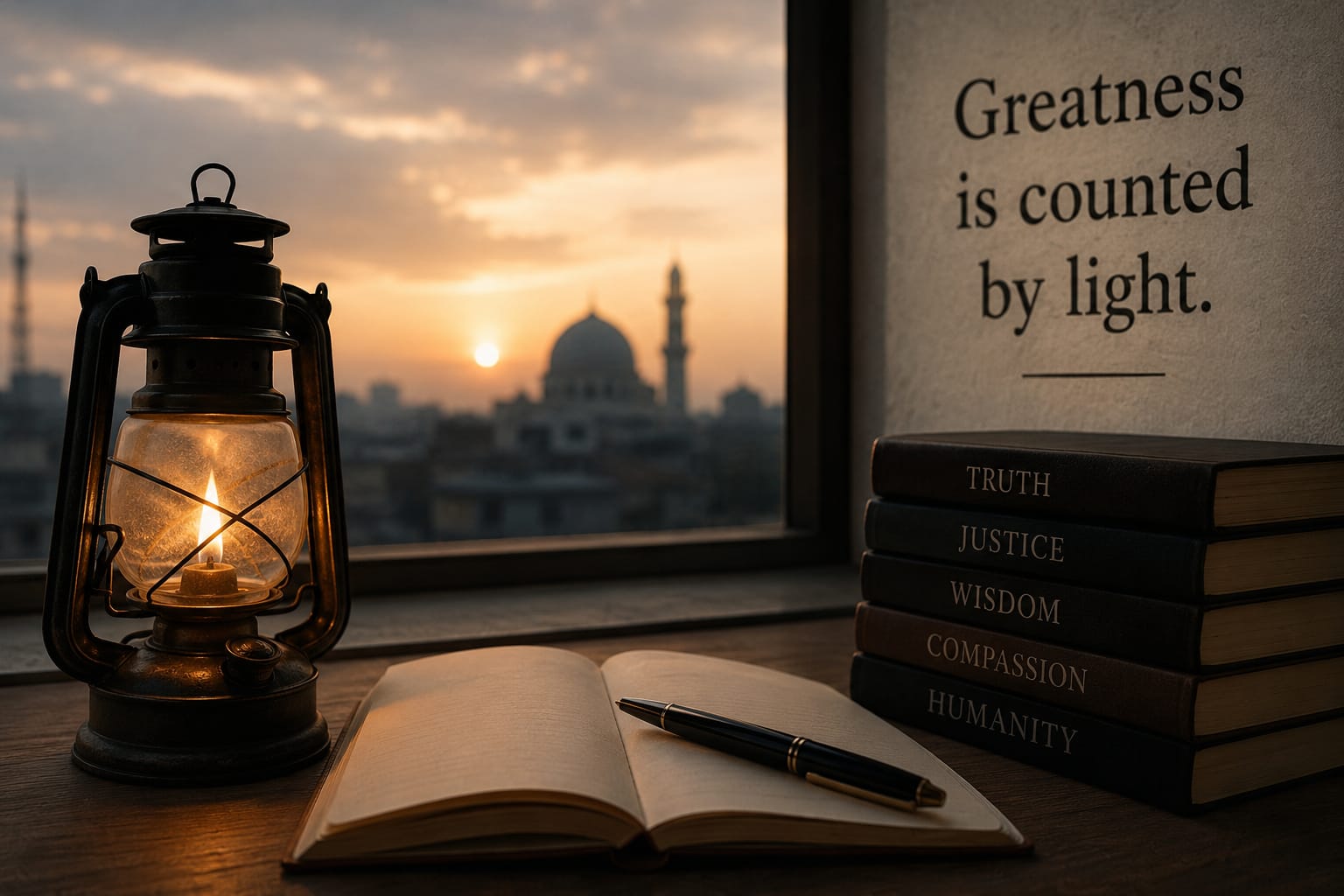
Greatness is among the most misunderstood words in human speech because human beings have always been tempted to mistake spectacle for substance, expansion for excellence, noise for significance, and possession for worth. Civilizations praise what can be counted quickly and displayed publicly: wealth, armies, monuments, popularity, speed, territory, technological novelty, strategic triumph, institutional prestige. Yet the most decisive things in human life have rarely been those easiest to count. Trust cannot be weighed. Wisdom has no market price. Conscience casts no measurable shadow. Compassion leaves no stable statistic. A just action may alter generations while appearing small in the hour of its performance. A cruel decision may seem efficient in the present while poisoning decades to come. For this reason, societies often reward what is visible while depending for survival upon what is nearly invisible. The confusion is ancient, but in the modern age it has become industrialized. We possess vast systems for measuring output and surprisingly weak instruments for measuring meaning. We know how to count transactions, but not gratitude; clicks, but not character; influence, but not integrity; expansion, but not elevation. Greatness therefore requires another standard. It is not chiefly the quantity of power one gathers, but the quality of reality one leaves behind. It is measured by what becomes clearer, freer, nobler, kinder, wiser, and more alive because someone or some community existed. In that deepest sense, greatness is counted by light.
Light remains the most fitting symbol because it performs without domination. It reveals while remaining itself unseen. It enables growth without advertisement. It does not argue with darkness; it renders darkness powerless by presence. A single lamp does not conquer a room through violence, but through disclosure. So too with moral and intellectual greatness. The greatest people often do not force reality into shape; they help reality appear as it truly is. They expose falsehood, clarify confusion, awaken dormant courage, reconcile estranged communities, and enlarge the horizon of what others thought possible. This is why light has served as a symbol across religions, philosophies, and poetries. Plato imagined ascent from the cave of shadows toward the sun of truth. Suhrawardi treated existence itself as degrees of radiance. Augustine of Hippo spoke of divine illumination within the mind. Rabindranath Tagore wrote of the light that breaks through narrow walls of identity. Muhammad Iqbal saw the self not as egoistic vanity but as a flame to be disciplined into creative responsibility. Across differences, the insight converges: greatness is inseparable from illumination.
Yet illumination is not mere brightness. Much of what dazzles is counterfeit. There is glare that blinds rather than guides, brilliance that intoxicates rather than instructs, charisma that seduces rather than serves. Entire societies have mistaken theatrical leaders for wise leaders, aggressive certainty for courage, propaganda for truth, and mass excitement for moral renewal. The twentieth century demonstrated repeatedly that technically advanced, emotionally mobilized, aesthetically staged movements could descend into barbarism while calling themselves glorious. The lesson remains urgent. Not every shining object is a star; some are flames consuming the house. Greatness must therefore be judged not by immediate excitement but by enduring fruits. Does it leave institutions more humane? Does it deepen freedom rather than dependence? Does it strengthen truthfulness rather than myth? Does it widen dignity rather than narrow belonging? Does it cultivate responsibility rather than worship? Where these fruits are absent, brightness is often only glare.
The interior life is decisive here because darkness is not only social or political; it is psychological and spiritual. Vanity seeks admiration more than service. Greed seeks possession more than sufficiency. Resentment feeds on injury until it becomes identity. Cowardice disguises itself as pragmatism. Pride mistakes refusal to learn for strength. Many public catastrophes begin as private disorders amplified through office. Jalal ad-Din Rumi warned that one must polish the mirror of the heart. Ibn Arabi taught that distorted perception arises when the self mistakes itself for the center. Teresa of Ávila described the labor of interior honesty. Lalleshwari turned spiritual realization into plain speech for ordinary people. Their common wisdom is exacting: one may command multitudes and still be enslaved inwardly; one may own little and yet radiate freedom. The person who cannot govern appetite, ego, or rage may temporarily rule institutions while remaining personally unruled.
Modern psychology and neuroscience, though speaking in another vocabulary, increasingly echo these insights. Raw intelligence predicts problem-solving capacity, but not benevolence. High achievement can coexist with narcissism, cruelty, addiction, emptiness, or ethical blindness. Emotional regulation, empathy, long-term orientation, moral imagination, resilience, and the capacity for cooperative trust are often stronger predictors of beneficial leadership than sheer intellect. The mind that can model economies may fail to understand loneliness. The strategist who can move markets may be unable to sustain friendship. The innovator who transforms devices may remain a stranger to meaning. Greatness therefore cannot be reduced to IQ, credentials, or competitive success. It requires integrated maturity. It asks whether power is governed by wisdom and whether talent has become service.
The history of science beautifully illustrates the difference between discovery and greatness. Discovery enlarges knowledge; greatness enlarges humanity through knowledge. Galileo Galilei expanded the visible universe and challenged complacent authority. Isaac Newton discerned mathematical order beneath motion. Marie Curie pursued truth at personal cost. Albert Einstein paired scientific genius with moral warnings about nationalism and weaponry. Abdus Salam linked excellence in science with educational uplift across the developing world. Their significance lies not only in equations but in humility before reality and in making wonder socially fruitful. Knowledge becomes luminous when it increases reverence, responsibility, and shared flourishing.
Writers and artists perform another indispensable labor: they rescue inner worlds from silence. A society may possess advanced infrastructure while remaining emotionally illiterate. It may have markets and machines yet lack language for grief, tenderness, exile, shame, longing, reconciliation, or transcendence. William Shakespeare mapped motives still active in boardrooms and bedrooms alike. Leo Tolstoy explored conscience amid privilege and war. Virginia Woolf illuminated neglected interiority and structures of exclusion. Toni Morrison restored memory where oppression sought erasure. Faiz Ahmed Faiz joined beauty with resistance. Mahmoud Darwish gave lyric dignity to dispossession. Literature matters because what cannot be said is often what cannot be healed. Sometimes a poem carries more medicine than a policy paper.
Historians and sociologists remind us that greatness is never purely individual. Human beings inherit languages they did not invent, roads they did not build, sacrifices they did not witness, and institutions sustained by countless strangers. Ibn Khaldun saw that solidarity builds civilizations while fall through selfish fragmentation and decadence hollows them.Émile Durkheim showed that private suffering is often tied to public disconnection. W. E. B. Du Bois exposed the wounds created by racial domination. Pierre Bourdieu traced how privilege reproduces itself invisibly. Their work teaches that some darkness is embedded in systems: unjust schools, predatory economies, segregated neighborhoods, manipulated media, extractive labor structures, inherited humiliation. In such conditions, asking only individuals to be virtuous without repairing structures is morally insufficient. Light must enter architecture as well as hearts.
Political greatness is especially difficult to judge because politics rewards theatre. The skilled performer can appear decisive while merely being dramatic. The loud leader may seem strong while weakening institutions behind the scenes. The ruler who flatters the crowd can become popular by feeding its lowest instincts. True statesmanship is quieter and rarer. It builds capacities that survive the leader’s departure. Nelson Mandela showed that justice need not exclude reconciliation. Vaclav Havel demonstrated the political force of living in truth. Abraham Lincoln bore civil war with tragic moral seriousness. Mahatma Gandhi converted disciplined conscience into mass resistance. Their greatness did not consist in never erring, but in enlarging moral possibility under pressure. The true leader does not merely gather followers; he leaves citizens more capable of governing themselves.
Revolutionaries and reformers also reveal a paradox: some peace is maintained by injustice, and disturbing that peace may be the beginning of healing. The abolition of slavery, extension of suffrage, labor protections, anti-colonial struggles, civil rights movements, and campaigns for education often appeared disruptive in their time. Those benefiting from darkness usually call the first candle dangerous. Yet history also warns that righteous causes can become tyrannical when they abandon limits, pluralism, and humility. Means educate ends. Violence leaves residues beyond victory. Hatred outlives slogans. Therefore greatness in struggle requires not only courage against oppression but discipline against becoming what one opposes.
Modern economies further confuse greatness because they convert almost everything into price while leaving much of value underpriced or unpaid. Care for children, loyalty to elders, patient teaching, honest maintenance, neighborhood trust, public cleanliness, emotional steadiness, ecological restraint, and community volunteering are civilizational assets, yet markets often undervalue them because they are difficult to monetize. Meanwhile speculative gains, manipulative entertainment, addictive technologies, or extractive practices may be richly rewarded. Price measures exchange conditions, not ultimate worth. A society that pays more for distraction than for formation is misreading its own survival needs. Wealth becomes luminous only when translated into public good: schools, hospitals, fair wages, research, parks, libraries, shelters, scholarships, restorative justice, and long-term stewardship. Otherwise luxury may conceal a deepening poverty of soul.
The ecological crisis forces an expansion of moral imagination. Previous centuries often praised conquest of land, river, forest, and mineral as evidence of progress. Our century knows that domination without restraint can impoverish descendants. Soil exhaustion, polluted water, species collapse, extreme heat, and destabilized climates reveal that greatness cannot mean winning against the Earth that sustains us. Rachel Carson exposed hidden poisoning. Wangari Maathai linked tree planting with democratic dignity. Vandana Shiva criticized exploitative models of agriculture and development. Future generations may judge greatness by who preserved habitability rather than who maximized extraction. We do not merely inherit the world from ancestors; we borrow it from those unborn.
There is also hidden greatness, perhaps the most common and least celebrated kind. A mother who labors through exhaustion yet still preserves tenderness within the home. A nurse who notices the fear no machine can register. An employee who refuses bribery year after year and keeps faith with honesty. A teacher who quietly buys books for students whose poverty would otherwise silence their promise. A mechanic who keeps ambulances running with integrity, knowing lives depend upon unseen diligence. A neighbor who shelters another family in times of unrest. A translator who carries wisdom across languages so strangers may become less strange to one another. An old grandfather who transmits memory after displacement, so children know they come from a story deeper than trauma. A shopkeeper who gives full measure and never steals by the scale. A milkman who does not dilute trust with water. A distributor who refuses to hoard essentials or profit from hunger through cruel price rises. A philanthropist who extends help without vanity and gives where pain is greatest. A doctor who lowers fees so healing remains within reach of the poor. A diagnostic worker who quietly reduces charges for the underprivileged, placing mercy beside medicine. An employee who offers service beyond obligation, performs duties beyond measure, and works with honesty, patience, and mercy without glare or self-display.Such lives may never trend, yet societies begin to fracture when they disappear. Public memory is biased toward spectacle; civilization is sustained by the obscure.
Time is the sternest judge because immediate opinion is often intoxicated. Many luminous figures were mocked, censored, imprisoned, exiled, or ignored while alive. Many celebrated figures faded once applause machinery stopped. Some reputations are fireworks: loud, bright, brief. Others are stars: distant perhaps, but steady across generations. Time tests whether a life continues to nourish after fashion changes. What still strengthens conscience centuries later was likely genuine light.
Education therefore should not ask only how to produce employable competitors, but how to form truthful, capable, compassionate human beings. Students need disciplined attention in an age of distraction, historical literacy in an age of manipulated memory, moral courage in an age of convenience, contemplative depth in an age of noise, ecological responsibility in an age of appetite, and dialogue skills in an age of polarization. To train hands while neglecting hearts is to arm confusion. To sharpen minds while shrinking souls is to accelerate decline.
At the personal level, mortality clarifies what vanity conceals. Titles pass. Markets fluctuate. Trends expire. Bodies weaken. Offices change hands. Applause falls silent. What remains is what entered other lives through us: courage we awakened, wounds we healed, truth we defended, beauty we created, institutions we strengthened, burdens we lifted, children we formed, strangers we protected, seeds we planted. Death does not erase light already kindled in others. In that sense, beneficent influence is among the few forms of immortality accessible to ordinary people.
Thus greatness is neither self-proclaimed nor safely inherited nor permanently purchased. It is recognized where existence becomes more lucid, humane, courageous, just, reverent, and alive because someone or some community passed through it. It is measured less by what was possessed than by what was generated, less by followers amassed than by persons freed, less by monuments raised than by burdens removed, less by noise made than by darkness lessened. Empires may dominate an hour and vanish. A truthful word, a merciful deed, a liberating insight, a just institution, a hidden sacrifice, a school founded in sincerity, a poem that restores courage, a scientific discovery guided by conscience-these can travel centuries.
Light outlasts power also.Power reveals a truth modern politics often forgets: greatness is not measured by hegemony, military superiority, dominance, wealth, weapons, or the power to command fear, but by truth, justice, wisdom, compassion, and the ability to uplift humanity. Military power may rule an age, redraw borders, and dominate headlines, yet it remains fragile and temporary. Light endures longer than force: it awakens conscience, heals wounds, inspires generations, and survives the fall of empires. History remembers many conquerors dimly, but continues to be guided by teachers, reformers, sages, scientists, and moral visionaries. In an age dazzled by spectacle and coercion, this title calls humanity to a higher standard: not who controlled the world, but who illuminated it.
In the end, marble cracks, brands expire, flags change, algorithms mutate, and applause falls silent. Thrones pass, markets shift, slogans fade, and the noise of an age is buried beneath the dust of another. Yet the child taught to think honestly, the stranger once defended, the river once restored, the lie once resisted, the hungry once fed, the lonely once noticed, the wound once comforted, the seed once planted, the trust once renewed, the soul once awakened-these continue their quiet labor long after monuments have become dust. For stone remembers little, but lives transformed become living memory. What is given in truth multiplies beyond the sight of the giver. Therefore the final and fairest ledger of humanity is this: greatness is counted not by what glittered for a moment, but by the light that endured.
Comments are closed.