
When Degrees Remain, but Knowledge Becomes Outdated


Dr. Reyaz Ahmad


“A teacher, doctor, engineer, or manager who refuses to update knowledge may still hold qualifications, but gradually risks becoming disconnected from present realities.”

There was a time when earning a university degree was considered a lifetime guarantee of intellectual authority and professional stability. A person completed graduation, entered a profession, and carried the same academic knowledge with pride for decades. Society respected the degree, institutions valued the certificate, and employers trusted the qualification. A doctor, teacher, engineer, lawyer, or administrator could rely on the education acquired in youth for most of their professional life.

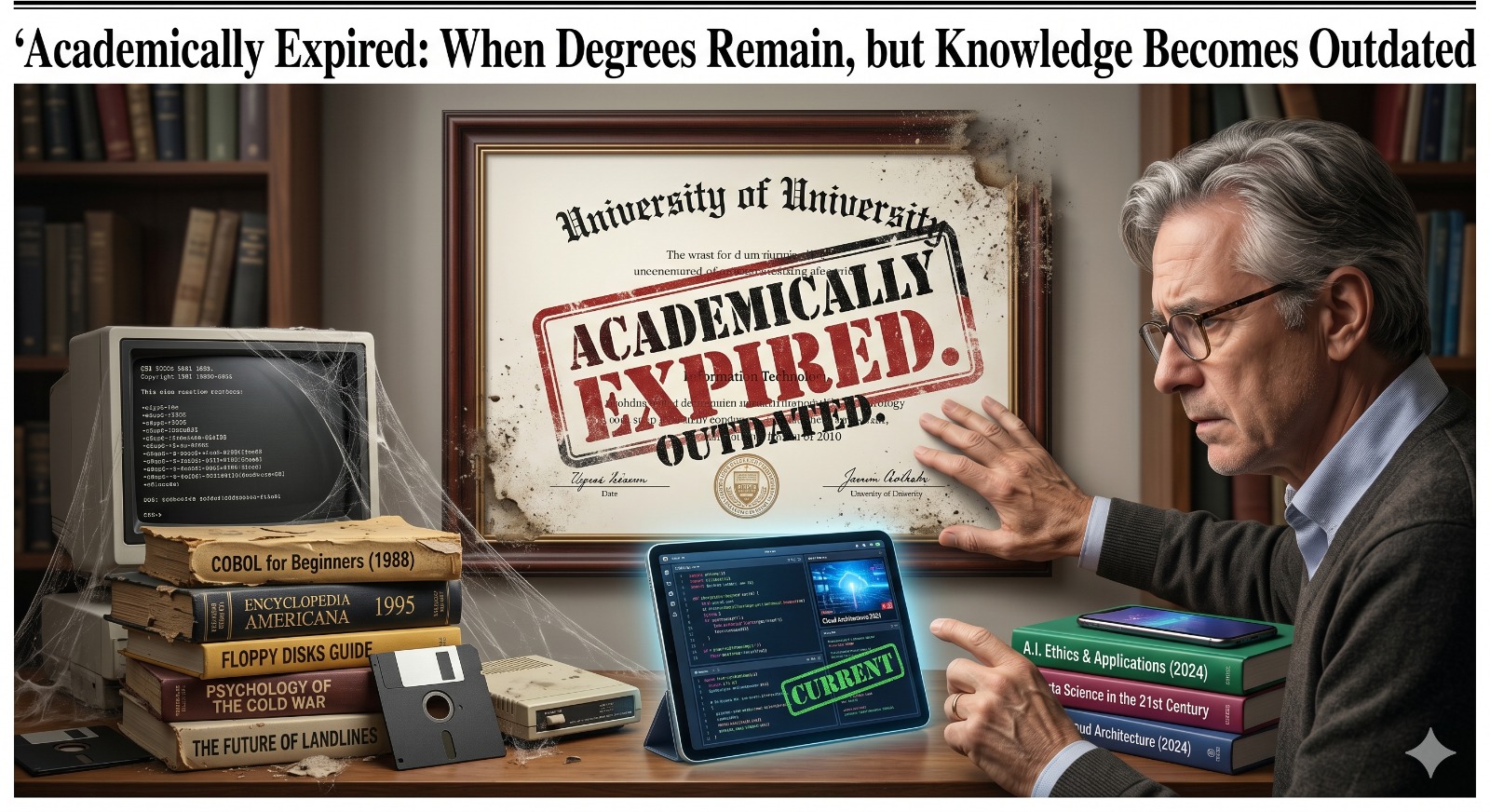
But the world has changed faster than our assumptions. Today, a degree may remain valid on paper, yet the knowledge behind it can quietly lose relevance if it is not continuously renewed. This growing condition may best be described as becoming “academically expired.”

The phrase may sound uncomfortable, even harsh, but it reflects a serious reality of modern professional life. Academic expiry does not occur because of age, experience, or the passage of time. It occurs when a person stops learning, stops adapting, and continues to depend entirely on old knowledge in a rapidly changing world. The certificate may still hang proudly on the wall, titles may still accompany the name, but the practical value of that knowledge may no longer match present realities.

This phenomenon is visible everywhere—in schools, universities, hospitals, industries, government offices, research institutions, and even public discourse. The modern world is no longer satisfied with qualifications alone. It asks a far more demanding question: What can you do with your knowledge today?

That question has changed the meaning of education itself. Consider the example of a teacher. A mathematics teacher who studied calculus, algebra, and statistics thirty years ago may still possess strong conceptual understanding. Mathematics itself does not expire. Two plus two will always equal four, and the derivative of a function will remain the same regardless of time. However, the way mathematics is taught, understood, and applied has changed dramatically.

Today’s students learn in a digital environment. They expect visual explanations, simulations, data interpretation, Excel modelling, interactive platforms, AI-assisted learning, and real-world applications connected to economics, engineering, business, and technology. If a teacher continues to rely solely on old lecture methods without adapting to modern educational tools, the teaching approach gradually becomes outdated, even if the foundational subject knowledge remains correct.

The same challenge exists in business education. A marketing graduate from the pre-social-media era may understand classical concepts like product, price, promotion, and distribution. But modern markets operate through digital advertising, consumer analytics, search engine optimization, influencer marketing, artificial intelligence, and e-commerce ecosystems. A professional who ignores these developments may still hold a respected degree, but the market increasingly values those who combine traditional principles with modern tools.

Perhaps nowhere is academic expiry more visible than in technology-related fields. A computer science graduate who mastered programming languages years ago but never updated knowledge in artificial intelligence, cybersecurity, cloud computing, automation, machine learning, or data science may suddenly discover that the industry has moved far ahead. The degree may still say “computer science,” but employers now demand practical expertise in contemporary systems and technologies. The question has shifted from What did you study? to What are you capable of doing now?

This pressure extends beyond technical disciplines. Medicine, journalism, law, management, social sciences, and education are all undergoing rapid transformation. A doctor must stay updated with new treatments, research findings, and medical technologies. A lawyer must understand cybercrime, digital evidence, data privacy laws, and evolving legal frameworks. Journalists must adapt to digital media, misinformation challenges, audience analytics, and real-time reporting. Researchers are now expected to understand publication ethics, citation tools, AI-assisted analysis, and interdisciplinary methodologies.

In every profession, lifelong learning is no longer optional. It has become essential for survival. One major reason behind academic expiry is the growing gap between educational systems and social reality. Universities often revise syllabi slowly, while industries and technologies evolve almost every month. Students may spend years studying material that becomes partially outdated by the time they graduate.

For example, business mathematics courses may still focus heavily on textbook calculations without connecting concepts to financial modelling, spreadsheets, data visualization, or practical decision-making. Such education may help students pass examinations, but it may fail to prepare them for real professional environments.

This creates a major challenge for educational institutions. Universities cannot preserve outdated syllabi in the name of tradition alone. Tradition has value, but tradition without renewal becomes stagnation. A curriculum should function like a living system—responsive to industry, society, technology, and emerging human needs.

Education must move beyond rote learning and chapter completion. Its real purpose should be to develop analytical thinking, creativity, adaptability, ethical judgment, communication skills, and problem-solving ability.

Another significant trend challenging traditional education is the rise of micro-credentials and short-term certifications. Earlier, people relied almost entirely on long academic degrees. Today, professionals increasingly pursue focused certifications in artificial intelligence, digital marketing, financial modelling, sustainability, project management, communication skills, and data analytics.

These learning modules do not replace traditional degrees, but they refresh and strengthen them. A degree provides the foundation; continuous learning maintains relevance.

However, academic expiry is not merely a problem of systems or institutions—it is also a problem of mindset. Some individuals become outdated not because they lack opportunities, but because they assume learning ends after formal education. This attitude is deeply dangerous in the modern world. In reality, experience becomes more powerful when combined with continuous learning. Experience provides depth and perspective, while new learning offers direction and adaptability. Together, they create wisdom.

There is also an ethical dimension to this issue. A teacher who refuses to update knowledge may unknowingly limit students’ growth. A manager who ignores new methods may weaken an organization. A researcher disconnected from current literature may produce irrelevant work. A public intellectual relying only on outdated assumptions may mislead society.

Remaining academically updated is therefore not merely a personal advantage—it is a professional responsibility.

The rise of artificial intelligence has made this discussion even more urgent. AI is reshaping how students learn, how teachers teach, how businesses operate, and how decisions are made across industries. Some fear AI, some misuse it, and others choose to ignore it completely. Yet the wisest approach is neither blind acceptance nor rejection. It is thoughtful understanding.

Technology should serve human intelligence, not replace it. A teacher does not need to compete with AI, but a teacher who understands AI will inevitably become more effective than one who refuses to engage with it. Similarly, professionals across sectors must learn how to integrate emerging technologies ethically and intelligently into their work.

To avoid becoming academically expired, every individual must adopt three lifelong habits: learn, unlearn, and relearn.

Learning means acquiring new knowledge and skills.
Unlearning means questioning outdated assumptions and rigid habits.
Relearning means rebuilding understanding according to new realities.

This cycle has become the foundation of modern professional survival.

Educational institutions also have a critical role in creating this culture. Faculty development programs, curriculum reviews, industry partnerships, research workshops, digital training, and outcome-based education should not be treated as administrative formalities. They should become the heartbeat of academic life.

Students should not merely be trained to pass examinations. They should be trained to remain lifelong learners.

This distinction is crucial because the future belongs not to those who memorize information, but to those who can adapt knowledge creatively in changing circumstances. Information today is widely available. What matters increasingly is interpretation, application, innovation, and ethical judgment. The idea of being “academically expired” should therefore not be used as an insult. It should serve as a warning—and more importantly, as motivation.

Nobody is too old to learn.
Nobody is too qualified to update.
Nobody is so experienced that change becomes unnecessary.

History repeatedly shows that societies progress when individuals remain intellectually curious. Civilizations decline when learning becomes static and self-satisfaction replaces growth. In many ways, the modern world has democratized learning. Online platforms, digital libraries, virtual classrooms, webinars, podcasts, research databases, and open-access educational resources have made knowledge more accessible than ever before. A motivated learner today can update skills from almost anywhere in the world.

The challenge is no longer access to knowledge alone. The real challenge is willingness to learn continuously. This willingness requires humility. It requires accepting that no matter how qualified a person may be, there is always more to understand. In earlier generations, education was often viewed as a destination. Today, it must be viewed as a lifelong journey.

That shift in thinking is perhaps the most important transformation of modern education. Ultimately, academic expiry does not happen when years pass. It happens when curiosity fades. A degree may open the first door of opportunity, but only continuous learning keeps a person relevant inside the rapidly changing rooms of professional life.

The future will not belong merely to those who once studied well. It will belong to those who continue to learn with humility, adapt with courage, and apply knowledge with wisdom.

Education does not expire with age. It expires only when curiosity dies.

Comments are closed.