

Zeeshan Rasool Khan
Mohi-ud-din Abu Muhammad Abu Saleh Abdul Qadir al-Jeelani (Al-Jilani) was an illustrious ascetic and mystic who became famous as the eponymous founder of the Qadriyah order of Sunni Sufism. He was Najeeb‑u‑Tarafaen Syed — that is, a descendant of the Prophet (SAW) on both sides of his family. Al-Jilani was born in a place called Neef, situated in Gilaan (Jilan) in Persia; for this reason he is remembered as Al‑Jilani or Geelani. Two narrations exist about his date of birth. According to the first, he was born on 1 Ramadan 470 AH; the second gives 2nd Ramadan, and scholars generally accept the second narration. He bade adieu to worldly existence in 561 AH, on 11 Rabi‑al‑Thani, in Baghdad, where his mausoleum is located.
From a tender age, Al‑Jilani spent most of his time in the remembrance of Allah and attained a station such that he is considered the leader of all Awliya (saints and pious friends of Allah). He expresses this in his Qaseedah Gausia: “I am Hassani and my abode is my cell, and my feet are on the neck of each Saint.” Besides being a spiritual personality, he was a great scholar and jurist who studied at Jamia Nizamiyya in Baghdad, the world‑renowned institute of its time. Al‑Jilani spent his life in religious preaching and authored several books that continue to serve as guidance for people.
His conversations were always engaging and effective in producing positive change of character — an elixir to enliven dead hearts. Sheikh Umar Kaisani writes that there was not a single meeting of Al‑Jilani’s that did not witness non‑Muslims embracing Islam, criminals repenting, or misguided finding guidance. About his depth of knowledge, the well‑known Hanbali jurist Ibn al‑Qudamah said: “I did not see anyone more respected than him. Kings and ministers considered it an honour to attend his lectures, not to mention the scholars and jurists. At least 400 inkpots were needed to record his discourses”. Though a savant with profound knowledge, wisdom, and deep insight, he retained a humble personality.
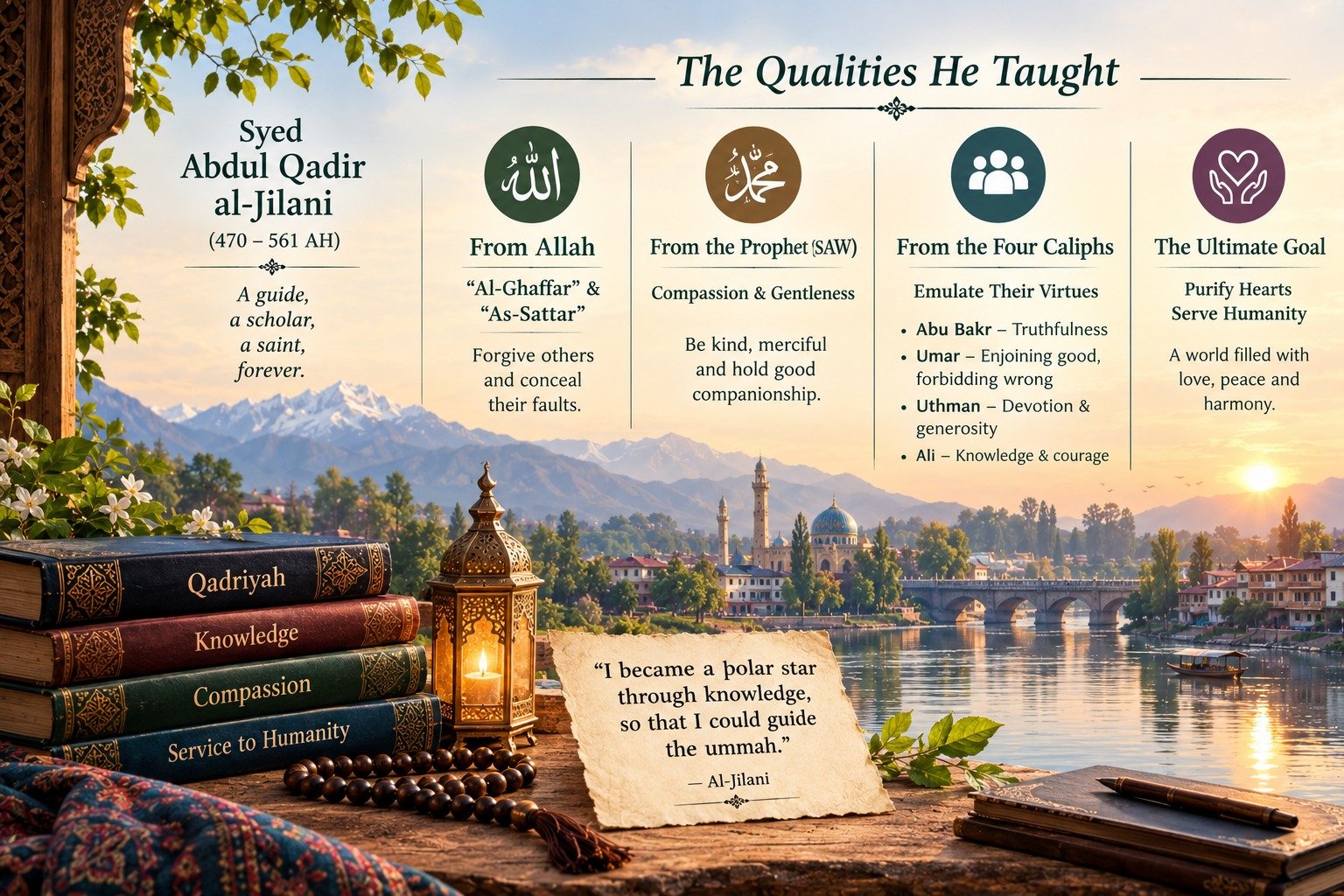
Al‑Jilani attributed his stature to knowledge and said he acquired knowledge “until I became a polar star and attained good fortune through the greatest Lord.” By “polar star” he meant a guiding light for the ummah, bringing them closer to Almighty Allah.
A question arises — and this is the theme of my writing —: in contemporary times many acquire knowledge but hardly any reach his stature. Al‑Jilani anticipated this question and answered it in his writings: to achieve such heights one needs qualities beyond mere knowledge. These qualities come from Allah and His Messenger (SAW), and from four companions — Abu Bakr al‑Siddiq, Umar ibn al‑Khattab, Uthman ibn Affan, and Ali ibn Abi Talib (may Allah be pleased with them all). Below is a brief overview of the qualities Al‑Jilani asks aspirants to cultivate.
From two attributes of Allah he asks followers to adopt “Al‑Ghaffar” and “As‑Sattar”: repeatedly forgiving others and concealing their faults. The name Al‑Ghaffar appears in the Qur’an in many verses, for example: “And your Lord is al‑Ghafoor (the Oft‑Forgiving), the Owner of Mercy” (18:58). The attribute As‑Sattar (the Concealer) is mentioned in the hadith of Abu Dawud (4012), in which the Prophet (SAW) says Allah is characterized by modesty (al‑Hayaa) and concealment (as‑Sitter). Al‑Jilani says that to become a Qutb (a spiritual pivot), one must reflect these two divine qualities.
From the Prophet (SAW) he highlights two characteristics that lead to perfection: compassion and gentleness in companionship. Allah describes the Prophet’s concern for his people and his mercy: “There has certainly come to you a Messenger from among you. Grievous to him is what you suffer; for he is concerned for you and to the believers he is kind and merciful” (9:128). Regarding gentleness, Allah says: “Thus it is by mercy from God that you deal with them gently; and had you been rough and harsh, they would have dispersed from about you” (3:159). And: “And indeed you are of a great moral character” (68:4). Al‑Jilani teaches that following these etiquettes raises a person’s stature before Allah.
From the four rightly guided Caliphs he recommends emulating their distinctive virtues: Abu Bakr’s truthfulness and immediate acceptance of truth; Umar’s commitment to enjoining good and forbidding wrong; Uthman’s devotion, worship, and generosity; and Ali’s knowledge and courage — where courage means standing against falsehood and injustice for the sake of Allah, not suppressing others.
All saints shared the mission of spiritually purifying the masses to raise them to a state where, as Iqbal put it, Allah would ask, “What is your wish?” Syed Abdul Qadir al‑Jilani pioneered this mission and changed many lives. His teachings remain before us and ought to be adopted before claiming his discipleship. If the message of Syed Abdul Qadir al‑Jilani and those like him is truly embraced, we can imagine radical change — a world invigorated by love, peace, and harmony.
May Allah guide us to the Right Path, which is also the mission of His close friends, the Awliya.
Comments are closed.