

S Ahmad
Birmati, a 65-year-old woman from Haryana’s Jind district, suffered a severe fracture in her femoral neck, which connects the hip to the leg. Fortunately for her, she was able to get timely surgery and proper care worth Rs. 44,140 at a district orthopaedic and maternity hospital through the Ayushman Bharat scheme for free. The scheme has proven to be a lifeline for the economically and socially weaker sections of society, providing them with affordable, timely, quality, and accessible healthcare.
Healthcare is often discussed in terms of hospitals, doctors, medicines and technology. But for an ordinary family, the real question is much simpler: what happens when illness arrives and the money to pay for treatment is not there?
For millions of Indian families, a serious illness has traditionally meant much more than pain and anxiety. It could mean selling livestock, mortgaging land, borrowing from relatives, taking high-interest loans, postponing a child’s education or exhausting years of savings. A hospital bed could therefore become the starting point of a financial crisis that continued long after the patient returned home.
This is why the idea of health coverage has to be understood as more than an insurance card or a government scheme. It is fundamentally about protecting a family’s ability to live with dignity when disease strikes.
Eight years after the launch of Ayushman Bharat Pradhan Mantri Jan Arogya Yojana (AB PM-JAY) on September 23, 2018, the scale of the programme offers considerable evidence of how public intervention can alter that equation. As the scheme marks its eighth anniversary, more than 48.51 crore people—about one-third of India’s population—have Ayushman cards. By August 31, 2026, the scheme had supported around 13.25 crore hospital admissions involving treatment worth Rs 2.03 lakh crore through more than 38,000 empanelled public and private hospitals.
The numbers are large enough to be impressive. But the more important story lies behind them.
Each hospital admission represents a person who needed treatment and a family that, under different circumstances, could have faced a substantial medical bill. The value of Ayushman Bharat therefore cannot be measured only by the number of cards issued. Its deeper significance lies in the financial protection it seeks to provide at precisely the moment when a household is most vulnerable.
Health expenditure is a poverty issue
For a poor or lower-income household, healthcare cannot be separated from economic security.
A middle-class family may find an unexpected hospital bill difficult. For a landless worker, informal labourer, domestic worker or small street vendor, the same bill can be devastating. The loss is not restricted to the cost of treatment. There may also be lost wages, transport expenses, food costs for attendants and the possibility that the principal earning member cannot work for weeks.
This makes publicly financed healthcare an important instrument of social protection.
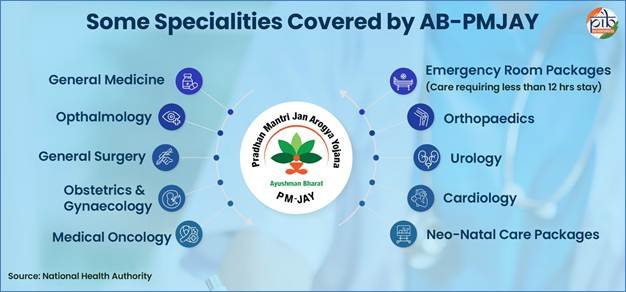
AB PM-JAY provides cashless hospitalisation cover of up to Rs 5 lakh per family per year for eligible beneficiaries for secondary and tertiary care. It covers 1,961 procedures across 27 medical specialties. The scheme is designed around the principle that a person should not be forced to choose between treatment and financial survival.
Government data indicates that this broader approach is already reflected in India’s health expenditure pattern. According to the National Health Accounts Estimates for 2022-23, out-of-pocket expenditure as a proportion of total health expenditure declined from 62.6 per cent in 2014-15 to 43.4 per cent in 2022-23. The government attributes part of this decline to increased public spending on health and publicly financed health insurance programmes such as AB PM-JAY.
That decline deserves attention because out-of-pocket expenditure is one of the least visible burdens in a healthcare system. It does not always appear in a government hospital statistic. It appears in a family’s depleted savings, unpaid debt or reduced household consumption.
Reducing that burden is therefore not simply a matter of accounting. It is a matter of economic resilience.
The Ayushman card is only one part of the story
There is a temptation to view Ayushman Bharat entirely through the PM-JAY card. That would be too narrow.
Ayushman Bharat is increasingly being built as an interconnected health system in which different components address different stages of a citizen’s healthcare journey.
AB PM-JAY addresses hospitalisation and financial protection. Ayushman Arogya Mandirs focus on comprehensive primary healthcare. The Ayushman Bharat Digital Mission attempts to create the digital infrastructure through which health information and services can move more efficiently. PM-Ayushman Bharat Health Infrastructure Mission focuses on strengthening physical infrastructure, laboratories, disease surveillance and critical-care capacity.
Together, these pillars represent a broader shift: from treating illness only after it becomes serious towards a healthcare system that also emphasises prevention, early detection, continuity and preparedness.
That distinction matters.
A family does not ideally want to reach a tertiary-care hospital. It wants accessible primary care close to home, timely diagnosis, affordable medicines and competent referral when specialised treatment becomes necessary. Insurance protection becomes most meaningful when it forms part of such a continuum.
Bringing primary healthcare closer to people
Ayushman Arogya Mandirs are particularly important in this regard.
Primary healthcare is where a health system meets citizens most frequently. It is where blood pressure can be checked before hypertension becomes dangerous, where diabetes can be detected early, where maternal and child health services can be provided, and where people can receive advice about nutrition, prevention and healthy behaviour.
The Ayushman Arogya Mandir model seeks to move beyond a narrow focus on maternal and child healthcare. The centres are intended to provide services related to non-communicable diseases, oral, eye and ear-nose-throat care, mental health, first-level emergency and trauma care, essential medicines and diagnostics.
By September 2026, more than 1.87 lakh Ayushman Arogya Mandirs were functional, according to the Ministry of Health’s official portal. The network has also recorded a cumulative footfall of more than 540 crore.
These figures indicate the scale of the primary-care network being built. But the real test will always be qualitative: whether a citizen entering such a centre receives timely, respectful and reliable care.
Buildings alone do not create a strong health system.
A functional health centre requires doctors and trained health workers, medicines, diagnostics, electricity, connectivity, clean facilities, referral mechanisms and regular supervision. A village may have a beautifully renovated health centre, but if essential medicines are unavailable or a patient must still travel many kilometres for basic diagnostic services, the promise of accessible healthcare remains incomplete.
The expansion of Ayushman Arogya Mandirs therefore needs to be accompanied by equal attention to staffing, supply chains and service quality.
Digital health can change the patient’s journey
The second major transformation is taking place in the digital space.
The Ayushman Bharat Digital Mission, launched in 2021, seeks to create an integrated digital health ecosystem. Its most visible component for citizens is the Ayushman Bharat Health Account, or ABHA, which provides a digital health identity through which health records can be linked and made accessible across participating healthcare facilities.
By September 17, 2026, more than 97.61 crore ABHA IDs were operational and more than 119.95 crore health records had been linked to them. The platform also had more than 5.78 lakh verified healthcare facilities and over 11 lakh registered healthcare professionals.
The significance of such infrastructure may not be immediately obvious to a patient standing at a hospital registration counter. But imagine a person moving from a district hospital to a medical college, or from one state to another, without having to carry a file containing years of prescriptions, diagnostic reports and discharge summaries.
A connected health record can potentially make the patient’s medical history more portable.
Telemedicine adds another dimension. Through e-Sanjeevani, citizens can connect with healthcare professionals beyond their immediate locality. More than 50 crore teleconsultations had been conducted by September 17, 2026.
For geographically difficult regions, this has particular importance.
India is not a uniform healthcare geography. Mountainous districts, remote villages and scattered settlements cannot always replicate the specialist availability of metropolitan centres. Digital connectivity cannot replace a doctor, hospital or diagnostic laboratory, but it can reduce the distance between a patient and professional advice.
For regions such as Jammu and Kashmir, where terrain and weather can affect travel, the potential of telemedicine and interoperable health records deserves sustained attention.
A stronger safety net for elderly citizens
The expansion of AB PM-JAY to all citizens aged 70 years and above was another important step in broadening health protection.
Ageing frequently brings increased healthcare requirements. A fracture, cardiac condition, cancer diagnosis, surgery or prolonged hospitalisation can impose a heavy financial burden on an elderly person and the family supporting them.
The inclusion of senior citizens through the Ayushman Vay Vandana initiative recognises this vulnerability.
The experience of Birmati, a 65-year-old woman from Haryana’s Jind district, illustrates the human dimension of healthcare protection. After suffering a severe femoral-neck fracture, she received surgery and treatment worth Rs 44,140 without paying for it through the Ayushman Bharat system.
The amount itself is not the central point. What matters is what that amount might represent to a low-income household.
For a wealthy family, Rs 44,140 may be an unexpected expense. For a poor family, it can represent several months of income.
Public healthcare programmes are ultimately judged at this human scale.
Reaching workers who are often invisible
The scheme’s expansion has also attempted to bring groups that perform essential social functions within the healthcare safety net.
In March 2024, approximately 37 lakh families of ASHAs, Anganwadi Workers and Anganwadi Helpers were brought under AB PM-JAY. By September 21, 2026, more than 44.81 lakh Ayushman cards had been created for these workers.
This is significant because frontline health and social-care workers often operate in precisely those communities where healthcare access is weakest.
The scheme also covers several additional categories through specific government initiatives, including eligible construction workers and dependants, identified waste pickers and sanitation workers, certain transgender beneficiaries, children covered under PM CARES for Children and Particularly Vulnerable Tribal Groups under PM-JANMAN.
Such convergence matters because vulnerability is not always captured by a single definition of poverty.
A household may be economically fragile because it owns no land. Another may depend entirely on casual labour. An elderly person may live in a financially secure household but face substantial healthcare needs. A sanitation worker may face occupational risks that others do not.
A modern social protection system therefore has to recognise different forms of vulnerability.
The importance of portability
One of the less visible strengths of PM-JAY is portability.
Healthcare is not always consumed where a person lives. Migrant workers move between states. Families travel for specialised treatment. Students and workers may live away from their permanent homes.
Official data showed that, by June 30, 2026, more than 29.05 lakh inter-state portability hospital admissions worth over Rs 8,383 crore had been authorised under the scheme. The system allows eligible beneficiaries to receive cashless treatment at empanelled hospitals outside their home state or Union Territory.
This is an important feature in an increasingly mobile economy.
A health entitlement that disappears at a state border is of limited value to a migrant worker. Portability turns the entitlement into something more closely resembling a national health assurance mechanism.
It also demonstrates why digital infrastructure matters. Verification, claims processing and settlement become easier when the system can identify beneficiaries and communicate across jurisdictions.
Infrastructure is the foundation
Insurance cannot compensate for the absence of hospitals.
If an eligible patient possesses an Ayushman card but the nearest appropriate facility is hundreds of kilometres away, financial protection alone does not solve the access problem.
This is where PM-ABHIM becomes important.
Launched in 2021 with a stated outlay of Rs 64,180 crore for 2021-26, the mission seeks to strengthen public health infrastructure, disease surveillance and health research. Its components include support for rural and urban health and wellness centres, block public health units, integrated public health laboratories and critical-care hospital blocks.
The lesson from the pandemic was clear: healthcare capacity cannot be created overnight.
Ventilators, intensive-care beds, laboratories, trained personnel, surveillance systems and supply chains must exist before the next emergency begins.
A resilient health system therefore requires investment during normal times, not only emergency spending during crises.
What the numbers cannot tell us
The scale of Ayushman Bharat is undoubtedly substantial. But numbers should be treated as a starting point for evaluation, not the end of it.
The number of cards issued tells us about coverage. Hospital admissions tell us about utilisation. The value of treatment tells us about financial protection. But these indicators do not automatically answer every question about quality.
How quickly does an eligible patient obtain treatment?
How easily can a beneficiary understand the process?
Are there enough empanelled hospitals in remote districts?
Are hospitals adequately reimbursed and therefore willing to continue participating?
Are beneficiaries ever asked to pay for services that should be cashless?
How effectively are complaints resolved?
Are diagnostics and medicines actually available at primary-care facilities?
These are implementation questions, and they deserve the same seriousness as headline figures.
The government has established grievance mechanisms for beneficiaries facing irregularities or denial of treatment, including a centralised grievance system and a 24-hour helpline. But the existence of a grievance mechanism is not enough. Citizens need to know that it exists, know how to use it and have confidence that complaints will be acted upon.
Awareness is therefore a critical component of universal healthcare.
Jammu and Kashmir’s particular stake
For Jammu and Kashmir, the Ayushman Bharat framework has particular relevance.
The Union Territory has a distinctive geography, dispersed settlements and difficult terrain in several areas. For patients living in remote mountainous regions, reaching advanced medical care can itself become a major burden.
The Centre-State funding pattern also recognises Jammu and Kashmir’s position. Under AB PM-JAY, the Centre and states generally share costs in a 60:40 ratio, while the ratio is 90:10 for Jammu and Kashmir, the North-Eastern states and Himachal Pradesh and Uttarakhand.
But financial architecture must ultimately translate into functioning services on the ground.
For Jammu and Kashmir, that means strengthening district hospitals, ensuring adequate specialist availability, improving diagnostics, expanding telemedicine, maintaining medicines and making referral systems more efficient.
The objective should not be merely to ensure that a patient from a remote village can eventually reach a major hospital. It should be to prevent avoidable deterioration by bringing preventive and primary healthcare closer to that patient in the first place.
From a scheme to a health system
Perhaps the most important idea emerging from the Ayushman Bharat experience is that universal health coverage cannot be delivered by one scheme alone.
PM-JAY protects families against large hospital bills.
Ayushman Arogya Mandirs seek to bring comprehensive primary healthcare closer to communities. ABDM creates a digital layer that can connect patients, professionals and health facilities.
PM-ABHIM strengthens the infrastructure required to withstand routine and extraordinary health challenges. These components make sense when viewed as parts of one continuum.
A person should ideally enter the health system through accessible primary care, receive preventive services and early diagnosis, obtain referral when necessary, reach a capable hospital without financial ruin, and have their health information follow them through the system. That is the real promise of universal healthcare.
The next challenge is quality and trust
The first phase of expansion has largely been about reach: more beneficiaries, more cards, more hospitals, more health centres and more digital identities.
The next phase must increasingly be about quality.
A health card is meaningful only if the beneficiary can use it without confusion. A digital record is useful only if it is accurate, secure and accessible. A health centre matters only if it has personnel, medicines and diagnostics. A hospital network matters only if patients receive timely and appropriate care.
The success of Ayushman Bharat should therefore increasingly be measured not simply by how many people are enrolled, but by how effectively the system works for the person who needs it most.
This will require continued public investment, stronger monitoring, transparent grievance redressal, better health literacy and close attention to gaps between policy design and implementation.
It will also require citizens to know their entitlements.
No public health programme can achieve universal coverage if eligible families remain unaware of their rights. Community workers, local institutions, schools, civil society organisations and media have a role in making health information understandable and accessible.
Healthcare as an investment in society
The larger lesson is that healthcare spending should not be seen merely as government expenditure.
A healthy population is more capable of working, studying, caring for families and participating in the economy. A child who receives timely treatment can remain in school. A worker who receives timely surgery can return to employment. An elderly person who receives treatment without impoverishing the family can retain dignity. A household protected from catastrophic medical expenditure can continue spending on food, education and housing.
In that sense, financial protection in healthcare has effects far beyond the hospital.
Eight years after its launch, Ayushman Bharat has moved from an ambitious policy announcement towards a vast health infrastructure involving insurance protection, primary care, digital systems and physical capacity.
Its journey is not complete.
India’s healthcare challenges remain considerable, and the quality of implementation will ultimately determine how much of the programme’s promise reaches ordinary citizens. But the direction is important: health protection is increasingly being treated as a component of social and economic security rather than merely an individual household responsibility.
The Ayushman card may fit into a wallet. Its real value, however, is much larger.
It represents the possibility that when illness enters a household, the family does not have to choose between treatment and financial survival.
That is why the next stage of Ayushman Bharat should focus not only on expanding coverage, but on deepening trust, improving quality, strengthening primary care and ensuring that the benefits reach the last person in the queue.
Universal healthcare is ultimately not measured by the sophistication of a policy document. It is measured by what happens when an ordinary citizen walks into a health centre, a hospital or an emergency ward and asks for help.
The true test is whether the system is there when it matters most.
Comments are closed.