


Dr Rizwan Rumi
Marriage in Kashmir has traditionally been regarded not merely as a social arrangement but as a sacred bond rooted in family, responsibility, companionship and mutual respect. For generations, Kashmiri society valued simplicity in marriage. Nikah was understood as the beginning of a shared life rather than the staging of a grand social event.
Today, however, that understanding appears to be changing.
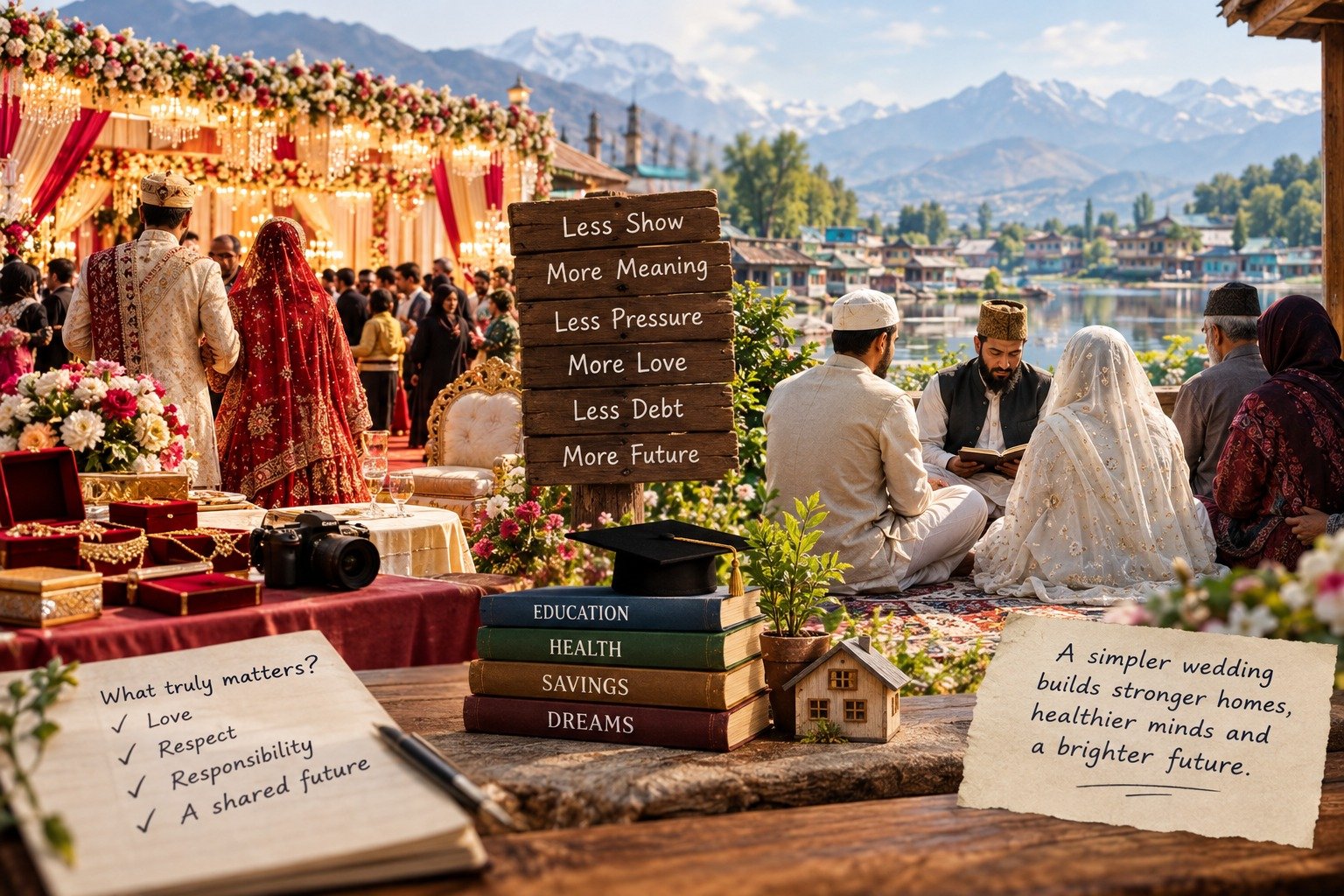
Marriage ceremonies are becoming increasingly elaborate, expensive and competitive. What was once primarily a religious and family occasion is gradually being transformed into a display of wealth, status and social standing. From lavish wedding halls and multiple functions to designer clothes, elaborate decorations, photography and Bollywood-inspired celebrations, the pressure to “do more” seems to be growing every year.
The problem is not the celebration itself. There is nothing wrong with families celebrating the marriage of their children according to their means. The concern begins when celebration turns into competition and when social expectations become so expensive that ordinary families feel compelled to spend beyond their capacity.
In many cases, families are no longer asking what is necessary for a marriage. They are asking what society will say if they do less.
This is where the real problem begins.
When Marriage Becomes a Financial Burden
For many young people, marriage is already associated with financial uncertainty. Employment opportunities are limited, incomes are often modest, and the cost of living continues to rise. In such circumstances, imposing additional financial expectations can make marriage unnecessarily difficult.
The issue is particularly significant for young men who may feel that they must first accumulate substantial savings, arrange a large wedding, meet expectations regarding gifts and clothing, and provide an expensive setup before they can even think seriously about marriage.
At the same time, families of brides can also find themselves under enormous social pressure. They may feel compelled to organize elaborate functions, purchase expensive clothing and jewellery, invite large numbers of guests and meet expectations that have little connection with the actual purpose of marriage.
Thus, both sides can become victims of the same social system.
Marriage, which should provide companionship and emotional security, begins with financial anxiety.
The Question of Mehar
Mehar is an important Islamic institution and a right of the woman. It should never be dismissed or treated as an unnecessary burden. But the growing tendency to treat an exceptionally high mehar as a symbol of status deserves thoughtful discussion.
When mehar becomes a figure determined primarily by social comparison rather than mutual understanding, it can defeat the spirit in which the institution was established.
The purpose should not be to create an impossible financial obligation for the groom. Nor should a woman’s dignity be measured simply by the numerical value attached to her mehar.
There is a need for greater awareness that dignity and security in marriage cannot be reduced to a financial figure.
Similarly, families should avoid turning marriage negotiations into a process of financial bargaining. The foundation of a successful marriage is character, compatibility, responsibility, trust and mutual respect—not the size of a wedding budget.
The Influence of Bollywood and Social Media
Another major factor behind the changing wedding culture is the influence of popular culture and social media.
Wedding ceremonies are increasingly being designed around images seen online. Couples and families are exposed to extravagant celebrations, cinematic entrances, professional photography, elaborate stages and destination-style events. What appears glamorous on a screen can gradually become a social expectation in real life.
The danger is that people begin comparing their personal circumstances with carefully constructed images of other people’s celebrations.
A family may have limited financial resources, but it may still feel compelled to organize a wedding that looks impressive on social media.
This creates a cycle of competition.
One family spends heavily. Another feels compelled to match it. A third family tries to go further. Eventually, extravagance becomes normalized, and simplicity begins to appear inadequate.
This is particularly unfortunate because a wedding should not be judged by how impressive it looks to outsiders.
The Silent Cost of Social Expectations
The financial cost of extravagant marriages is visible. The psychological cost is less visible.
Parents can experience enormous anxiety trying to meet expectations. Young men may postpone marriage because they believe they cannot afford the ceremony expected of them. Young women may also feel pressured to look a certain way, wear expensive clothes and jewellery, or have a wedding that resembles those displayed online.
Behind the photographs and celebrations can therefore exist debt, stress and insecurity.
Some families borrow money simply to maintain their social image. Others spend their savings accumulated over many years on a few days of celebration.
The question we need to ask is simple:
Is it reasonable to spend years saving for a marriage only to spend most of those savings on ceremonies that last a few days?
Would it not be wiser to invest some of that money in the couple’s future—education, housing, healthcare, business or savings?
We Are Losing the Meaning of Simplicity
There is nothing inherently wrong with beautiful clothes, good food or a joyful gathering. Kashmir has its own rich cultural traditions, and celebrations are an important part of social life.
The problem is excess.
When food is wasted because too much has been prepared, when families invite hundreds of people simply because they fear criticism, when expensive arrangements are made only to compete with others, or when marriage negotiations become dominated by financial expectations, we have moved away from the spirit of simplicity.
Islam does not teach people to measure happiness through extravagance.
The essence of nikah is remarkably simple: two individuals accepting responsibility for a shared life in the presence of their families and community, with mutual rights and obligations.
Perhaps we need to return to that understanding.
Marriage Should Not Become a Test of Wealth
One of the most troubling consequences of this trend is that marriage can gradually become a test of economic capacity.
A young person may possess good character, education, responsibility and the ability to build a stable family, but still feel inadequate because he cannot afford an extravagant wedding.
Likewise, a family should not feel that its daughter has received a “lesser” marriage simply because the ceremony was modest.
We must challenge the idea that expensive means better.
A simple nikah does not mean an insignificant marriage. A modest wedding does not mean a family lacks dignity. And an elaborate wedding does not guarantee a successful marriage.
The success of a marriage is ultimately measured not by the number of guests, the decoration of the venue or the price of the bride’s dress, but by what happens after the guests leave.
Kashmir Needs a Social Conversation
This issue cannot be addressed simply by blaming one gender, one family or one generation.
Parents, religious scholars, community leaders, young people and civil society all have a role to play.
Religious scholars can encourage simplicity and explain the spirit behind Islamic marriage. Parents can reduce unnecessary expectations. Young people can resist social-media-driven competition. Community leaders can promote simple collective weddings and discourage wasteful practices.
Most importantly, society must stop applauding extravagance as though it were a measure of success.
We should learn to appreciate families that choose simplicity rather than making them feel inferior.
Perhaps the most powerful social change would begin when people stop asking, “How grand was the wedding?” and start asking, “Are the couple happy, responsible and secure?”
A Return to Purpose
Kashmir is proud of its culture, traditions and religious values. But traditions are meaningful only when they serve human dignity rather than become burdens upon people.
Marriage should bring two families together, not place them under financial pressure. It should provide companionship, not competition. It should create responsibility, not debt. It should bring dignity, not social anxiety.
We do not need to abandon celebration. We need to abandon unnecessary excess.
We do not need to reject Kashmiri culture. We need to distinguish culture from social pressure.
And we do not need to make marriage less beautiful. We need to make it more meaningful.
If we continue turning marriage into an expensive competition, we risk creating a society in which young people fear marriage not because they fear responsibility, but because they fear the financial and social expectations attached to it.
That would be a serious failure of our collective priorities.
The time has come to rethink what we are celebrating.
A marriage should be remembered for the life two people build together—not for the money spent on the day they began building it.
Comments are closed.