
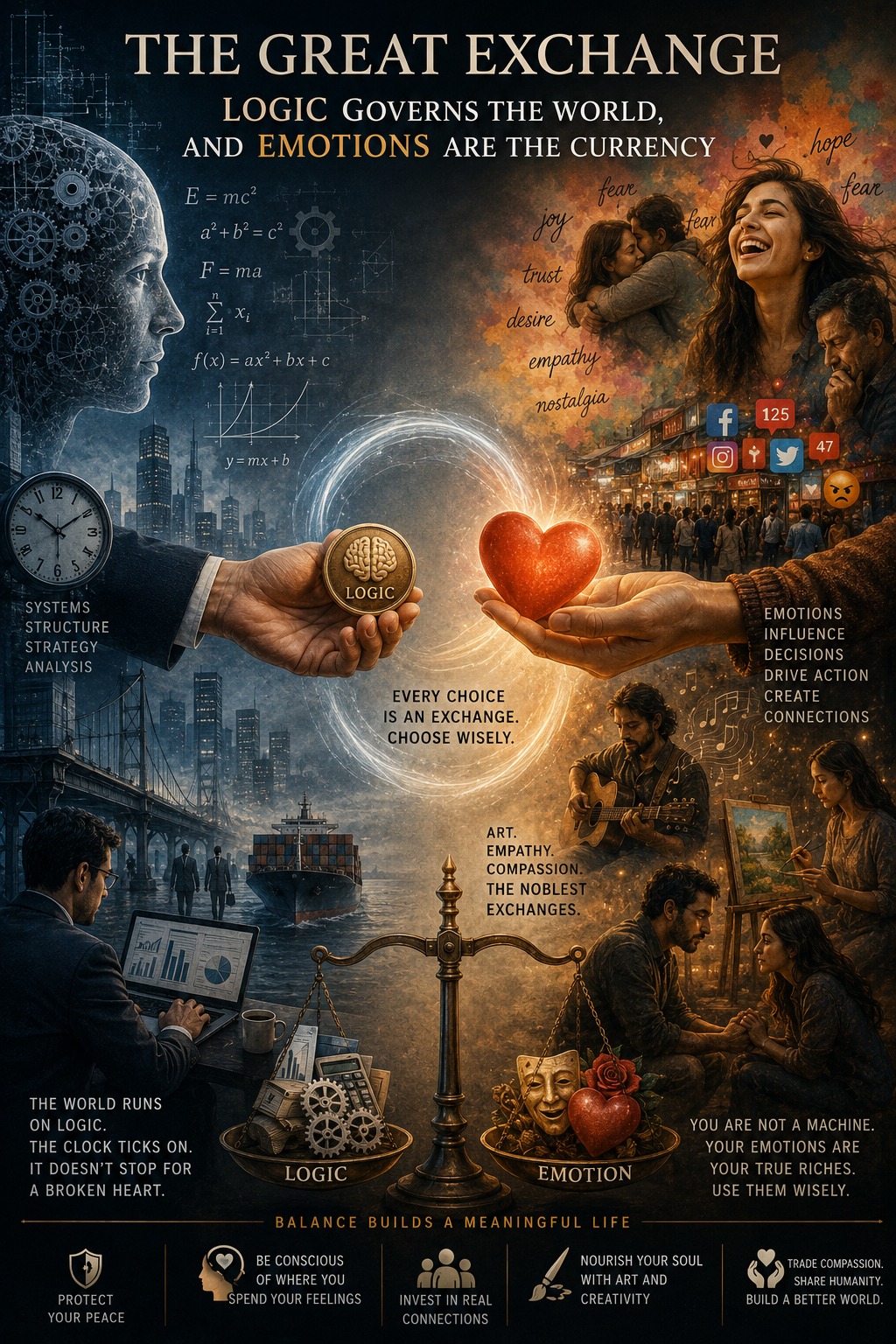


The Great Exchange: Logic Governs the World, and Emotions Are the Currency

Ziea Ul Aalam


“Human civilisation is built upon logic, but human relationships are built upon emotion. Every day we participate in an invisible exchange of hopes, fears, desires, trust, and empathy, often without realizing that these emotional transactions shape our choices far more powerfully than facts ever could.”

We walk into a world that doesn’t ask permission to keep turning. The sun rises on a strict timetable, tides are drawn by the moon’s gravity and society is built on an inflexible, intricate web of cause and effect. If you are to survive in this world, you must learn the language of this world, the language of logic.

We live our lives on a platform of mathematics, timetables, contracts and commerce. You get paid a certain amount of currency for working a certain number of hours. You mix certain materials together and you build a bridge that won’t fall down. If you follow the algorithm rules your business will grow. The architecture of human civilisation is a vast, humming machine of cold, hard facts. The universe, in all its vast and indifferent majesty, is ruled by pure logic. It don’t stop for a broken heart. It doesn’t pause for a moment of deep grief. The clock ticks on, with no trace of sympathy.

But if logic is the world’s cold engine, emotion is its fuel. It’s the invisible, pulsating currency that exchanges hands every single second. Although our society is built on the framework of rationality, the actual human experience, the daily commerce of our lives, is a continuous, high-stakes trade of emotions.

The Emotion Marketplace

Look hard at the world around you. When you stroll down a bustling street or scroll through a never-ending digital feed, what are you actually buying and selling?

We like to think we are consumers of products, but we are really consumers of feelings. A luxury car is not marketed for its engineering precision; it is marketed for its promise of status and freedom. Designer perfume is not a chemical blend, but bottled desire.  Insurance companies don’t sell paperwork, they sell the currency of peace of mind. They play on our innate fear of the unknown .

Every billboard, every ad, every political campaign is a masterful negotiation for your emotional real estate. Marketers and leaders know the logic of how a system works. But the logic of how humans act within that system is emotion. “We make decisions based on how we feel. We justify those decisions with logic. In the huge marketplace of modern society, our insecurities, hopes, nostalgia, desires are weighed, measured, commodified.

 The Digital Stock Market This kind of emotional trading is nowhere more evident, or more ruthless, than in the digital age. Social media is the 21st-century stock exchange of human vulnerability. Behind the screens at work are complex, deeply logical algorithms. They operate on binary codes and math optimisation. Pure math. No feelings. But what are they optimising? Your feelings.

Outrage is a high dividend stock. It gets instant clicks, quick shares and long time on site. The algorithms know this logic, and fuel the fire, trading our collective ire for advertising dollars. Joy and inspiration are traded, too, encapsulated in aesthetic reels and transient moments of connection that keep us scrolling, searching for the next rush of dopamine. We give away our time, our attention and our mental peace – our most valuable assets – for a short-term emotional response. We are the traders and the traded.

 The Noble Trade: Art and Sympathy

To describe the trade in emotions as entirely cynical is to do a disservice to the human spirit. There is great beauty in this exchange when done with purpose.

Consider the artist Think of a musician in a far off, quiet room, channelling raw, unfiltered heartbreak agony into the strings of a guitar, or the quiet beauty of a landscape in a haunting vocal melody. They take their most intimate, fragile feelings and make them into a song. When we listen to that music there’s a sacred trade. The artist offers up their vulnerability, and in return the listener offers up empathy.

In this space, the trade of emotion is not exploitation; it is survival of a different kind. It’s about being seen. When we read a beautiful poem, watch a heartbreaking film or listen to a soulful melody, we are happily trading our time to get a piece of someone else’s soul. We buy books to be amazed. We listen to music to be understood. Art is the most noble marketplace in the world, where the currency of feeling enriches both buyer and seller.

 Looking After Your Currency The duality of our existence is unavoidable. To keep a roof over our heads and food on our tables we have to work the cold, logical machinery of the world. We have to honour the maths, the science, the systems that stop society from falling into chaos.

But we also have to fiercely protect the sanctity of our emotional currency. If our emotions are the most valuable tradable asset in the world, we have to be incredibly conscious about where we spend them. Don’t let the algorithms drain your reserves of empathy for the cheap outrage. Don’t let the marketers play to your insecurities.

Instead, plant your feelings where they will grow. Exchange your love of deep connections. Trade vulnerability for actual art. Barter your compassion to mend another’s pain. The world is going to run on logic. Always. That’s the way it is. But you are not a machine.  You are a human being and your emotions are your true riches. Use them wisely.

Comments are closed.