


Muzamil Arif
“Climate change is not merely an environmental issue; it is a civilizational challenge encompassing justice, security, equity, and long-term survival.”
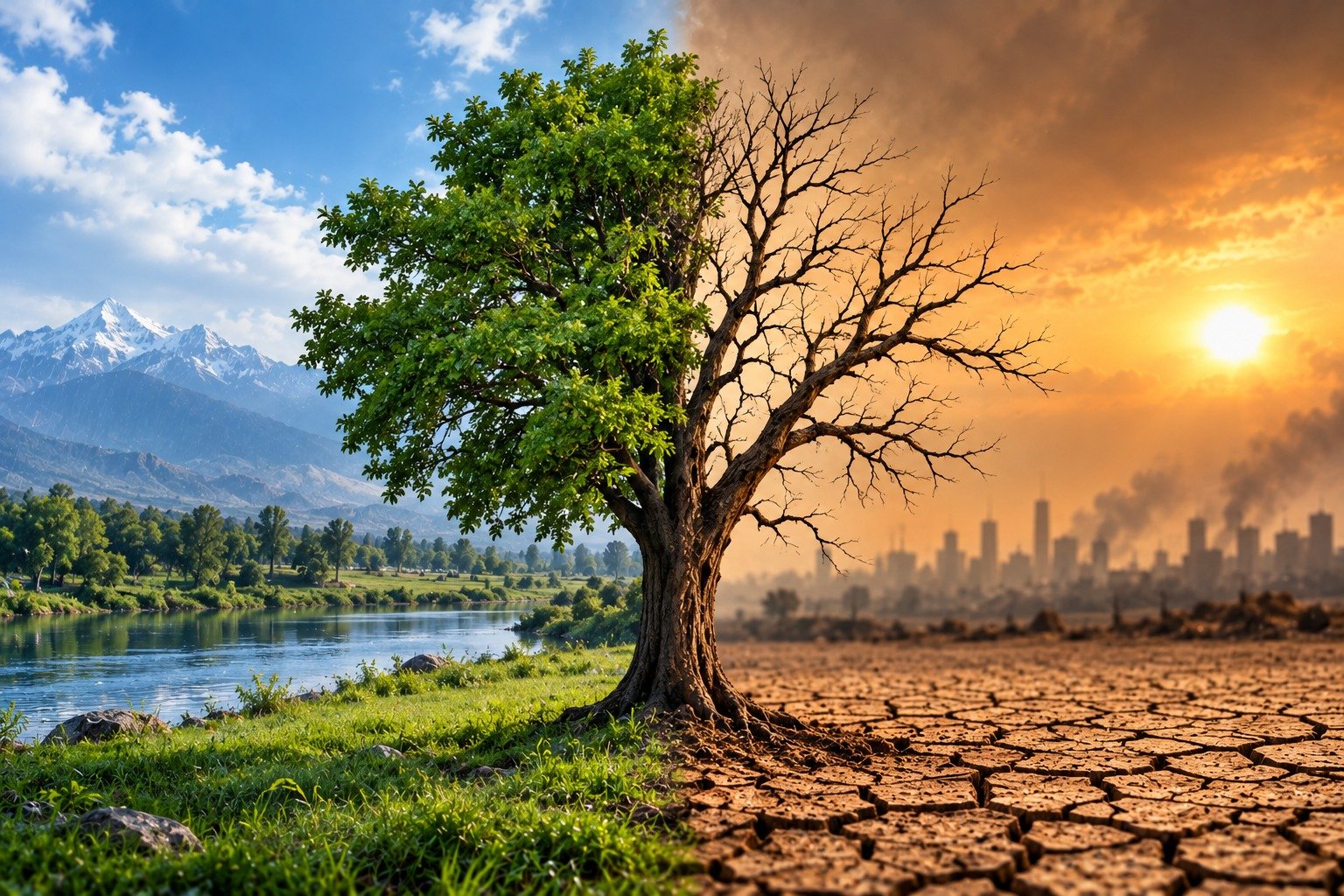
Climate change stands as one of the defining challenges of the 21st century — a crisis driven largely by human activity that now threatens ecosystems, economies, livelihoods and planetary stability. Once dismissed by many as a distant scientific warning, it has become an immediate reality marked by record temperatures, extreme weather events and growing ecological disruptions. The past eleven years, from 2015 to 2025, were the warmest eleven years on record, while global mean temperature in 2025 was about 1.43–1.44°C above the 1850–1900 average. This continued warming, driven primarily by the accumulation of greenhouse gases in the atmosphere, demands urgent and collective global action. For a country like India, with its diverse geography, large population and developing economy, the stakes are particularly high.
Scientific Basis and Global Scenario
The scientific evidence is clear: human activities, particularly the burning of fossil fuels, land-use change and industrial processes, are the main drivers of observed global warming. Atmospheric concentrations of carbon dioxide, methane and nitrous oxide continue to rise, contributing to a growing imbalance in the Earth’s climate system. Ocean heat content continues to reach record levels, sea levels are rising, glaciers are retreating, and changes in Arctic and Antarctic sea ice are being closely monitored as important indicators of a warming planet.
Recent reports and research syntheses, including the “10 New Insights in Climate Science 2025/2026”, highlight growing pressures on land carbon sinks, groundwater resources and marine ecosystems, along with increasing risks from climate change. Extreme weather events such as heatwaves, heavy rainfall, droughts, wildfires and tropical cyclones are causing serious disruption in different parts of the world. High temperatures and changing rainfall patterns are also placing additional pressure on agriculture, water resources, food systems and public health.
Climate change is therefore no longer only an environmental concern. It is increasingly connected with economic stability, food and water security, public health and the resilience of communities.
Impacts on India
India confronts these challenges with considerable vulnerability. As a tropical country with a long coastline, fragile Himalayan ecosystems and a population of more than 1.4 billion, India faces a wide range of climate-related risks.
Heatwaves and rising temperatures have affected agriculture, labour productivity and public health in different parts of the country. Extreme rainfall and flooding have also caused repeated disruption in urban and rural areas, while some regions continue to face water stress and drought-like conditions. Coastal communities remain vulnerable to sea-level rise and extreme weather, while changes in Himalayan glaciers and snow systems pose growing risks to water availability and the wider ecosystems and communities dependent on major river basins.
Agriculture, which supports a large share of India’s workforce, faces multiple risks from changing rainfall patterns, heat stress, pests, soil degradation and potential yield losses. Climate-related health risks are also becoming increasingly important, particularly in densely populated urban areas and among vulnerable communities.
The economic consequences are equally significant. Climate-related disasters can damage infrastructure, disrupt economic activity, reduce productivity and increase the cost of adaptation. For a developing country seeking rapid economic growth, strengthening climate resilience is therefore essential.
International Efforts and Persistent Challenges
Globally, the Paris Agreement continues to provide the central framework for international climate action. However, the gap between existing policies and the level of action required to limit warming remains significant.
At COP30 in Belém, Brazil, countries continued work on implementing the Paris Agreement and advancing new climate targets for 2035. The United Nations has noted that new national climate plans are moving global emissions in the right direction, but much stronger action is still required to remain aligned with the temperature goals of the Paris Agreement.
Independent assessments also indicate that current policies remain insufficient. The Climate Action Tracker’s 2025 assessment projected around 2.6°C of warming by 2100 under current policies, while submitted targets and long-term pledges would still leave warming above the Paris Agreement’s 1.5°C goal.
Key challenges include the continued dependence on fossil fuels, inadequate climate finance for developing countries, technological and infrastructure gaps, and geopolitical tensions that can make international cooperation more difficult. At the same time, renewable energy deployment has expanded rapidly, with falling costs and technological improvements creating new opportunities for the global energy transition.
Equity remains an important part of the climate debate. Developing countries often face serious climate impacts while having contributed less to historical greenhouse gas emissions. Climate finance, technology transfer and capacity building therefore remain important components of international cooperation.
India’s Response and Initiatives
Despite the challenges, India has taken several important steps towards expanding clean energy and reducing the emissions intensity of its economy. The country achieved the milestone of 50% of its cumulative installed electric power capacity from non-fossil fuel sources in June 2025, five years ahead of the 2030 target set under its Nationally Determined Contribution. India has also set a target of reaching 500 GW of non-fossil energy capacity by 2030 and has committed to achieving net-zero emissions by 2070.
Flagship initiatives such as the National Solar Mission, International Solar Alliance, National Green Hydrogen Mission and LiFE (Lifestyle for Environment) movement reflect India’s efforts to address different aspects of the climate challenge.
The country is also working on its carbon credit trading framework while investing in electric mobility, energy storage, grid modernisation and climate-resilient infrastructure. Greater attention is also being given to areas such as agroforestry, watershed management and climate-smart agriculture, which can strengthen resilience at the community level.
India’s approach seeks to balance economic development, energy access and climate action. As a developing country with a large population and growing energy requirements, this balance remains an important part of its climate strategy.
The Way Forward: Solutions and Hope
Addressing climate change requires a comprehensive and multi-pronged strategy. Mitigation demands faster decarbonisation, greater use of renewable energy, improved energy efficiency, responsible land management and the protection of forests and other natural ecosystems.
Adaptation measures are equally important. Early warning systems, climate-resilient crops, sustainable urban planning, water conservation and protective infrastructure can help communities prepare for climate-related risks and reduce their impacts.
International climate finance, technology transfer and capacity building must also receive greater attention, particularly for developing countries. Behavioural change, circular economy models and youth participation can further contribute to climate action.
For India, priorities include accelerating the transition towards cleaner energy, expanding renewable energy and storage, electrifying transport, decarbonising hard-to-abate sectors and strengthening resilience in agriculture, cities and coastal regions.
Climate action, however, cannot be the responsibility of governments alone. Businesses, educational institutions, communities and individuals all have a role to play. Small changes in consumption patterns, energy use, waste management and transportation can contribute to broader efforts when combined with effective policies and institutional action.
Conclusion
Climate change is not merely an environmental issue; it is a wider challenge involving justice, security, equity, development and long-term human well-being. The choices made in this decisive decade will influence the conditions in which future generations live.
While the situation is serious and temporary periods of warming above 1.5°C are increasingly likely, there are also reasons for hope. Advances in clean technologies, falling costs of renewable energy, growing public awareness and stronger climate policies demonstrate that meaningful action is possible.
India has an opportunity to continue pursuing a model of inclusive, sustainable and green growth that balances development with environmental responsibility. The challenge requires determination, cooperation and sustained action at every level.
The time for delay is running short. Through collective effort, scientific understanding and responsible policy, it is still possible to build a more resilient and sustainable future and ensure that coming generations inherit a habitable, thriving and equitable Earth.
“The time for incremental half-measures has passed. This generation must rise to the challenge with determination, solidarity, and transformative action.”
Comments are closed.