


Mohammad Muslim
“Kashmir’s future development may depend upon its success in developing value chains of the fruits which have been grown alongside the apple, but not given similar importance.”
Say Kashmir’s economy to anyone, other than those from Kashmir, and the talk will inevitably turn to apples. This is justified since apple production alone gives employment to over 3.5 lakh families, as stated by the Directorate of Horticulture, and constitutes about three-fourths of the total production of fruits in the Valley. However, growers, bureaucrats, and agriculture experts are increasingly recognizing the dangers of such dependence on one particular fruit crop, and Kashmir’s future development may depend upon its success in developing value chains of the fruits which have been grown alongside the apple, but not given similar importance.
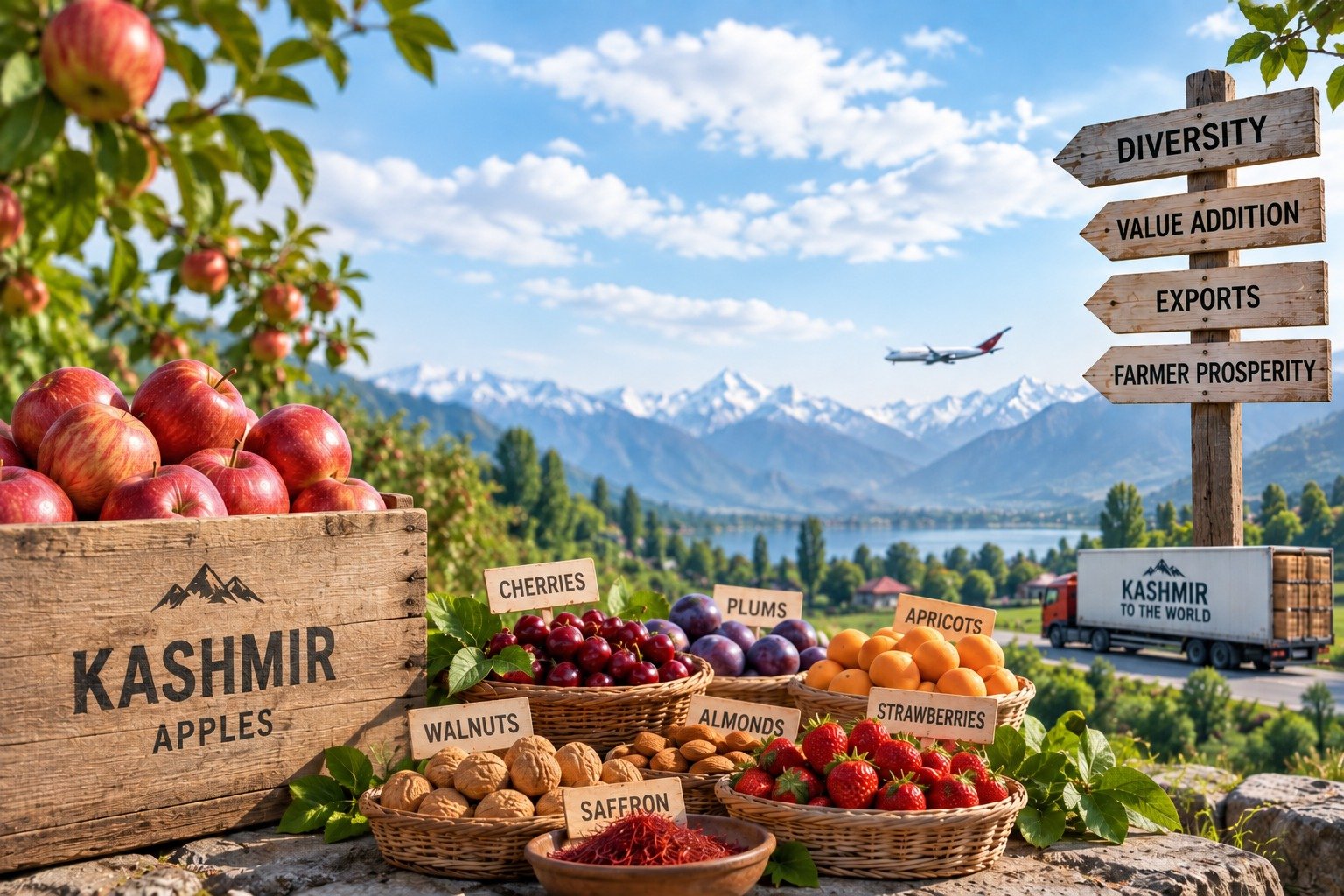
Statistics related to the sector are impressive in their own right. The entire horticultural sector constitutes almost 9 percent of the state’s GDP and employs around seven lakh families, as per the Department of Horticulture. Exports through the fruit category stood at nearly 70 billion rupees in 2022. The land under horticultural cultivation grew from 0.48 lakh hectares in 1970-71 to 2.12 lakh hectares in 2022 – a near fivefold growth in five decades, due to both growth in population and importance of the sector to the local economy. Walnuts and cherries are also often mentioned as the other two crop varieties which have substantial potential alongside the others like almonds, apricots, pears, plums, strawberries and saffron, with the ability to anchor an independent value chain for themselves.
High Density Plantation (HDP), which entails much greater tree planting density and early fruiting years compared to conventional orchards, has become the main means adopted by the government to achieve modernization in the sector. According to the budget of Jammu and Kashmir for the financial year 2026-27, a total of 1,119 hectares have been brought under HDP since 2017-18, with financial assistance of Rs 139 crore, while for the coming financial year 1,455 hectares are targeted to be covered. For medium and high density plantation combined the scale becomes even larger; according to the roadmap for horticulture development by NITI Aayog, 4,023 hectares were covered in 2023-24 following 4,776.88 and 2,540.04 hectares respectively in 2021-22 and 2022-23. There is an altogether five year scheme covering 5,500 hectares for apple, walnut, almond and cherry plantation, which provides 50 percent subsidy to farmers to facilitate transition. In Baramulla District alone, which is a prominent apple-producing region in Kashmir, 599 farmers had been assisted under this scheme over an area of 245 hectares during the period 2016-17 to 2025-26, most of the coverage taking place in 2025-26.
The reality of diversification is that it is already taking shape through exports. In 2026, Kashmir made its first-ever export shipment of premium Areko cherries and Scentrose plums grown in the orchards of Shopian and Pulwama to Singapore, which is an indication of true diversification into another export segment apart from apples. The Areko cherry is a European sweet cherry variety which belongs to the high-density category and is different from the existing varieties grown in the Valley. This is a positive indication that Kashmir can also grow premium fruit varieties which yield much more profits than apples do. Another crop which cannot be directly associated with horticulture, but has seen a dramatic increase in terms of production, is mustard. Production has increased to 143,476.9 metric tonnes in 2025 from 107,476.9 metric tonnes last year due to extensive cultivation and use of high-yielding varieties of seeds.
Private enterprise has entered this space too. Qul Fruit Wall, established in 2013-14, built what is described as India’s first high-tech, high-density orchard using AI-assisted precision farming techniques, and claims to have empowered over 5,000 farmers while quadrupling apple yields on participating land. The company, which employs more than 600 people, has stated plans to reach 30,000 farmers and cross Rs 1,000 crore in revenue within five years, with diversification into cherries, plums, kiwis and pears forming a central part of that growth strategy.
But then again, it does not mean that the structural issues which have plagued the Kashmiri horticulture industry for many years now are no more a problem just because there has been a push towards diversification. In fact, in a recent report written under the concept of “Ultimate Oasis,” it was highlighted that one of the problems of the sector is still the continued reliance on the single corridor for transporting perishable goods, lack of Controlled Atmosphere facilities through which farmers can store fruits for selling at better rates after harvest instead of selling them immediately, and cheap imported apples which put Kashmiri farmers at risk in their own domestic market. The report has pointed out that it is impossible for Kashmir to compete in such a competitive environment when the biggest apple producing countries are in the picture unless the farmers adopt superior varieties and superior techniques for packaging and processing and also build their brand name in the industry.
And that issue, that of ownership of the storage facility, the processing facility, the packaging and the branding, is central to the significance of diversification for more reasons than mere diversity of crops. A farmer selling fresh cherries from his orchard at the point of harvest earns just a fraction of what these cherries will be worth when branded and packed and shipped to Singapore and other markets around the world. Establishing local capacity in terms of logistics, agro-processing hubs and quality certification could ensure that the value generated by Kashmiri farmers in their orchards stays with them.
The improved road infrastructure that is taking place in the Jammu-Srinagar corridor, which has already been covered elsewhere in this analysis, will have an immediate bearing on this issue, because it means that any increase in speed and efficiency of transport decreases the chances of spoilage of cherries, plums, and apricots, while at the same time increases the amount of time during which the produce can be sold to remote markets in a viable condition. This makes diversification, logistics, and branding three strands in the same project. None of them will individually protect Kashmiri horticulture from the threats posed by climate uncertainty, market shock, or apple dependence. Together, however, they constitute the only clear route that the industry has towards building resilience.
“A farmer selling fresh cherries from his orchard at the point of harvest earns just a fraction of what these cherries will be worth when branded and packed and shipped to Singapore and other markets around the world.”
Comments are closed.