
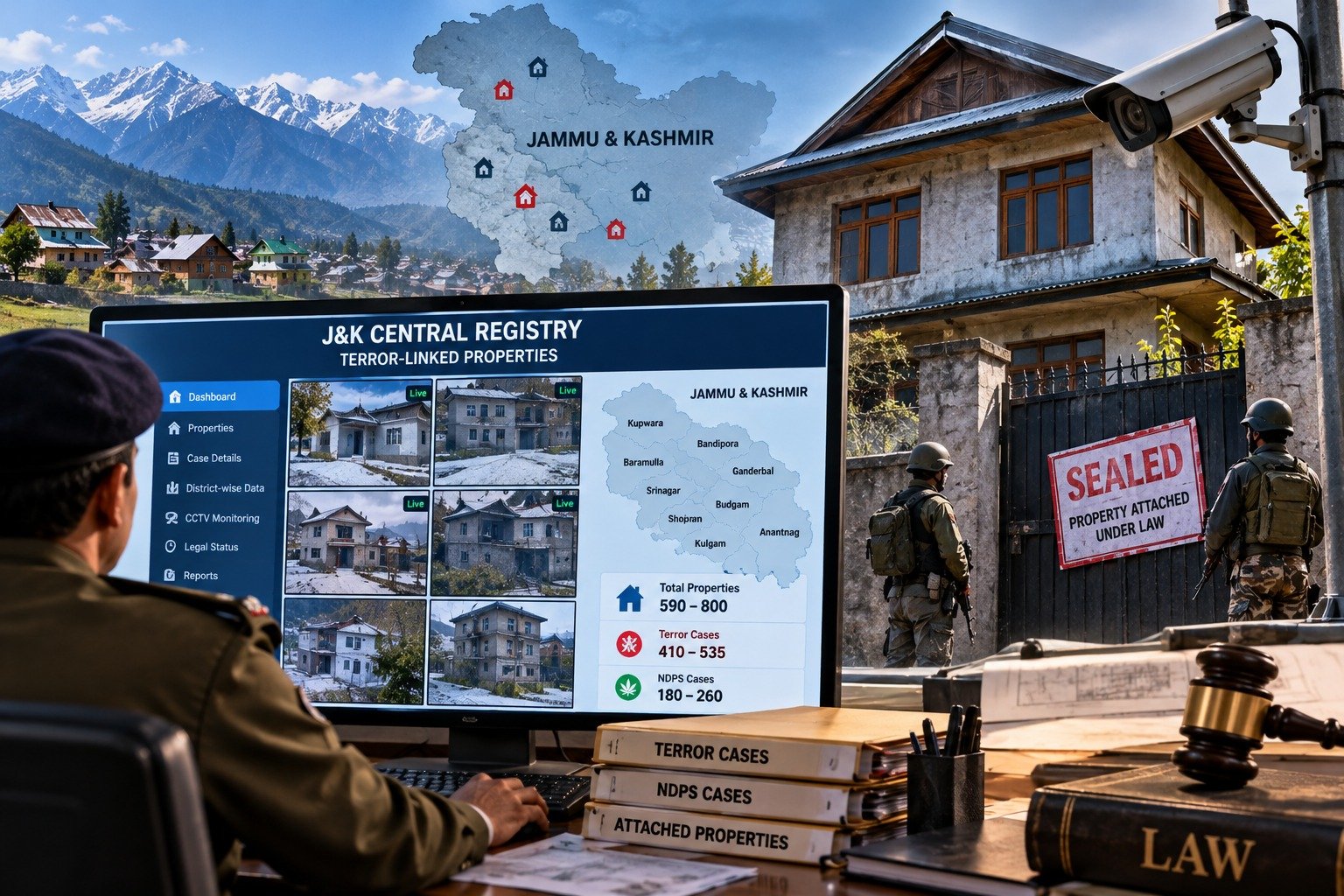


JK Needs a Central Registry for Terror-Linked Properties

Dr. Siddhartha Ghosh


J&K has shown that the terror ecosystem can be dismantled, not just its ground members. Now we should strive to make each of those gains permanent. The idea should be to seize or attach a property and then keep it under continuous, centralised, transparent monitoring until its legal status is determined. Taking a property from people aiding and abetting terror is a good step. Making sure it stays away from them is what completes the process.

Jammu and Kashmir has in the last five years seized, attached and secured properties across the Kashmir Valley that have been used to sustain terror. Hundreds of such actions have been taken and disclosures by intelligence and law enforcement agencies, police records and district-level information indicate that such actions number between 590 to nearly 800. This is a change in approach that focuses on a terror ecosystem rather than on terrorists.

Such an approach seeks to negate the terrorists’ rationale that “terror pays”. For too long in India, a terrorist ecosystem was largely ignored and the focus was always on terrorists. Attacking the ecosystem head-on, along with the terrorists is a welcome shift.

However, the same can’t be said about what happens after terror ecosystem’s property is seized. There are gaps in the legal system which needs to be addressed, and without them, the approach in which property linked to terror is seized is more of a symbolic gesture. Currently, there is absence of any consolidated mechanism to track these properties after an enforcement action.

Their upkeep and status mostly depend on the local police stations, follow-up visits and spot verification by officers at the field level. In the end, a seal on a door is just a piece of paper and a lump of wax. Without independent verification, there is no way of knowing if a sealed house has been reoccupied or used for illegal purposes.

Because of the magnitude of the problem, manual monitoring of the properties is not practical and possible. Across the Valley’s ten districts, an estimated 590 to 800 properties have been acted against. Roughly 410 to 535 of these are in terror-related cases and 180 to 260 under the NDPS. Srinagar has the most NDPS cases: about 60 to 75 properties in terror cases and 40 to 55 in NDPS cases.

Pulwama and its adjoining areas have the most terror cases, at 70 to 85, along with 20 to 30 NDPS cases. Baramulla, including Sopore and Pattan, follows with 55 to 70 and 25 to 35. The rest of the figures similarly for other districts are: Anantnag, 50 to 65 and 20 to 28; Kupwara, 45 to 60 and 20 to 30; Kulgam, 40 to 50 and 15 to 22; Shopian, 35 to 45 and 10 to 15; Budgam, 30 to 40 and 15 to 25; Bandipora, 15 to 25 and 8 to 12; and Ganderbal, 12 to 20 and 6 to 10.

Two trends are noteworthy here. First, the four Kashmir districts of Pulwama, Anantnag, Kulgam, and Shopian, account for an estimated 195 to 245, terror-related actions, reflecting the location of the most-dense terror infrastructure. Second, the estimated 180 to 260 narcotics-related cases in the Valley, serve as a stark reminder that terror and drugs in Kashmir have become two sides of the same coin.

Keeping a few officers in each district to physically monitor thousands of terror related activities is both unfair to the officers and inadequate. Hence, a central registry and round-the-clock CCTV monitoring of such properties is the need of the hour.

One must never doubt on the honesty of local officers. The Jammu and Kashmir Police has been on the frontline against terror and made the supreme sacrifice against it. But, distancing custody from oversight is a good practice and has additional benefits.

It takes care of the local officer who is in a sensitive posting and may get pressured, intimidated or defamed by individuals or institutions having vested interests. A senior officer’s CCTV feed that is accessible at any time, answers all of the above.

The most important step, in my view, is not the CCTV cameras; it is the record. Jammu and Kashmir needs a centralized, verified, and regularly updated database of all seized/attached properties across the UT. Each entry should have the location of the property; the case number, the investigating agency, the date the property was seized or attached, the legal status, the authorized custodian, and the present physical status of the property.

Linking this database to the police and court records will enable the status of a case to be updated from attachment to a final court order decreeing or releasing the property. Without an updated central list, there is no benchmark against which the status of a property can be monitored, no matter how many cameras are installed.

There is a strong rule-of-law case for this reform, and it works in India’s favour. In most cases, attachment is a provisional step, and final forfeiture is decided through due legal process. When courts order a property released, it is the duty of the state to demonstrate that it was a responsible custodian in the interim. When forfeiture is upheld, it is the duty of the state to show that the asset was not diverted in the process.

Both cases are best answered by continuous monitoring. This not only simplifies bureaucratic processes, but addresses a prominent propaganda tool of separatists and their backers across the border, that the state is arbitrarily punishing Kashmiris. A state that can show a verified registry and a continuous and uninterrupted record of custody can address this narrative.

Various solutions to do so exist. Power and internet connectivity in some areas of Kupwara and Bandipora can tend to be irregular, especially in winters. However, the use of solar power and mobile data in camera units can be made for the deployment of such monitoring devices routinely.

A phased approach could be to implement the use of such surveillance mechanisms in the districts of Srinagar, Baramulla and Pulwama where the caseload is the highest, and then extend it in other places of the UT. These cameras should focus on the property rather than the surrounding area, and to ensure proportionality, rules should be put in place regarding who can access the footage and how long it can be stored.

In the last few years, Jammu and Kashmir has shown that the terror ecosystem can be dismantled, not just its ground members. Now we should strive to make each of those gains permanent. The idea should be to seize or attach a property and then keep it under continuous, centralised, transparent monitoring until its legal status is determined. Taking a property from people aiding and abetting terror is a good step. Making sure it stays away from them is what completes the process.


Author is Director Red Lantern Analytica Foundation

Comments are closed.