

Malik Nazir
After all, what does excessive spending really achieve? However much a host spends, someone may still complain that a dish was too salty, a course arrived late or a portion was too small.
There is a particular sadness in watching traditions change when you remember how they once were. I was born in the twentieth century, but I live in the twenty-first. Between these two worlds, much has changed. Our mountains remain the same, but the way we celebrate weddings has changed considerably. I write not to judge, but to reflect on how some of our cherished traditions are slowly losing their meaning.
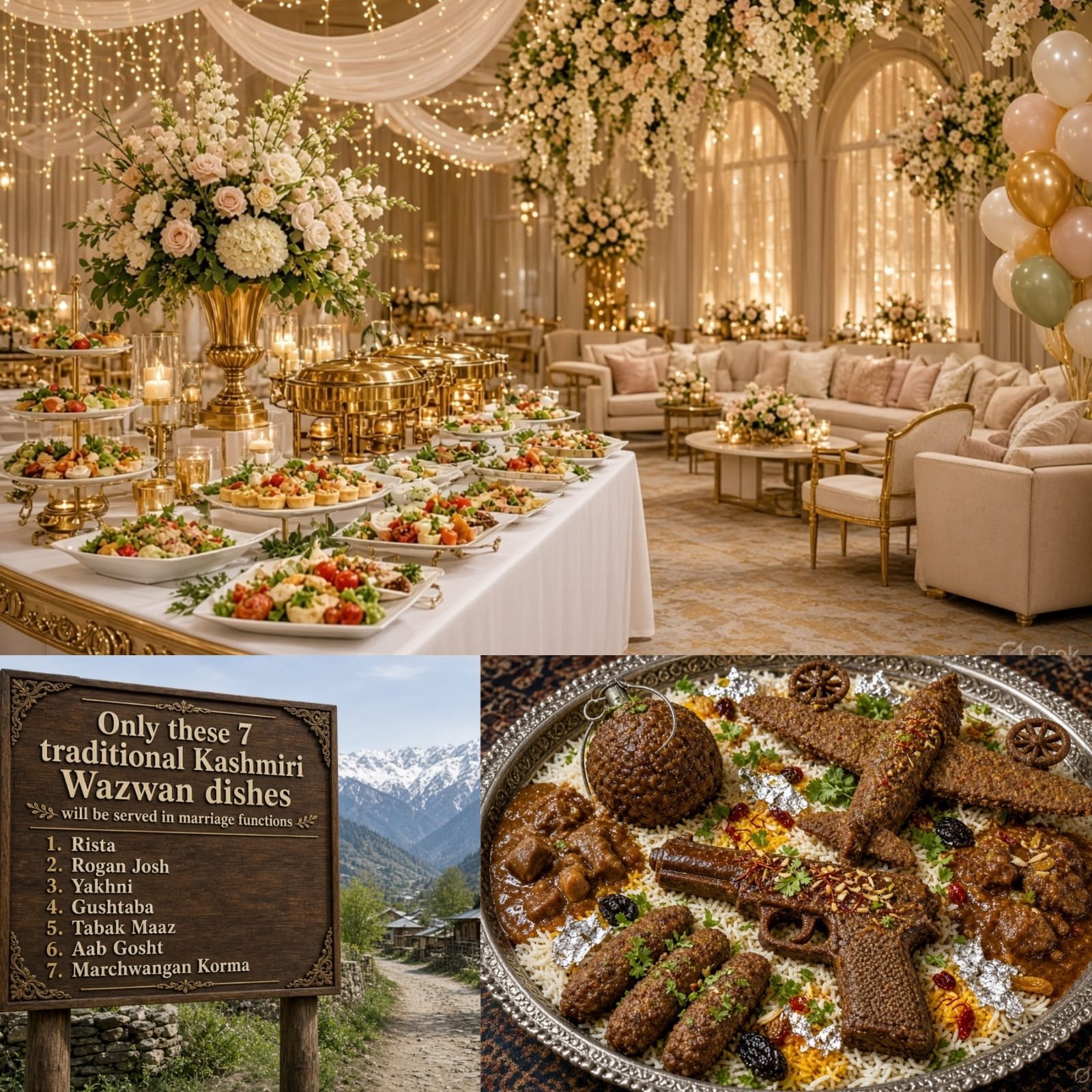
The change is most visible in our trami. Kashmiri Wazwan was once known for its taste, order and dignity. Every dish had its place, following traditions passed down through generations of wazas. The purpose was simple: to honour guests through good food and warm hospitality.
Today, however, the trami is increasingly becoming a display for cameras. Some wazas are encouraged to shape kebabs like pistols and gushtabas into oversized spheres resembling grenades or even drones. Such experiments may attract attention on social media, but do they add anything to the taste or cultural value of Wazwan?
When food is designed more for photographs than for enjoyment, something important is lost. Wazwan is not merely a collection of dishes; it is part of our identity.
The same desire to impress is visible in other aspects of weddings, including the Nikah. A recently reported marriage attracted attention because the Mehar exceeded twenty lakh rupees, settled in gold and jewellery. Mehar is the bride’s right and an important form of security, with no fixed upper limit. The concern is not the amount itself, but how such matters are presented publicly. When a personal right becomes a public display, it can encourage comparison rather than understanding. What deserves quiet respect can become a subject of social media discussion.
Thankfully, some communities are trying to reverse this trend. In Ganderbal, Baramulla, Kishtwar and other areas, local societies and village committees are encouraging simpler wedding menus to reduce expenditure and food waste. Such initiatives deserve wider support.
Every mohalla could adopt a reasonable menu and display it at its entrances, reminding families to serve well, avoid waste and keep celebrations affordable. Collective decisions can reduce competition and reassure families that they need not spend beyond their means to meet social expectations.
Governments have also issued guidelines to discourage extravagance, but lasting change requires community participation. After all, what does excessive spending really achieve? However much a host spends, someone may still complain that a dish was too salty, a course arrived late or a portion was too small.
Families sometimes take loans to finance celebrations that last only a few hours. The appearance of prosperity disappears quickly, but the debt remains. We borrow the display, but carry the burden ourselves.
Another change is the growing popularity of event-management services in rural areas. These services can be helpful, especially for families with few relatives nearby or children settled far away. Yet we should remember what weddings once meant to our communities.
Relatives and neighbours arrived early, helping with cooking, serving and other arrangements. Their contribution was more than unpaid labour; it expressed love and belonging. Professional organisers may make events easier to manage, but they cannot always replace the warmth created when a community works together.
Social media has added another dimension. Many weddings now seem to be planned around photographs and short videos. Every entrance, gesture and moment is recorded for an online audience. Some customs that were once uncommon, including public dancing and carefully staged couple appearances, have become more visible.
Every generation has the right to shape its own customs, and change is natural. However, we should ask whether we are sometimes so busy recording celebrations that we forget to experience them.
A wedding should be a moment of happiness shared with family and friends, not merely an event prepared for public viewing. Photographs can preserve memories, but they should not become the main purpose of the occasion.
This reflects a wider concern about our relationship with Kashmiri culture. We have gradually allowed our mother tongue to lose its place in many children’s lives.
The Pheran, once an everyday part of winter, is increasingly treated as something to wear for photographs or special occasions. Now even Wazwan faces pressure from trends that prioritise novelty over tradition.
Culture survives when we practise it, understand its meaning and pass it on to our children. If our food, language and clothing become little more than material for photographs, we risk preserving the appearance of our culture while losing its substance.
This is not a call to resist every change or return to the past. Traditions evolve, and new ideas can bring their own beauty. The real question is whether these changes enrich our lives or simply increase the pressure to compete. We can welcome modern conveniences without abandoning the community spirit that once defined our weddings.
Our mountains have stood for centuries without needing an audience. Perhaps our celebrations, too, can rediscover their quiet dignity.
In the end, a wedding is not remembered only for the number of dishes served, the value of jewellery exchanged or the quality of photographs taken. It is remembered for the people who stood beside us, the warmth they shared and the happiness they brought.
A celebration should be measured not by how much it displays, but by how much happiness it leaves behind. After all, how much of a wedding’s true warmth can a social media reel really hold?
In the end, a wedding is not remembered only for the number of dishes served, the value of jewellery exchanged or the quality of photographs taken. It is remembered for the people who stood beside us, the warmth they shared and the happiness they brought.
Comments are closed.