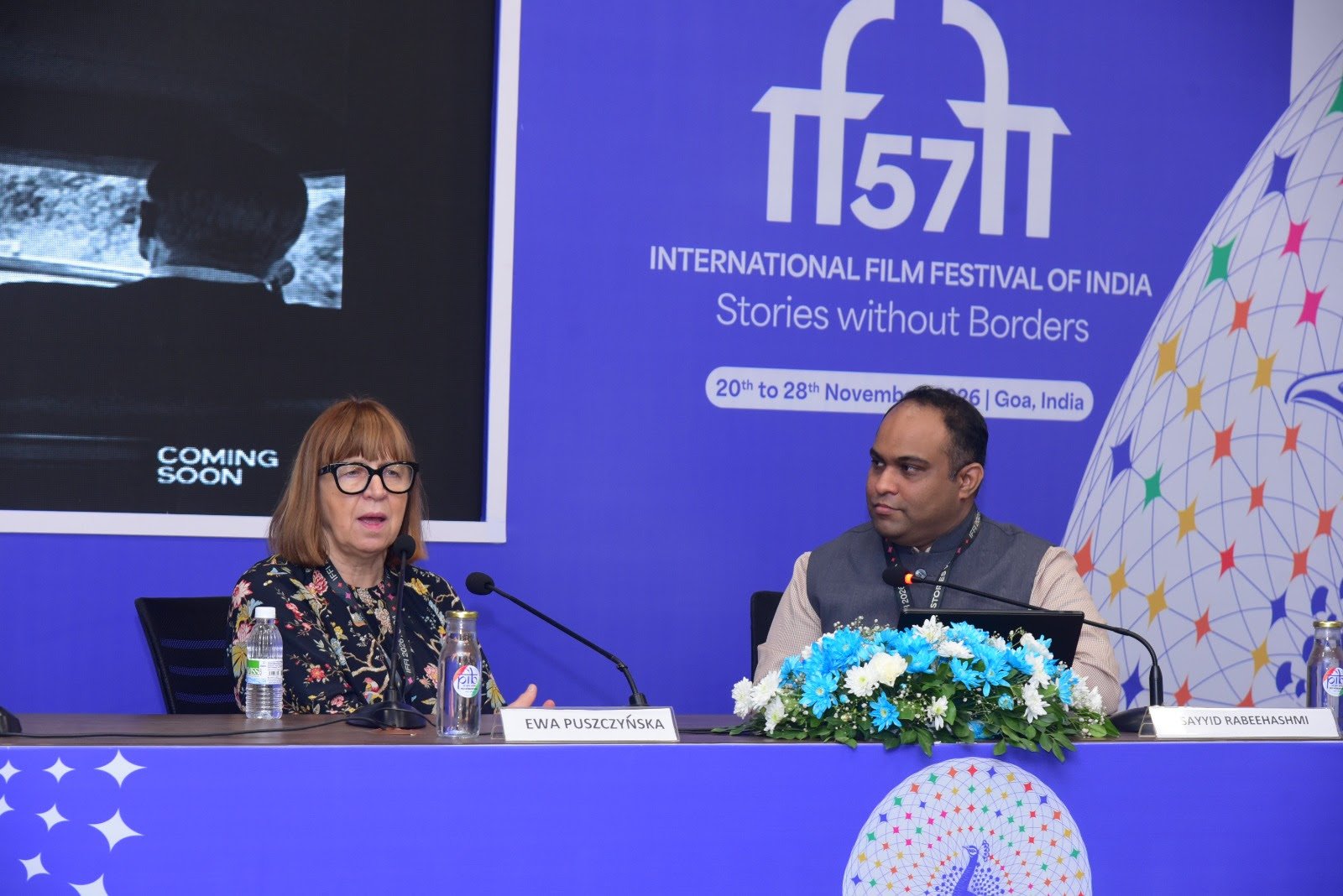
GOA, November 21: Films may not change the world overnight, but they can open minds, encourage dialogue and inspire people to reflect on society, acclaimed Polish producer Ewa Puszczyńska said at the 57th International Film Festival of India (IFFI) on Saturday.
Addressing a press conference, Puszczyńska, producer of Fatherland, the opening film of IFFI 2026, said cinema could bring people closer by encouraging conversations and exposing audiences to different perspectives.
“We have to talk to people through our films. We have to open people’s minds to other sides of life, to other sides of the world,” she said.
Reflecting on divisions in contemporary societies, she said no single narrative or agenda could claim to represent the only valid perspective. She called for dialogue and efforts to identify common ground.
“There is no one agenda, no one narration which is right. Talk to each other, let’s find the common ground,” she said.
Describing Fatherland as a multi-layered story, Puszczyńska said the film was set against the backdrop of a divided Europe in 1949 and explored themes of identity, belonging, migration and the East-West divide.
The film also examines what defines a person’s homeland, raising questions about whether it is determined by the country where one lives, the language one speaks or one’s historical roots.
Through the story of German writer Thomas Mann and his family, the film explores the relationship between culture and society, family relationships and the influence of historical developments on individual lives. It also examines the expectations faced by children of celebrated artists and the pressures associated with living up to their parents’ achievements.
On the film’s visual treatment, Puszczyńska said it was shot in black and white and in a 4:3 aspect ratio, following an approach adopted in her earlier collaborations with director Paweł Pawlikowski, Ida and Cold War.
The visual format, she said, was chosen to lend authenticity to the period depicted in the film. She suggested that Fatherland could be viewed as the third film in the trilogy.
Puszczyńska said the film was an international co-production involving Poland, Germany, Italy and France. Although its story is set in Germany, nearly 95 per cent of the shooting took place in Poland, where locations were selected to recreate the appearance of Germany in 1949.
The producer also expressed interest in exploring a film based on the shared history of India and Poland, particularly the story of Polish children who found refuge in India during the Second World War.
Referring to her conversation with IFFI Festival Director Ashutosh Gowariker, who has written a script on the subject, she said she hoped discussions would continue and the possibility of taking the project forward could be explored.


Comments are closed.