

Sidrat Mehraj
“A girl should be able to understand her own body without feeling that she is violating a social rule.”
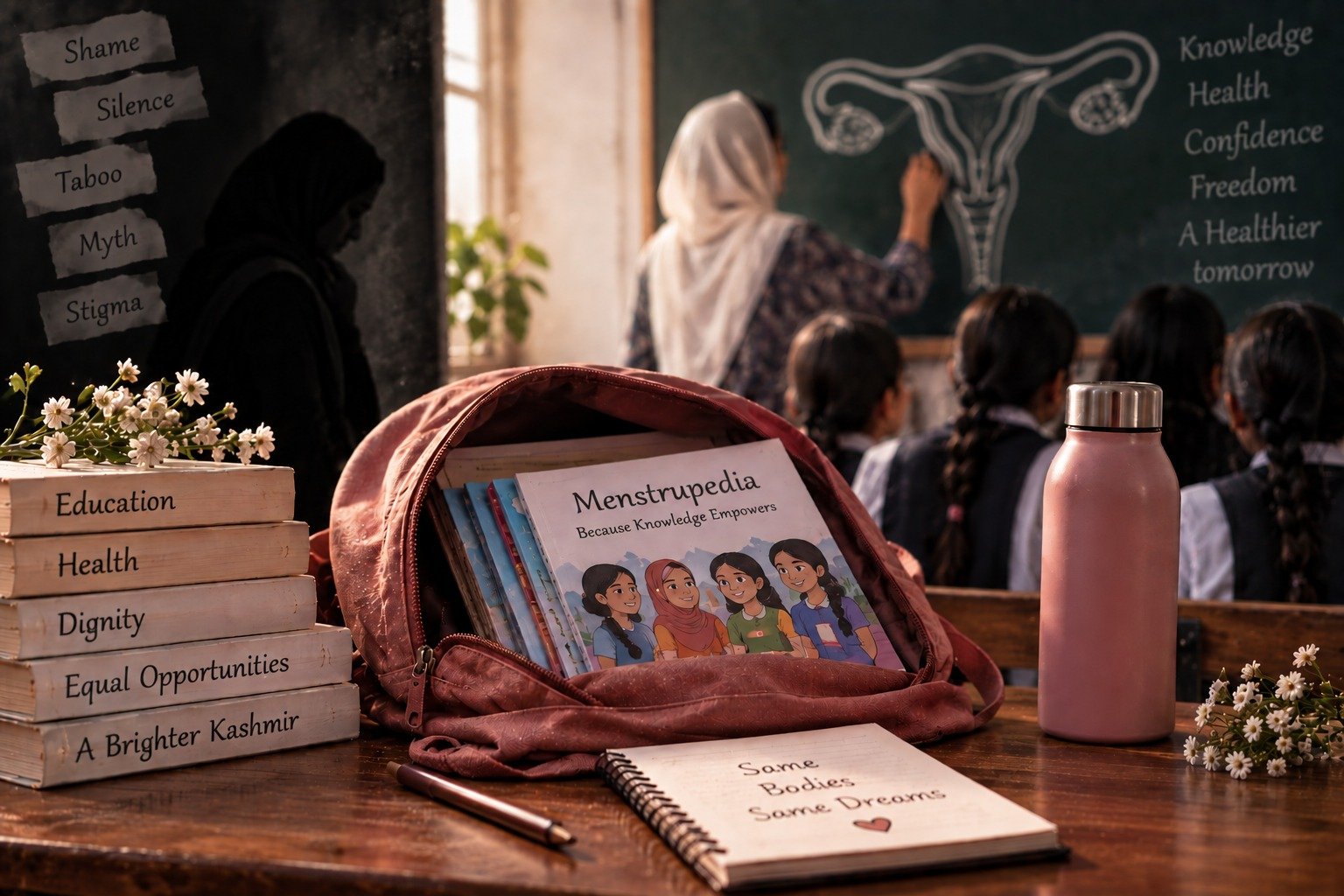
The first time I drew a scientific diagram of the uterus on the board, the girls giggled with shyness and looked down. Two hours later, when they realised that having periods is a vital sign of a healthy and normal body, I was bombarded with questions they would never have expected to ask anyone.
I am Sidrat Mehraj, a master’s student at Dr B.R. Ambedkar University, Delhi, and a certified menstrual educator with Youth Innovation Foundation. I have been working across different districts of Kashmir, conducting awareness sessions with adolescent girls and distributing age-appropriate Menstrupedia comic books and sanitary napkins.
It was a huge challenge for me to step out of my house with a desire to educate adolescent girls about periods, coming from a Kashmiri society where many conventional norms and silences still surround menstruation. Before I could help others break this silence, I first had to break out of this mythical cocoon myself so that others could follow.
Being a Muslim, I also often found myself asking: what does Islam teach about periods?
The Prophet Mohammad (PBUH) said that seeking knowledge is a duty upon every Muslim. This narration is reported in Sunan Ibn Majah. Women also directly raised questions related to menstruation before the Prophet (PBUH), and Aisha (RA) narrated several teachings concerning menstruation. These traditions show that questions about menstruation were not treated as something that had to remain hidden or unspoken.
For me, this is an important lesson. Knowledge about the human body, health and hygiene should not be surrounded by unnecessary shame. Menstruation is a natural biological process, and girls should be able to learn about it without feeling embarrassed or guilty.
There is also a difference between religious rules concerning menstruation and cultural practices that may treat menstruating women as dirty or socially inferior. These should not automatically be treated as the same thing. The Prophet’s teachings recorded in Sahih Muslim, for example, include his reassurance to Aisha (RA) that menstruation was not something that made her physically untouchable.
Every woman should know about her body’s health, hygiene and functions. She has been entrusted with this body, and understanding it should be a matter of knowledge and dignity rather than secrecy.
In Kashmiri society, periods are still often associated with shame, discomfort and silence. It is unfortunate that a subject as natural as menstruation can still make people uncomfortable. Period knowledge is sometimes treated as if it is opening a cover that should never be lifted. But what exactly is this cover hiding?
I have visited several educational institutions across Kupwara and other districts of Kashmir. Many of the institutions I worked with were government schools and tribal Anganwadi centres. The young girls I interacted with were filled with enthusiasm to learn. It was not a lack of interest or ability. It was simply that many of them had not been given enough opportunities to ask questions and receive accurate information.
The young girls of Mithabag, Kupwara, whom I interacted with, were curious and eager to learn. Their questions were often simple, but they reflected how little space they had previously been given to discuss menstruation openly.
I am a student, not a doctor, but I tried to act as a bridge between the lived reality of these girls and the diagrams in their textbooks. I understood many of their concerns through the questions they asked during these sessions.
During a workshop at a school in Sopore, a Class 8 girl, with a serious look on her face, asked me, “Why don’t boys get periods? And why do they make jokes about girls’ periods?”
This was a question I received very commonly. I could not give her a perfect one-line answer. I simply told her that boys often make jokes because they lack knowledge and do not understand what periods actually mean. That is true to a great extent, but it also made me realise how important it is for boys to receive age-appropriate information as well.
On the social media page of Youth Innovation Foundation, we often come across comments asking why workshops for girls and boys are not conducted together. I understand the reasoning behind this question. Boys also need to understand menstruation because ignorance can lead to teasing, embarrassment and stigma.
At the same time, I do not think that every conversation about menstruation has to happen in a mixed setting. Adolescent girls should have spaces where they feel safe enough to ask personal questions without fear of being judged or laughed at. Separate sessions can provide that comfort, while boys can also be given appropriate education about menstruation in a setting where they can ask their own questions.
During workshops in a few schools in Kupwara, I often heard schoolboys in the corridors shouting “periods, periods” when they knew that a menstrual workshop was taking place. This itself becomes a challenge. If we want to reduce stigma, boys cannot remain completely outside the conversation either.
It is also important to recognise that menstrual taboos can be passed from one generation to another. Mothers and grandmothers may sometimes pass on beliefs that they themselves inherited, often without questioning them. But this does not mean that women are solely responsible for these taboos. Families, peers, schools and the wider community all have a role in shaping how menstruation is understood.
Now it is our responsibility not to pass on the same mindset to the present and future generations.
There are girls who are bright and sharp, who can speak three languages fluently and recite Quranic verses with confidence, but who may still not know why their bodies bleed, what is normal during menstruation and how to manage their periods safely and hygienically.
According to the National Family Health Survey-6 (NFHS-6), conducted in 2023-24, 79.3 percent of women aged 15-24 years in rural Jammu and Kashmir use hygienic methods of menstrual protection. This means that around 20.7 per cent of young women in rural J&K are not using such methods. At the overall J&K level, the figure is 82.5 percent. The survey considers reusable and disposable sanitary pads, tampons and menstrual cups as hygienic methods of menstrual protection.
These figures show that although menstrual hygiene has improved, there is still a gap, particularly in rural areas. Access to appropriate menstrual products, accurate information, sanitation facilities and a supportive environment all matter when it comes to menstrual health.
A 2025 study published in Health Care for Women International, titled “Menstrual bodies and cultural practices: The voices of adolescent tribal girls from Kashmir,” examined the menstruation experiences of adolescent tribal girls from the Fakir Gujri community of Srinagar. The researchers collected information from 15 participants and identified themes including experiences of menarche, cultural taboos and myths, fear of discovery and shame, and the consequences associated with menstruation.
The study is important because it gives space to the voices of girls themselves. It also shows how fear and shame can become part of a girl’s experience of menstruation when she is not adequately prepared for her first period.
However, these findings should not be taken to mean that the experience is identical in every tribal household. What the study does show is that there are girls in tribal communities who continue to face fear, shame and cultural restrictions around menstruation, and that these experiences deserve greater attention.
That is what initiatives like ours are trying to address: to dismantle the sense of fear and shame and empower girls to take responsibility for their health and bodies.
Being a menstrual educator in Kashmir has not been an easy task. But someone has to step out. Someone has to become the bridge between information and understanding. Change does not come overnight, but it comes steadily, and what is needed at a particular moment has to become the first step.
That first step has already been taken in many places.
The real work of education begins with us, the learners who have acquired the right knowledge. That knowledge should not remain confined to us. It has to reach those who are still in desperate need of it.
The experience of working with girls has taught me that sometimes the biggest barrier is not the absence of information but the absence of a safe space to ask for it.
A girl should be able to ask why she is bleeding without being made to feel ashamed.
She should be able to ask how to manage her period without being told that the subject is inappropriate.
She should be able to understand her own body without feeling that she is violating a social rule.
And a boy should be able to learn what menstruation is without turning it into a joke.
This is where education can make a real difference.
Through menstrual-awareness sessions, the effort is to create a link between knowledge and prevention, and between secrecy and science. These conversations do not have to be uncomfortable or complicated. Sometimes, all that is required is a healthy and honest conversation.
We need to create an environment where girls are prepared before their first period rather than being frightened when it arrives. We need families to speak about menstruation without embarrassment, schools to provide accurate and age-appropriate information, and communities to understand that menstrual hygiene is not a luxury but a basic part of health and dignity.
There is still a long way to go. But the silence has already begun to break.
For me, every question asked by a girl during a workshop is a small sign of that change. Every time a girl leaves a session with greater confidence in understanding her own body, it is a step forward.
The task is real, and it begins with all of us.
And it begins now.
“There is still a long way to go. But the silence has already begun to break.”
Comments are closed.