

Maj Gen Ranjan Mahajan (Retd)
“The people of Jammu and Kashmir have benefited immensely from the disciplined cooperation, shared commitment and professional coordination between the Indian Army and the J&K Police.”
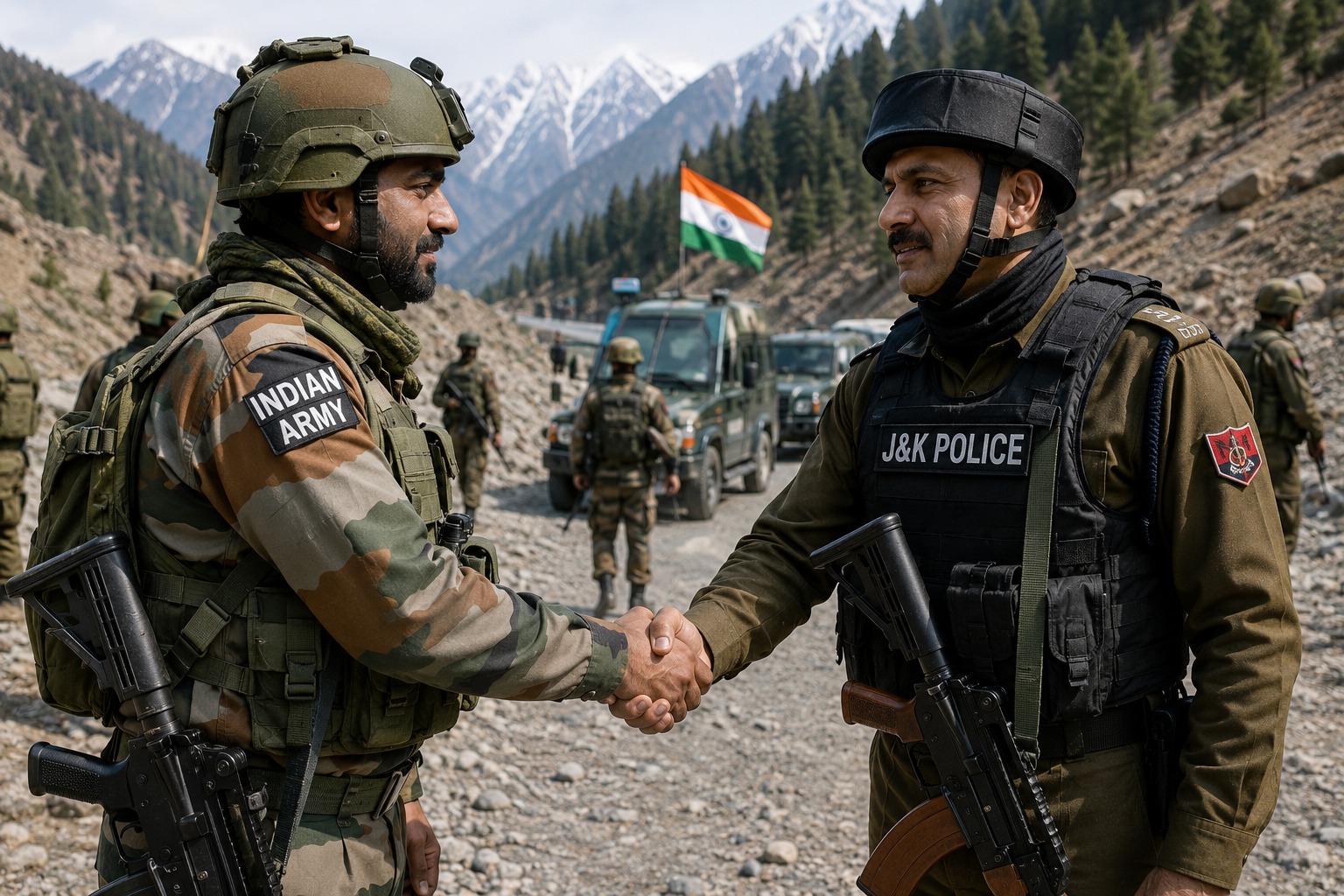
Having spent nearly a decade and a half in Jammu and Kashmir and having been closely involved in counter-terrorism operations, I say this with deep conviction: the security situation in the region has improved steadily due to one decisive factor, the strong operational synergy between the Indian Army and the J&K Police. Their coordination, mutual trust, shared intelligence, and joint training have built a framework far more effective than any single force working in isolation.
Over the years, they have stood shoulder to shoulder in numerous difficult situations, facing live fire many times and, on several occasions, sustaining casualties while safeguarding one another. Their shared resolve and professionalism have been central to the successful conduct of operations and to managing the counter-terrorism situation in J&K with effectiveness and restraint.
Recent reporting and updates across news channels and social media platforms indicate that this partnership is being further strengthened through refresher courses and joint operational initiatives aimed at improving coordination, interoperability, and tactical readiness. Under the stewardship of Lt Gen Pratik Sharma, Northern Army Commander, this synergy remains one of the key focus areas, and it continues to play a vital role in the success of security operations in the region.
The recent incident in Kishtwar Area between the Army and Police should be viewed as an isolated occurrence. All concerned must act responsibly and avoid amplifying it on social media.
The Indian Army and J&K Police complement each other in a very practical way. The Army brings field experience, counter-terrorism expertise, mobility, and tactical depth, while the J&K Police bring local knowledge, ground intelligence, legal authority, and continuity in area policing. When these strengths are combined, operations become faster, more accurate, and more sustainable. Official sources also note that joint training is being used to standardise procedures and improve joint operational effectiveness.
This synergy matters because counter-terrorism in J&K is not just about response; it is about prevention, intelligence, and area domination. Security reviews have emphasized better coordination between agencies, instant operational feedback, and the use of advanced technology and intelligence for a tighter security grid. The focus is not only on reacting to threats but on denying space to terror networks in the first place.
High-level government review has also reinforced the same direction. The Home Minister has specifically directed agencies to continue synergy among the Indian Army, J&K Police, and other forces, while also focusing on intelligence generation, border vigilance, and dismantling the terror ecosystem. This shows that coordination is not only a field-level habit but also a policy priority.
The recent isolated incident between the Army and Police is no way a reflection of the larger relationship between the two institutions. In any large security ecosystem, occasional friction can occur, but it can not overshadow years of cooperation, sacrifice, and joint success in difficult terrain and high-risk operations. The responsible approach is to allow institutional mechanisms to address the matter calmly and professionally.
Social media escalation in such situations helps no one. It can distort facts, inflame emotions, and weaken morale among personnel who work together daily in the national interest. The correct message is that the broader Army–Police partnership remains strong, professional, and essential for peace and stability in J&K. Even
The people of Jammu and Kashmir have benefited from the disciplined cooperation of the Indian Army and J&K Police. Their shared commitment, mutual trust, and coordinated action have been central to successful counter-terrorism operations and to maintaining public confidence in a difficult security environment. One isolated incident should not be allowed to define a relationship that has repeatedly delivered security, stability, and results.
The best response now is restraint, maturity, and respect for institutional procedures, while continuing to recognise the vital role both forces play in safeguarding J&K.
Comments are closed.