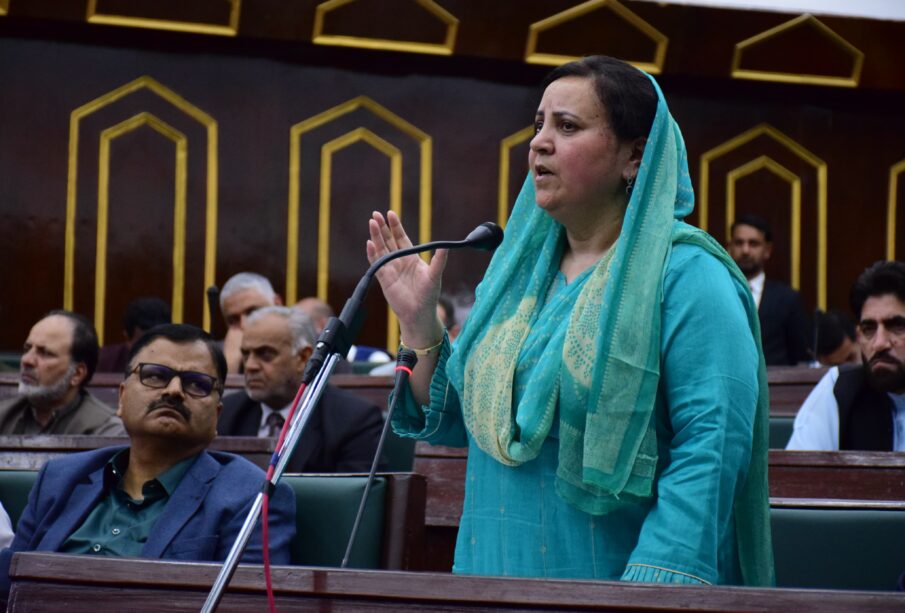

Sakina Masood Itoo: The Iron Lady of Resilience and Reform

Gowher Ahmad Bhat

“The tragedy of her father’s assassination could have silenced her path. Instead, it became the turning point that forged her resilience and sense of purpose.”

There is a timeless truth often repeated across generations: “A gem cannot be polished without friction, nor a person perfected without trials.” Few public figures embody this idea as completely as Sakina Masood Itoo. Her journey is not merely one of political success, but of quiet endurance, personal loss, and an unwavering commitment to public service in one of the most challenging regions of the country.

Born into a politically aware family in Jammu and Kashmir, Sakina Masood Itoo’s early life was shaped by both privilege and profound tragedy. The assassination of her father in 1994 was not just a personal loss—it was a moment that could have derailed her future. For many, such an event would have meant retreating into private life. But for her, it became a turning point. The grief may have left a permanent mark on her soul, but it did not weaken her resolve. Instead, it forged a deeper sense of purpose—one rooted in service, resilience, and responsibility.

What makes her story compelling is not simply that she entered politics, but how early and decisively she did so. In 1996, at just 26 years of age, she was elected to the legislative assembly—a remarkable feat in a region grappling with instability and uncertainty. It was a time when politics in the region demanded not only vision but courage. Her election was not symbolic; it was a clear indication of public trust in her ability to lead.

Her early tenure in government, particularly as Minister of State for Education, came during a period when the education system in Jammu and Kashmir was under immense strain. Schools were disrupted, academic continuity was fragile, and institutional confidence was low. It is in such circumstances that leadership is truly tested—not in moments of comfort, but in times of crisis. Sakina Masood Itoo demonstrated that she was not merely a political inheritor but a capable administrator. Her efforts to stabilise and reform the education sector during those turbulent years earned her recognition as a leader willing to act decisively when it mattered most.

Over the years, her political journey has been defined by consistency rather than spectacle. Being elected multiple times to the legislative assembly is not a matter of chance; it reflects sustained public confidence. Her repeated electoral success underscores her deep connection with the people, particularly those at the margins. Politics, in her case, has not been about rhetoric but about delivery—about ensuring that governance reaches those who need it the most.

Her administrative experience spans several critical departments, including education, health, social welfare, and tourism. This breadth of responsibility is not just a reflection of seniority but of trust—trust in her ability to manage complex portfolios that directly impact everyday life. Each of these sectors demands a different kind of leadership. Education requires vision, health demands urgency, social welfare calls for empathy, and tourism needs strategic thinking. Balancing these diverse responsibilities is no small task, yet she has navigated them with a sense of purpose and pragmatism.

Her recent electoral victory and subsequent appointment as Cabinet Minister overseeing school education, health, higher education, and social welfare mark another significant chapter in her career. These are not ceremonial roles; they are among the most demanding portfolios in governance. They define the quality of life, the future of youth, and the well-being of society. Taking charge of these departments requires not just administrative skill but a clear understanding of ground realities.

One of her most talked-about decisions as Education Minister has been the restoration of the academic session from March back to November in Kashmir. At first glance, this may appear to be a technical administrative change. In reality, it addresses a deeply rooted issue affecting students across the region. The mismatch in academic calendars had long posed challenges, particularly for students preparing for national-level examinations. By aligning the academic session more effectively, the decision not only preserved valuable study time but also created a more level playing field for students competing beyond the region. It is a reminder that sometimes, meaningful reform lies in understanding practical difficulties and responding with timely solutions.

Equally significant has been her push to address staff shortages in the education sector. The referral of 594 posts of 10+2 lecturers across 27 disciplines to the Public Service Commission for fast-track recruitment reflects a clear recognition of one of the system’s most pressing gaps. In regions where schools struggle with limited faculty, especially in far-flung and underserved areas, such steps are not merely administrative—they are transformative. A well-staffed school is the foundation of quality education, and by prioritising recruitment, she has taken a concrete step toward strengthening that foundation.

What stands out in her approach is a blend of intellect and grounded understanding. Governance, particularly in a region like Jammu and Kashmir, cannot rely solely on policy frameworks. It requires an intuitive grasp of local realities, an ability to anticipate challenges, and the willingness to act with clarity. Her decisions reflect not just administrative competence but a thoughtful engagement with the issues at hand.

Her work in social welfare further highlights her commitment to inclusive governance. In a region marked by socio-economic disparities, the role of social welfare policies becomes critical. Ensuring that support systems reach the most vulnerable sections of society—whether through financial assistance, healthcare access, or community programmes—is a task that demands both sensitivity and efficiency. Her tenure in this department has been guided by the understanding that governance must ultimately serve those who have the least.

Similarly, her contributions to the health sector carry particular significance in a time when public health systems are under increasing pressure. Strengthening healthcare infrastructure, improving accessibility, and ensuring better service delivery are ongoing challenges. Leadership in this domain is measured not by announcements but by outcomes—by the extent to which ordinary citizens experience real improvements in healthcare services.

It would be easy to describe Sakina Masood Itoo simply as a seasoned politician, but that would miss the essence of her journey. She represents a form of leadership that is shaped by adversity, sustained by resilience, and defined by service. Her story is not one of dramatic transformation, but of steady, determined progress.

In many ways, she embodies the evolving role of women in Indian politics. Her career challenges traditional notions of leadership, demonstrating that strength does not always manifest in loud declarations. Sometimes, it is reflected in quiet persistence, in the ability to endure, and in the commitment to continue serving despite personal and professional challenges.

The title “Iron Lady” is often used loosely in political discourse, but in her case, it carries weight. It signifies not just strength, but endurance—the ability to withstand pressure without losing direction. It reflects a leadership style that is firm yet responsive, resilient yet empathetic.

As Jammu and Kashmir continues to navigate its complex socio-political landscape, leaders like Sakina Masood Itoo play a crucial role in shaping its future. The challenges are many, and the expectations are high. But her track record suggests a willingness to engage with these challenges head-on, guided by experience and a clear sense of purpose.

In the end, her journey is a reminder that leadership is not defined by position alone. It is defined by the ability to rise above circumstances, to remain committed in the face of adversity, and to translate responsibility into meaningful action. From personal loss to public service, from early challenges to sustained leadership, Sakina Masood Itoo’s story is one of resilience forged into responsibility—and responsibility translated into reform.

Author is President Jammu Kashmir General Line Teachers Forum

Comments are closed.