

Najar Firdous
“The crisis in public schools is not just of shortage, but of maldistribution. It is a systemic imbalance that has weakened the very foundation of education in Jammu and Kashmir.”
The condition of public schools in the Union Territory of Jammu and Kashmir has been steadily deteriorating, raising serious concerns among educators, parents, and common citizens alike. While multiple factors contribute to this decline: such as inadequate infrastructure, limited access to technology, lack of continuous professional development, and weak monitoring mechanisms, the most critical and often overlooked issue is the politically influenced and inequitable distribution of existing human resources, coupled with the prolonged ban on teacher recruitment. This systemic imbalance has severely weakened the foundation of the education system, disproportionately affecting rural and far-flung areas where the need for teachers is most acute.
The most pressing issue, and indeed the primary driver behind the current decline, is the stark disparity in the rationalization and deployment of teachers. In the past, even in resource-limited settings, dedicated and capable teachers delivered outstanding outcomes. Today, however, such outcomes no longer seem possible; not because teachers lack dedication, but due to the uneven distribution of human resources taking place under the guise of rationalization and deployment practices across rural, urban, and semi-urban areas.
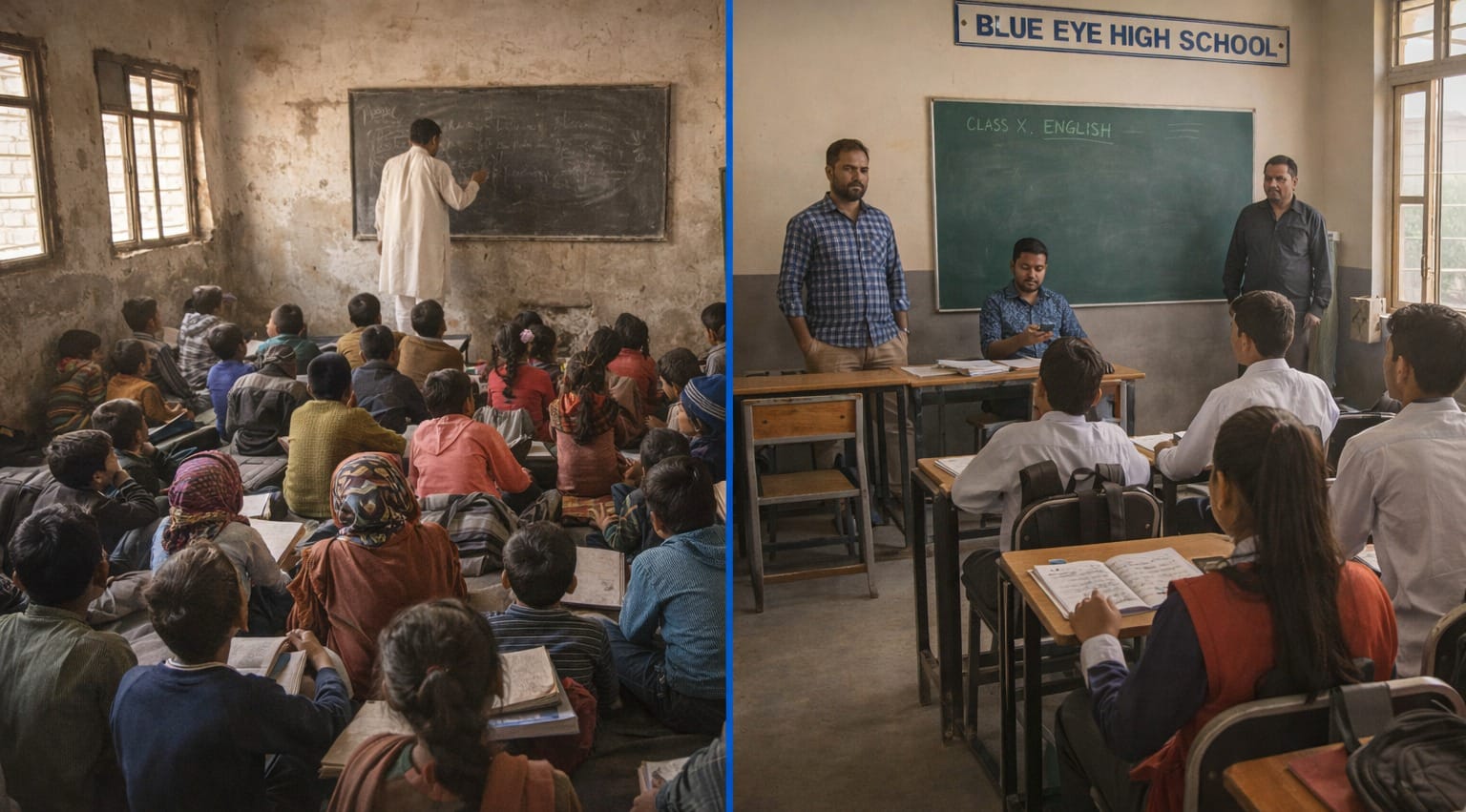
The consequences are not merely theoretical; they are clearly evident on the ground. In many rural schools across the region, severe teacher shortages persist year after year. Reports indicate that numerous government schools, particularly in remote areas, continue to operate with an insufficient number of teachers, directly undermining the quality of academic delivery. In extreme cases, primary schools catering to over 100 students are managed by a single teacher, forcing one individual to handle multiple classes simultaneously.
Under such circumstances, the teacher’s role is often reduced to ensuring attendance and maintaining order, leaving little scope for effective instruction, individual attention, or meaningful learning. Consequently, this not only compromises the overall quality of education but also widens the gap between rural and urban learning outcomes.
In contrast, schools located in towns or in areas favored by influential teachers are often overstaffed despite having relatively low student enrollment. Such institutions effectively become “comfortable postings” for politically backed or so-called “blue-eyed” teachers, who benefit from a significantly lighter workload. In many cases, these teachers are assigned only one or two periods a day and spend the remaining duty hours in casual discussions or attending to personal matters, whereas their counterparts in rural and underserved areas are often burdened with handling eight to twelve classes in a single day.
This imbalance not only creates inequity among teachers but also diminishes their motivation and commitment to teaching, ultimately affecting the overall quality of education.
The process of teacher rationalization, which is intended to address such disparities, has failed to achieve its intended outcomes. Instead of ensuring an equitable distribution of teachers, rationalization often becomes selective and, at times, biased in its implementation. It is frequently carried out in a manner that favors those seeking convenient or desirable postings, while already under-resourced schools continue to suffer neglect.
Ironically, such decisions are often justified on the basis of the pupil-teacher ratio (PTR). While this may appear logical, the reasoning is fundamentally flawed. A school cannot maintain a “balanced” ratio when it lacks even the minimum number of teachers required to function; PTR cannot replace essential human resources.
What makes this more questionable is its selective application. The same PTR logic is not enforced in towns and other favourable areas, where enrollment is low but teacher strength remains high.
This selective approach deepens inequality. Well-staffed schools attract more students, and rising enrollment is then used to justify their staffing, creating a cycle of advantage. In contrast, under-resourced schools with fewer teachers lose community trust, leading to decline of enrollment, not due to teacher incompetence, but systemic failure.
Tragically, this decline is often blamed on teachers, diverting attention from policy failures and systemic neglect.
The role of administrative officers in this situation is equally concerning. Many officials, aware of these disparities, find themselves unable to take corrective action due to political pressure and fear of repercussions. Certain schools and teachers are treated as “red lines,” meaning they are beyond the reach of administrative intervention. Attempting to address these imbalances can invite professional and personal challenges for the officers, leading to a culture of inaction and acceptance of the status quo.
Another critical issue undermining the education system is the continued ban on teacher recruitment, coupled with a lack of long-term planning. Each year, hundreds of experienced teachers retire, while large-scale promotions from teachers to lecturers are carried out simultaneously. This dual process steadily depletes the pool of classroom teachers, and over time, a significant number of vacancies have accumulated, creating a widening gap that directly affects the efficacy of the system.
The irony is that these teacher-to-lecturer promotions are often carried out without due consideration of actual subject requirements or the needs of students on the ground. In many instances, promoted lecturers find themselves with zero student enrolment in their respective subjects. As a result, they are frequently assigned clerical or other non-teaching duties.
This not only leads to a gross underutilization of qualified human resources but also exposes a serious disconnect between policy decisions and ground realities. Instead of strengthening the academic framework, such practices inadvertently weaken it, leaving critical teaching positions vacant while trained educators remain underutilized in roles that do not align with their expertise.
Addressing these challenges requires a comprehensive and well-structured policy framework. First and foremost, teacher recruitment must be resumed to fill the growing number of vacant posts. Simultaneously, a fair, transparent, and need-based system of teacher rationalization must be implemented to ensure equitable distribution of human resources across all regions.
Clear baseline staffing norms are essential to prevent schools from becoming functionally deficient. For instance, every primary school with a substantial number of students should have at least three teachers, while even those with lower enrollment must be provided with a minimum of two. Similarly, middle schools with higher enrollment should be staffed with at least eight teachers, whereas those with fewer students should have no fewer than six. Such minimum staffing standards would help create a more balanced and efficient system, ensuring that no school remains understaffed and that every child has access to a basic level of quality education, regardless of location.
In addition, accountability mechanisms and monitoring systems must be strengthened to ensure that policies are implemented in both letter and spirit. Teacher promotions should also be aligned with actual academic needs, with lecturer positions sanctioned only in subjects where there is sufficient student demand. Moreover, candidates should be required to qualify through departmental examinations to ensure merit, competence, and subject expertise.
Only through such targeted, transparent, and need-based reforms can the education system be strengthened and restored to effectively serve all sections of society.
Comments are closed.