
Stillness Speaks Deeper
The story is all about how deserving people are deprived of their dues when vested interests take over.

Usuf Mir
“In the rush to receive, need and greed stood indistinguishable in the same line. No one stopped to ask who truly deserved to be there.”
Gorimarg Kalaan, a hilly rural area blessed with natural beauty and lush green forests, lies about 55 kilometers from its district headquarters in the north. On a slightly cloudy Wednesday morning, April 15, the village unfolded with its usual quiet grace. A pale sun hovered over the hills as life stirred gently. Doors opened to daily routines—some people offering morning prayers, others engaged in running exercises and yoga in courtyards and parks, while many hurried to board buses connecting them to towns, colleges, and hospitals.
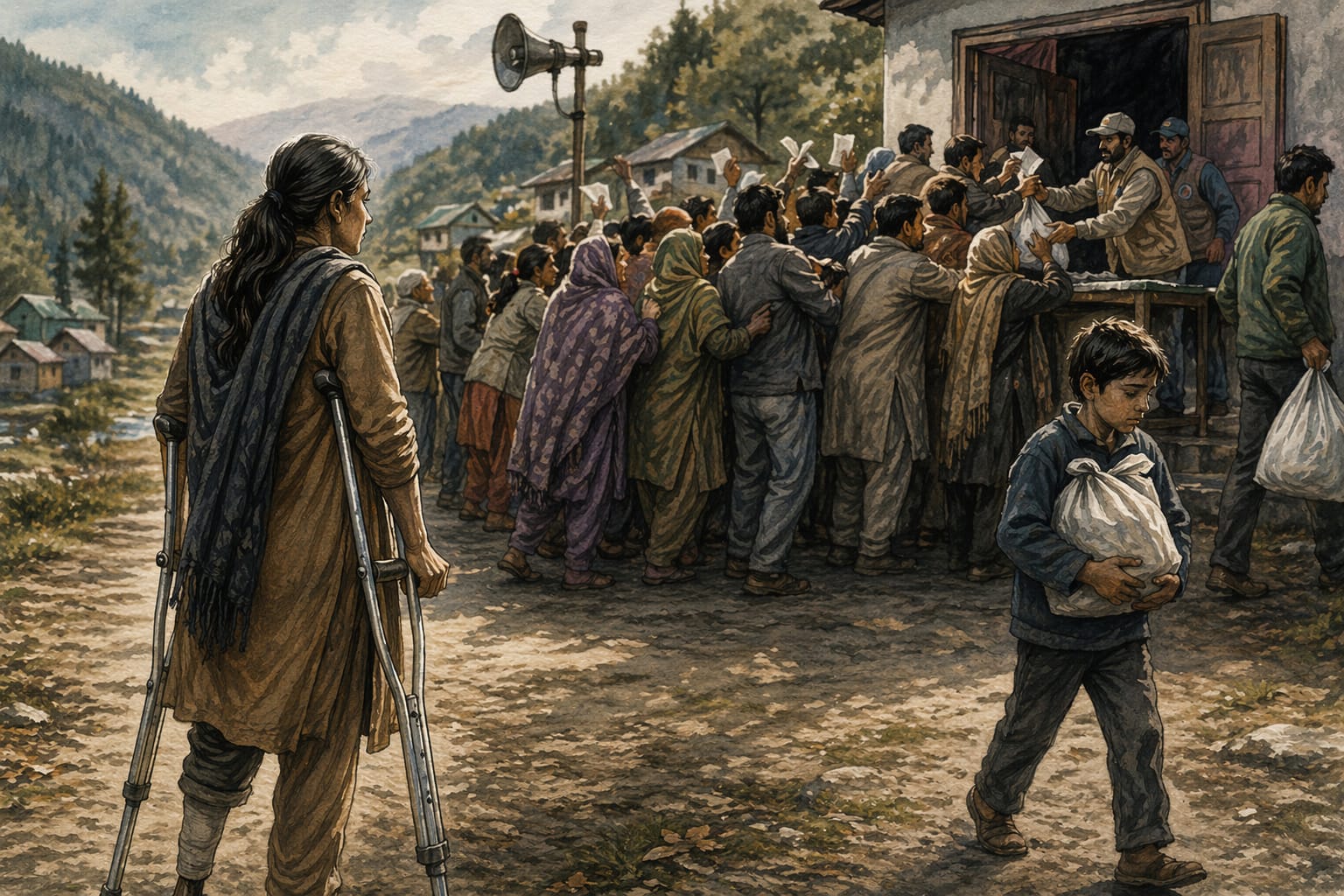
Amid this calm rhythm, an announcement suddenly echoed from the village panchayat loudspeaker, breaking the stillness. An NGO, HELP-Deserve, had arrived at Sunshine Public Park, Gorimarg Kalaan. All deserving persons, including the physically challenged and specially abled, were informed to gather at the relief camp where aid would be distributed among the poor and the needy.
The message spread faster than the morning light.
Plans changed instantly. Those about to leave found reasons to stay. The relief camp quickly became the center of activity as people gathered—not gradually, but with urgency—to secure a place at the front.
Among them was Peree.
She stepped out of her modest home, adjusting her grip on the crutches that had become her constant support. Two years ago, a car accident had taken her leg, but not her quiet resolve. Each step she took carried both effort and dignity. In Gorimarg Kalaan, her story was known to everyone. If need had a face, it looked like hers.
But the crowd that gathered that morning was not guided by recognition.
By the time Peree reached the camp, the open space had turned into a restless cluster of bodies. Voices overlapped, impatience grew, and a subtle competition took shape. People edged forward—some loudly declaring their hardships, others pushing ahead without a word.
A man in clean clothes insisted on his entitlement. Another quietly collected more than one packet. A woman, known for her comfortable means, argued her way closer to the front. No one stopped them. No one questioned them.
Peree paused at the edge.
She did not push. She did not speak. She simply waited—her presence a silent appeal in a place that had grown deaf to silence.
Inside the camp, distribution continued, but order had long dissolved. Need and greed stood indistinguishable in the same line. Time moved on. The sun rose higher.
And then, as abruptly as it had begun, it ended.
“The supplies are over,” a voice announced.
The doors shut.
A dull finality settled over the space. The crowd began to thin—some clutching their gains, others murmuring dissatisfaction. A few laughed. A few complained. Most moved on, their urgency spent.
Peree remained.
Her crutches pressed into the soft earth as she stood facing the closed door. Her expression did not change. There was no protest, no visible disappointment—only a stillness that spoke of something deeper than words.
Nearby, a young boy adjusted the relief packet in his arms. It seemed larger than his need. For a brief moment, his eyes met Peree’s. Then he looked away and followed the others.
The loudspeaker was silent now.
The village slowly returned to its routine, absorbing the morning as just another passing event. But something had shifted—quietly, almost invisibly.
No rules had been broken. No laws had been violated. The system, by all appearances, had worked.
And yet, somewhere between the announcement and the closing of that door, fairness had lost its place. Help had arrived in Gorimarg that day. It simply had not reached where it truly belonged.
Comments are closed.