

Shabeer Ahmad Lone
“Financial, ethical, civic, and life-skill wisdom for youth, as echoed by Benjamin Franklin-“An investment in knowledge pays the best interest”-Warren Buffett on saving before spending, Nathan W. Morris on the cost of borrowing, Robert Kiyosaki on cultivating mental wealth, Aristotle on happiness, Socrates on the examined life, Aditya Jha on empathy, John W. Rogers, Jr. on civic responsibility, and Alan Greenspan on societal impact, demonstrates that true literacy in finance transcends money alone, nurturing foresight, self-discipline, ethical judgment, empathy, and socially conscious, empowered citizens capable of shaping equitable, resilient, and engaged communities.”
The cultivation of financial wisdom in children and youth is far more than an introduction to money; it is a foundational exercise in autonomy, foresight, ethical discernment, life-skills and civic responsibility. Money serves not only as a practical tool but also as a mirror reflecting values, priorities, and interconnectedness within families, communities, and societies. Without guided engagement, young people risk entering adulthood unprepared to navigate economic choices, manage resources strategically, or comprehend the broader social and moral implications of financial decisions.
This deficit is not merely personal; it is structural, influencing patterns of inequality, vulnerability, and social cohesion across contexts. Nurturing financial literacy therefore cannot be separated from ethical development, civic education, and cultural understanding. When approached thoughtfully, it becomes a formative practice, shaping habits, reasoning, and empathy that extend far beyond the ledger, preparing children and youth to participate responsibly and creatively in a complex and interconnected world.
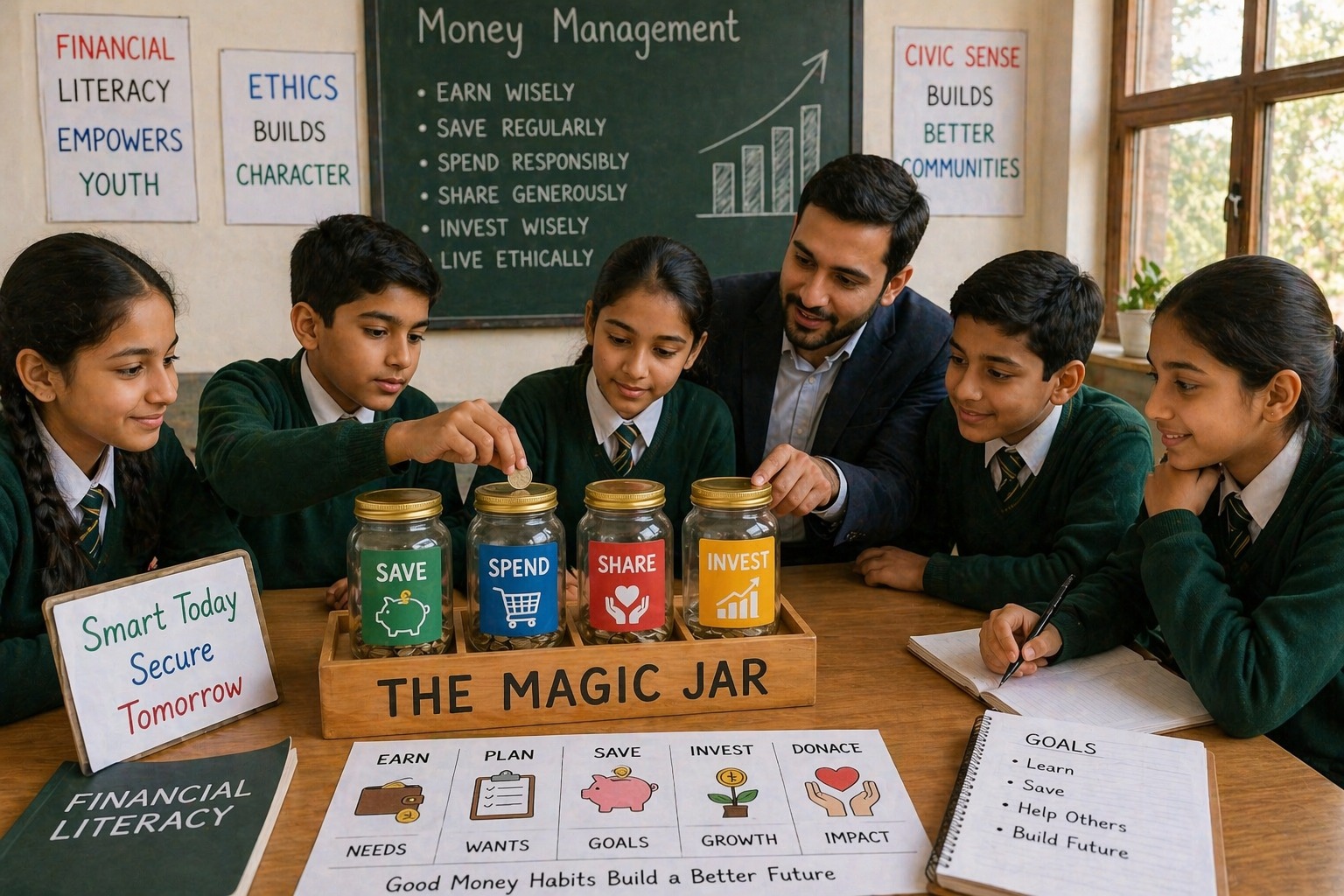
The Magic Jar (both a learning tool and a miniature model of life, teaching financial skills, foresight, and ethical thinking in a practical, hands-on way) offers a tangible, experiential tool to bridge this divide, translating abstract financial principles into concrete, reflective practice. By dividing resources into compartments for saving, spending, sharing, and investing, children observe consequences of their choices in real time, cultivating foresight, self-regulation, ethical reflection, and emotional resilience. This exercise strengthens delayed gratification, prioritization, strategic planning, and empathy, demonstrating that financial literacy is inseparable from emotional intelligence, civic awareness, and moral reasoning.
Its impact is amplified when contextualized within children’s lived realities: rural youth may learn through family cooperatives, barter networks, or local community savings practices, while urban youth navigate digital wallets, e-commerce, and fintech applications. Internationally, models like Japan’s Chokinbako savings boxes, Germany’s Kinderkonto accounts, cooperative credit practices in East Africa, and gamified savings programs in Singapore illustrate that culturally embedded methods, when combined with mentorship and reflective dialogue, cultivate lasting financial competence while reinforcing cultural identity and communal ethics. Early exposure to these practices enhances cognitive skills such as planning, impulse control, problem-solving, and risk assessment, forming the foundation for lifelong financial judgment.
Developmental psychology underscores that cognitive absorption, comprehension of risk, and ethical reasoning evolve with age. Younger children benefit from concrete, visual demonstrations of accumulation and allocation, while adolescents can engage with abstract concepts of investment, credit, and systemic interconnections. Peer influence, collaborative exercises, social accountability, and friendly competition reinforce reflection, adaptability, and ethical judgment. Parental modeling and intergenerational guidance remain critical, as children internalize habits, ethical perspectives, and risk tolerance from family behavior, highlighting that financial literacy is simultaneously an individual, relational, and cultural process. Inclusive approaches that address gender-specific challenges, marginalized communities, and children with limited resources ensure that learning is equitable, culturally sensitive, and socially empowering.
“Without guided financial learning, young people risk entering adulthood unprepared for real-world decisions. This gap is not only personal but structural, influencing inequality and social cohesion. Nurturing financial wisdom is therefore both an educational and societal necessity.”
Comments are closed.