

S. Ahmad
India’s agricultural transformation is no longer confined to the familiar narrative of wheat and rice. A quieter, more strategic shift is underway—one that is redefining how the country grows, earns, and competes globally. This shift is rooted in diversification, driven by horticulture, and anchored in the promotion of high-value crops. From coconut plantations along coastal belts to walnut orchards in the valleys of Jammu and Kashmir, a new agricultural story is unfolding—one that promises higher incomes, stronger exports, and more resilient rural economies.
The Union Budget 2026–27’s emphasis on high-value crop diversification reflects not just a policy adjustment, but a broader recognition: that the future of Indian agriculture lies not in producing more of the same, but in producing smarter, richer, and more globally competitive outputs.
For decades, India’s agricultural success was measured in terms of food security—ensuring enough production to feed a growing population. That objective, while still relevant, is no longer sufficient. Today’s challenge is different: how to increase farmer incomes, reduce vulnerability, and integrate Indian agriculture into global value chains.
High-value crops—fruits, vegetables, spices, plantation crops, and nuts—offer a compelling answer. Unlike traditional cereals, they generate significantly higher returns per unit of land. They also create opportunities for processing, branding, and export, multiplying income streams beyond the farm gate.
The numbers tell a compelling story. Horticulture now contributes around 37 percent of the Gross Value Output within agriculture. Production has risen sharply—from 277 million tonnes in 2013–14 to over 370 million tonnes in 2024–25. This growth is not incidental; it reflects a structural transition toward crops that are economically, nutritionally, and commercially more rewarding.
What makes the current policy push particularly significant is its regional precision. Instead of adopting a one-size-fits-all approach, the government has aligned crop promotion strategies with agro-climatic realities.
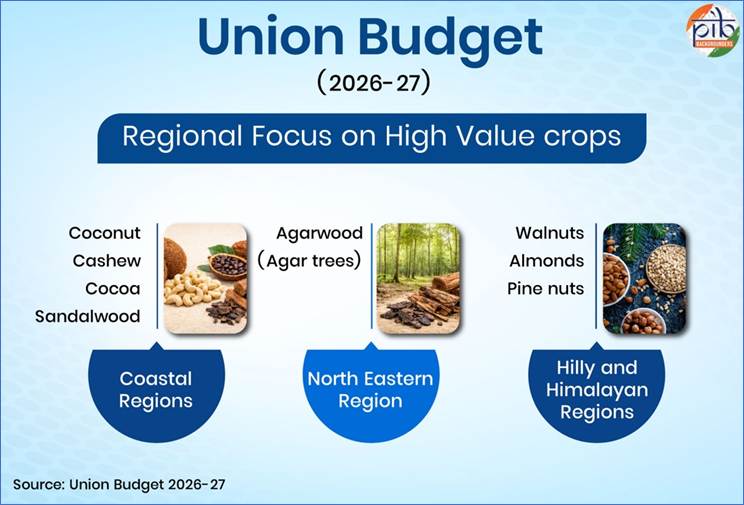
Coastal regions are being positioned as hubs for coconut, cashew, cocoa, and sandalwood. The North-East is being developed as a center for agarwood cultivation. Himalayan and hilly regions are being encouraged to expand nut crops like walnuts, almonds, and pine nuts.
This geographically anchored approach recognises a simple truth: agriculture succeeds when it works with nature, not against it.
India’s long coastline is more than a geographical feature—it is an economic asset. Coastal agro-ecosystems, with their unique soil and climatic conditions, are ideally suited for plantation crops.
The coconut sector, for instance, supports nearly 30 million livelihoods, including around 10 million farmers. India ranks second globally in coconut production, contributing over 22 percent of global output. States like Kerala, Tamil Nadu, and Andhra Pradesh each demonstrate different strengths—be it area, production, or productivity.
What is particularly noteworthy is the sector’s transition from traditional products to value-added offerings. Coconut exports, once limited to raw produce and oil, now include virgin coconut oil, coconut milk, and packaged water—products that cater to global health and wellness trends. Export earnings crossing ₹4,300 crore in 2024–25 signal a maturing industry that is moving up the value chain.
Cashew and cocoa add further depth to this coastal economy. Cashew, often described as the “gold mine of wasteland,” transforms degraded land into productive assets. Its resilience and adaptability make it both economically and environmentally valuable. With exports nearing USD 370 million, cashew remains a strong contributor to India’s agricultural trade.
Cocoa, meanwhile, represents an intelligent model of intercropping. Grown under the shade of coconut and arecanut trees, it maximises land use efficiency while providing farmers with additional income streams. Its integration into global chocolate and confectionery markets gives it strong commercial potential.
Few crops combine cultural heritage and economic value as seamlessly as sandalwood. Known scientifically as Santalum album, Indian sandalwood has long been prized for its fragrance, medicinal properties, and religious significance.
With over 90 percent of resources concentrated in southern states, sandalwood offers significant export potential. The renewed policy focus on its cultivation and processing is a recognition of its dual value—as a traditional resource and a modern luxury commodity.
However, its success will depend on balancing commercial expansion with sustainability, given its ecological sensitivity and history of overexploitation.
If coastal India represents plantation strength, the North-East represents untapped potential. Rich in biodiversity and ecological diversity, the region is uniquely positioned to lead in high-value agroforestry crops like agarwood.
With nearly 150 million trees—90 percent located in the North-East—India already has a strong base. Agarwood, known globally as oud, is among the most expensive natural raw materials used in perfumery and traditional medicine. Its market value, combined with relatively low land requirements, makes it a lucrative option for farmers.
States like Tripura and Assam are emerging as key centers, supported by policy measures such as geospatial mapping, export facilitation, and regulatory streamlining.
The estimated ₹2,000 crore annual market potential in Tripura alone underscores the scale of opportunity. But this growth must be carefully managed. Agarwood cultivation, if not regulated, can lead to ecological imbalances. Sustainable practices, therefore, are not optional—they are essential.
In the cooler climates of India’s hilly regions, a different kind of agricultural wealth is taking shape—one rooted in nut crops.
Walnuts, almonds, and pine nuts are not just high-value commodities; they are deeply embedded in the socio-economic fabric of mountain communities. Among these, walnuts dominate, with Jammu and Kashmir accounting for the majority of production.
With output reaching over 3 lakh tonnes and exports touching USD 7.8 million, walnuts represent both domestic strength and export potential. Almonds, too, are gaining prominence, with the region contributing over 80 percent of national production.
Chilgoza pine nuts, often harvested in the high-altitude regions of Himachal Pradesh, offer a niche but valuable income source for tribal communities. Their ecological adaptability and high nutritional value make them both economically and environmentally significant.
The push for high-density plantations and orchard rejuvenation reflects an effort to modernise these traditional systems. By involving rural youth and promoting value addition, the policy aims to make these sectors more dynamic and sustainable.
Behind this diversification push lies a robust institutional framework. Bodies like the Coconut Development Board and the Directorate of Cashewnut and Cocoa Development play critical roles in research, extension, and market linkage.
Programmes under the Mission for Integrated Development of Horticulture (MIDH) further support expansion, productivity enhancement, and infrastructure development.
These institutions are essential in bridging the gap between policy intent and ground-level implementation. However, their effectiveness depends on coordination, funding, and adaptability to local conditions.
The case for high-value crops is not merely agricultural—it is economic.
First, they offer higher income potential, helping address the long-standing issue of low farm profitability. Second, they create employment across the value chain—from cultivation to processing and marketing. Third, they strengthen export earnings, contributing to macroeconomic stability.
But diversification also carries risks. High-value crops are often more sensitive to market fluctuations, require better infrastructure, and demand higher initial investment. Without adequate support systems, farmers may face new vulnerabilities.
No discussion on high-value agriculture is complete without addressing infrastructure. Cold storage, transportation, processing facilities, and market access are critical for perishable commodities.
While policy frameworks acknowledge these needs, implementation remains uneven. Bridging this gap will be crucial for sustaining the gains from diversification.
High-value crops also intersect with the broader challenge of climate change. Many plantation and horticultural crops are climate-sensitive, making them vulnerable to changing weather patterns.
At the same time, crops like millets, agroforestry species like agarwood, and drought-resistant plantations like cashew offer pathways to climate resilience.
The future of diversification, therefore, must be aligned with sustainability—ensuring that economic gains do not come at ecological costs.
India’s high-value crop strategy represents a significant evolution in agricultural policy. It moves beyond subsistence and surplus toward value, diversity, and global integration.
Yet, the journey is far from complete. The success of this transition will depend on several factors: effective implementation, inclusive growth, infrastructure development, and market stability.
It will also require continuous engagement with farmers, ensuring that they are not just beneficiaries but active participants in shaping this transformation.
From the coconut groves of the south to the walnut orchards of the north, India’s agricultural landscape is being reimagined. High-value crops are not just an economic strategy—they are a vision for a more prosperous, resilient, and globally competitive rural economy.
This vision recognises that agriculture is no longer just about feeding a nation; it is about empowering its farmers, strengthening its markets, and positioning it in the global economy.
If nurtured carefully, this shift could redefine the future of Indian agriculture—turning fields into enterprises, farmers into entrepreneurs, and local produce into global brands.
And in that transformation lies the promise of a truly diversified, value-driven agricultural economy—one that is as rooted in its regions as it is connected to the world.
Comments are closed.