Srinagar, Sep 14: The continuing reports of encroachments, illegal sand mining and degradation of water bodies across Kashmir have raised questions over the ground-level monitoring and follow-up work of various organizations and civil society groups that have positioned themselves as environmental watchdogs.
Sources familiar with environmental issues in the Valley said that while such groups frequently raise concerns after an environmental violation comes into public focus, there is a need for more sustained field-level monitoring, documentation and follow-up of complaints before and after they attract wider public attention.
A retired government teacher, who has been following environmental issues in Kashmir, said environmental protection could not depend solely on statements issued after an incident or alleged violation becomes a subject of public debate.
“Those claiming to act as watchdogs should regularly visit vulnerable water bodies, document changes, identify fresh encroachments and pursue the matter with the concerned authorities,” he said.
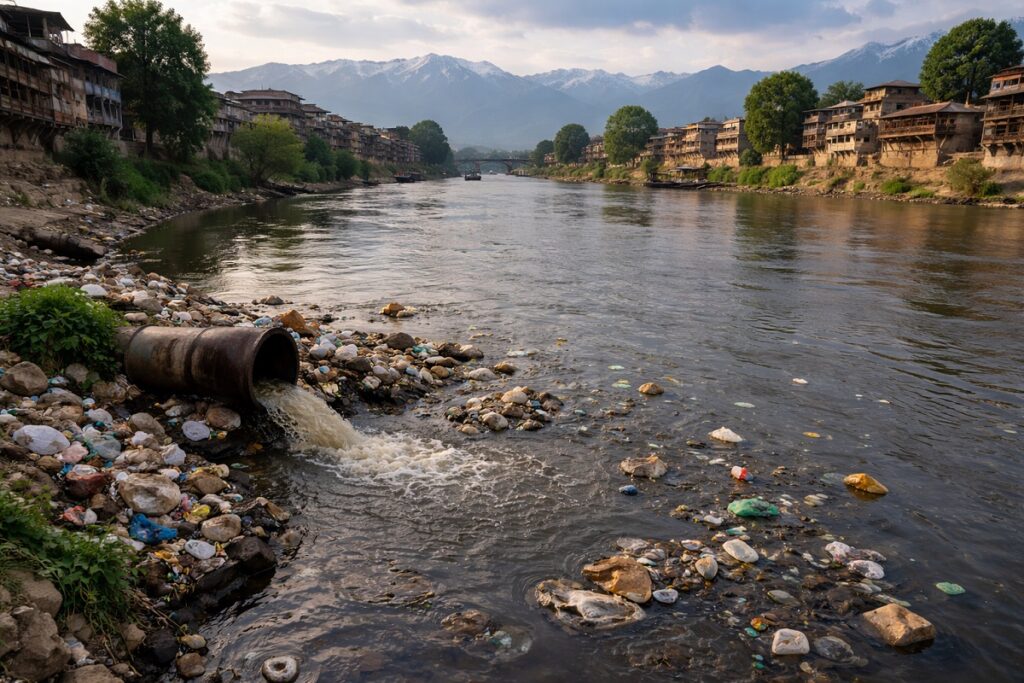
The concerns come against the backdrop of continuing environmental violations along the Jhelum and other water bodies in Brari Nambal. A recent academic study by researchers associated with the Central University of Kashmir described illegal sand mining in the Jhelum as a major environmental-law and governance challenge, citing concerns including riverbank erosion, habitat destruction and increased flood vulnerability.
The National Green Tribunal has also dealt with the issue of illegal sand extraction and damage to the Jhelum embankment near Khankah Bagh in Pampore after taking suo motu cognisance of a report concerning the alleged destruction of the embankment and risks to nearby households.
More recently, concerns over Kashmir’s water bodies have continued to surface. In August, an environmentalist submitted a memorandum to the J&K Legislative Assembly’s Environment Committee over the reported deterioration of Anchar Lake, citing pollution, encroachments, waste accumulation and shrinking water channels.
Similarly, a recent complaint concerning alleged filling or reclamation near Dal Lake prompted calls for an on-ground verification and satellite mapping to establish the exact nature and status of the activity.
Sources said the recurring pattern has now shifted the focus from merely identifying environmental violations to examining how consistently such issues are monitored after they are reported.
“An environmental watchdog should ideally be able to identify a violation before it becomes a headline and should continue following the matter until there is a documented outcome,” the retired government teacher said.
Environmental groups and civil society organizations have, however, been involved in legal proceedings, representations and public campaigns on different ecological issues, making it difficult to characterize their entire contribution as limited to media-driven interventions. The concern being raised by local observers is instead about the frequency, continuity and measurable outcome of independent field monitoring.
The issue has assumed greater significance as official inspections and enforcement drives continue to uncover environmental concerns. In July, the J&K Legislative Assembly’s Environment Committee inspected Anchar, Hokersar and Khushal Sar and sought action concerning illegal encroachments on wetlands and water bodies.
Environmental observers said Kashmir’s water bodies require continuous monitoring rather than periodic interventions triggered by individual complaints, viral videos or media reports.
They said environmental organizations could strengthen their role by maintaining publicly accessible records of encroachments and violations, conducting periodic field inspections, documenting the status of complaints and publishing follow-up reports on action taken by the authorities.
The continuing degradation of water bodies, they said, makes sustained independent monitoring increasingly important, particularly in areas vulnerable to encroachment, illegal extraction, dumping and obstruction of natural drainage channels. [KNT]


Comments are closed.